
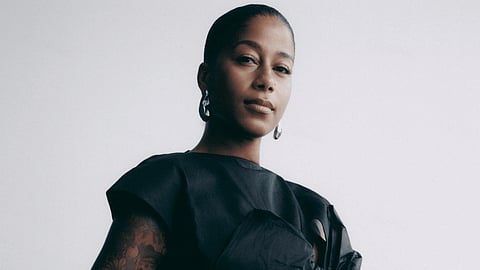
What It Means to Be an Artist in Uncertain Times: A Q&A With aja monet

aja monet offers audiences the medicine of words and possibility during a time of social and political chaos. Accompanied by pianist Brian Hargrove, the surrealist blues poet performed and answered questions with Kiesha B. Free at a packed Town Hall on Feb. 5, as part of Seattle Arts & Lectures' Poetry Series. To open the program, local artist and educator Amber Flame sang a song based on aja's poetry, and youth poet Peighton Pearson recited an original poem about her Caribbean roots.
monet's jazzy recitation of poems from her latest collection, Florida Water, and a wholly improvised number about falling in love reminded attendees how art makes people agents of autonomy and connection, to each other and the land, and that there's power in simply being playful.
Ahead of the event, monet spoke with the Emerald over Zoom about how the concept of place has inspired her, collaborations with people she admires, and her thoughts on the role of the artist in uncertain times.
The interview has been edited for length and clarity.
You're from New York City but have lived and worked in several places in the U.S. — Chicago, Miami, and now you live in L.A.. How have these locales inspired you, and which fits you best?
I don't think there's one that fits me best. What I've learned — as someone who's faced housing insecurity all of my life — is that you move where you are loved and welcomed, where you find community. At different phases in my life, my community has shifted based off where I was as an artist, where I was as a culture worker, where my family was, where my friends have been.
School motivated me to leave [where I grew up]. From there, it was meaningful relationships, people I wanted to be closer to, or those who offered me opportunities to make my life more meaningful or expansive. I don't feel attached to one place over another; they all have meaning, and they have all taught me so much about myself.
M-1 from dead prez said something to me about living in Florida, Chicago, New York. There was this example of Chicago giving you a sense of heart, New York giving you street smarts, and Miami — or Florida in general — giving you a connection to the land, and to the environment and its history. Every city has different lessons to teach. Living in Miami and growing up in New York, it's a totally different climate and environment. In Miami, you have to deal with hurricane season, and that equips you in such a different way to be aware of your limitations as a human being.
[New York] was always this place that felt more like a playground of culture and experience and human connection and interaction because of the proximity of the neighborhoods. There's just so much: different kinds of foods, sounds, and smells. You're really stimulated on a day-to-day basis.
I've lived in Paris too, and that's a city that's similar in its cultural exchanges. The beauty of the arts and the music that comes out of that place is significant, as well as the legacy of people who have traveled through that city.
Spoken-word performance is your background. You have published work and studio albums. What does music do for your writing, and what is that process of creating like, versus writing a book?
Just to clarify: I resist the title of "spoken-word poet." What I do is poetry, I'm a poet. I've been writing since it started as me writing poems in my notebooks. It only became sharing and reciting poems — I say I recite poetry — because of my exposure to a community who recited their poems. I started getting involved with Urban Word NYC, which offered performance opportunities as well as open mics, slams, and workshops with mentors. I started to understand that world of reciting your poetry out loud and it being something you can commune around.
My first ever performance in public, I won a talent show with poetry, then a friend put me on to UWNYC, and I signed up for a competition. It was at the legendary St. Mark's Church, where the Poetry Project was started. It was a profound space because of that legacy, the Beat Generation of poets. Those Beat poets were in conversation with the Black Arts Movement, especially once Amiri Baraka left the Lower East Side and went to Harlem, and it was always about the sound of the poetry.
If you know what makes [a poem] powerful, it's based on technique. All those techniques are based on sound, rhythmic information, when you edit the poem on the page. [Poetry is] an oral tradition. It's the first griot, really.
That's why I resent the title of "spoken word," because poetry's always been spoken. That title becomes this thing that others us, categorizes Black poets who speak well. Usually literary, mostly white poetry spaces don't measure the effectiveness of a poem based on how it falls on the ear, and I think it should be something that you measure. That's really important. All that to say, [poetry's] always been a form of music.
The difference working with the band is that now there's a conversation between the musicians and those sonic references you're hearing in the poem. You're using your voice. It's a different instrument, but it's still instrumentation. I see it as an expansion of word-music, that relationship.
What's different about making an album versus a book is you have to become a bandleader. We're creating a song structure from the ground up together. Using actual instruments and musicians is a unique experience than just someone who produced a beat in a room by themselves and then said, "Oh, can you put a poem on this?"
That's really resonating, your evaluation of how poetry is meant to be shared verbally, musically, and comes across so differently than reading from the page. Related to the album, who are some of your favorite, or maybe surprising collaborators?
[The new music] has been one of the most eye-opening, transformative experiences. I've gotten to work with my partner, Justin Brown, who's an incredible musician, as well as Meshell Ndegeocello, who is someone I've always looked up to and always wanted to just meet and tell them how much I love their work.
Then to be in a position where I'm touring or doing an event with them! That's how it happened, we have the same booking agent, and she asked me to come in and sit in on one of her pieces. That experience led to us developing a friendship, then a collaboration-partnership. I was very touched because … I think Meshell would identify as a woman, but also as a spirit in the world. Just working with someone whose energy is balanced in other ways, where feminine leadership is not threatening, where input is welcome, regarded, and revered. There's a lot to learn from that experience.
I ask this question to every artist or culture worker I talk to, especially since you have a robust background and grounding in community work and advocating for others: What is your idea of the role of the artist in times of upheaval, where we have to make difficult decisions on a day-to-day basis?
Thank you so much for asking that. We are definitely in a time that is unique in many ways, one of them being because of the state of technology and its impact on our day-to-day, as well as multiple genocides and a fascist president in office. But I don't think that actually makes this time more unique for the artist than [any] other time. All artists have always had a responsibility to be present with the truth. You can only do that if you have some sense of self: self-worth and self-determination.
We're in this place where people are like, "Speak up, speak out!" and that is very important for sure, but you can't do that if you ain't got no sense of self, ya know? Who you are and what your values are, how to take care of yourself.
The role of the artist is the role of any living being: most fundamentally, to get right with self. But I don't think it's unique to artists.
Artists are unique in that they're usually misfits, the ones who can't function with the status quo of society, so they have some sort of obsession, whether it be the sounds of words or the colors on the palette or the textures of fabric or movement of the body.
I think [the obsession is] beautiful because artists contribute so much beauty into the world. There's this notion that if [artists] are doing their art to themselves, it's enough — and it is, in a way — but we don't live in a vacuum. We're responsible for each other. If you don't have a sense of self you can't connect to community, and if you don't have a community, you don't really have a sense of self. I try to be what I need, and the artists who really move and inspire me are ones who live by truth and look after people.
The Emerald's arts coverage is supported in part with funding from 4 Culture and the City of Seattle's Office of Arts & Culture. The Emerald maintains editorial control over its coverage.


No Paywalls. No Billionaires. Just Us.
We're building a newsroom rooted in community, not corporate backing. Help us raise funds to hire our first-ever full-time reporter and grow our capacity to cover the South End. Donate today.
