
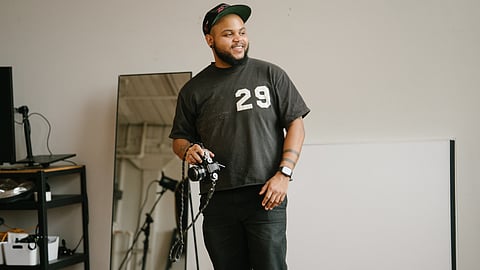
A Beacon Hill Photographer Focuses on the Mental Health of the BIPOC Trans Community

When most people think about gender-affirming care, their mind usually guides them to medical interventions like hormone replacement therapy and surgery. But photographer Remy Styrk, who offers free photo shoots to Black and Brown trans folks, shows that gender-affirming care can be much more.
Styrk is the founder and director of the Halogen Project, a nonprofit that raises awareness of suicide prevention in Black and Brown trans communities. Their main program offers free, one-hour photo shoots for Black and Brown trans and gender-expansive folks. Styrk, who is a trans man, has been facilitating these free photo shoots for almost two years.
Styrk started the Halogen Project in 2022 while living on the East Coast. “I really wanted to cover a sense of self in queer BIPOC individuals,” said Styrk. Styrk flew to Chicago to film a docu-series. “Then three weeks after I finished the pilot episode, I got called out to Washington to work on a documentary.”
Styrk said, “life took its course,” and it took two whole years before Styrk returned to Halogen in the fall of 2024. Now that life has slowed down for him, Styrk wants to offer his studio space to queer folks who want to celebrate themselves and be seen. “I have free time right now. I want to take this work to the next level,” Styrk said. “Right now, for my people, I can offer my time and space to really explore what visibility and autonomy means to them.”
Styrk, who lives in North Beacon Hill, has worked as a filmmaker since high school and been a musician for 21 years. He said it was his talent for making music that motivated him to pick up a camera for the first time.
“I'm a very visual person. I don't write music without thinking about what the visuals would look like. I don't really do anything visual without thinking about what the music would look like. I’ve just been constantly pushing to get into doors — just straight-up asking people, ‘Can I take your photos?’ I'm pounding that until I find my bigger and bigger projects.”
Today, it is suicide prevention that motivates Styrk to keep picking up his camera. “I started journaling about, ‘Why this work? What does this work mean? What is the overall big vision of the work?’ It really started from a research perspective of: ‘[How can I] define suicide prevention that's not clinical?’”
Research shows that suicidal ideation affects many trans people. A 2023 study by the Williams Institute at UCLA School of Law found that while 42% of U.S. trans adults have attempted to take their lives, 81% of trans adults have considered it. A study from the Trevor Project, also from 2023, revealed that 25% of Black trans and nonbinary youth had reported a suicide attempt the previous year.
After struggling with suicidal ideation, Styrk said he discovered what he loves most about himself. “It came from the realization that [considering] suicide forced me to come face to face with the things I love most about myself and that [thought of] wanting to end things that I didn't like at a time or situations I didn't like: I realized I'd have to give up a love for my art, my music, my relationships that I'm building, and my family.”
Styrk wanted to explore this realization further, so he went around and spoke to people. “I started asking folks if they felt similarly, and they did. So I wrote a book interviewing folks about how they view their soul knowing all of those things.”
Styrk took the model he used while interviewing the subjects for his book and expanded it with the Halogen Project. “The photos are kind of secondary to the program. It's more about being able to spend an hour with folks and really give an intentional space to be them, everything that they are, and everything that they're becoming — and realize that every interaction is some sort of suicide prevention,” said Styrk.
According to the project’s website, halogen means “salt-producer,” from the Greek roots hals “salt” and gen “giving birth to.” The site goes on to say that salt can preserve and heal, and it's the most ancient embalming chemical. Halogens, meanwhile, are electronegative, so the smaller the atom, the stronger its ability to attract electrons.
Styrk’s work with the Halogen Project has inspired others, like videographer James “Taz” Braddy, who met Styrk through a mutual friend. “One of our mutual contacts ended up doing a photoshoot with Remy for the Halogen Project, and it was about queerness and visibility, and that sort of thing, so that just kind of piqued my interest,” said Braddy. “I myself am a Black trans man who is also a filmmaker/photographer, and so for the longest time that I was in the city of Seattle, I was the only person that I knew that did what I did.”
Braddy, who has been making films for the past 10 years, said he aligned with Styrk’s work from the first the moment he saw it. “The fact that Remy has created this project and is giving us a chance for visibility and to have our voices heard, I definitely wanted to participate in that.”
Braddy is not the only person Styrk’s project has inspired. Vaquero Azul is a Mexican and Puerto Rican, Boriken-Taíno, IndigeQueer illustrator and sewist who learned about Halogen Project on Instagram.
“I saw the post that was [offering] free portraits for BIPOC trans community and that made me very excited. I'm already somebody who's very comfortable behind the camera for photo shoots, and it was really nice to just meet a black trans person in community who is offering that,” said Azul.
Azul modeled in front of photographers prior to transitioning. After they came out as trans, things changed. “When I modeled before I transitioned, I would get a lot of opportunities when I was female-presenting and the second I started my transition, less and less photographers would reach out,” said Azul. “Just that heartbreaking transphobia and that bodily respect being taken away — like, ‘Oh well, was I really only a model for my chest? Was I really only a model for your male gaze?’ And it's very frustrating and demeaning.”
For Azul, shooting with Styrk and the Halogen Project was liberating because knowing they were going to be captured through the lens of another trans creative gave them the permission to fully be themself. “Getting to meet more photographers who are trans and who are Black and Brown community members — it amounts to a world of difference because I already knew going into it, ‘I can present however I want to,’” they said.
Azul said the queerness that Styrk captures in his work and presents to his audiences is suicide prevention because representation can be life-saving, “All of it affects our mental health because if we don't get to see it, we think that we're an outcast, we think that we're abnormal,” said Azul. “That's definitely [something from] colonization: trying to constantly erase our documentation. That’s why the camera is so powerful, because it helps remind future generations, and also those in the now, that there are many of us.”
No Paywalls. No Billionaires. Just Us.
We're building a newsroom rooted in community, not corporate backing. Help us raise funds to hire our first-ever full-time reporter and grow our capacity to cover the South End. Donate today.
