
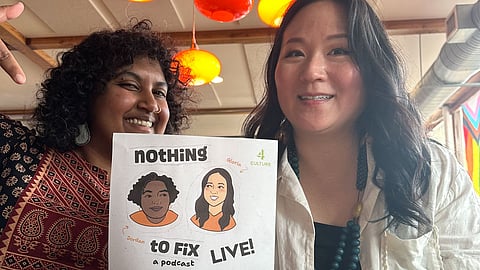
Jordan Alam and Gloria Huh Offer Ways to Resist the 'Seattle Freeze'

Jordan Alam, South End therapist and Seattle Times mental health columnist of "The Therapist Is In," and Gloria Huh, therapist and writer, co-host the new podcast "Nothing to Fix" where they discuss how working with messy and uncomfortable parts of ourselves in therapy is important for healing. They show how this relates to our relationships with family members and communities.
As part of this exploration, the two co-hosts are inviting the community to a discussion about the "Seattle Freeze," the phenomenon where people find it difficult to make lasting friends in our region. Along with looking at how the Freeze works and its real impacts, they'll also invite people to share their experiences. The event will be held July 16 at Common Objects at 6:30 p.m.
Alam and Huh spoke with the Emerald about the Seattle Freeze and the upcoming event.
This interview has been lightly edited for length and clarity.
Tell me about the live podcast event.
Jordan Alam: Our season has been framing how we keep and maintain deep, meaningful relationships. Things we talk about on our podcast — like "Why's it so hard to make adult friends?" and "What's the point of feeling bad?" — set us up for talking about healthy conflict and what it means to be in relationship. We want this event to be an extension of exploring this messiness by discussing the Seattle Freeze, an important concept that everyone talks about. It serves as a good launch point into what gets in the way of starting or keeping relationships that we care about.
The Seattle Freeze is different for each person, and there are many permutations of it. People who are coming to the event can send in their experience on a form in advance, or they can tell their story on stage. We want this to be an interactive event.
What is the "Seattle Freeze"?
Gloria Huh: It's like a weird memo was sent out. It says you're supposed to act calm and a little cold. If you show any intensity, if you're loud or you're [outwardly] too excited, you're doing something wrong. It's like there's a certain way of being here that's associated with being politically correct and calm, but my analysis of this is that it's actually an anxiety: insecurity that too much will be revealed or a discomfort with something that challenges the norm. It's so pervasive that when people come here from other places, they conform to acting in the same way.
Here's an example of how it played out for me: I'm not originally from the area, and it was really difficult to make friends here. Once I met someone and we texted so we could have each other's number, and then they didn't respond to me when I wrote them. I kept going because I didn't know Seattle yet. I wrote, "When do you want to meet? What time?" and there was no response. That made me feel insecure because it felt like they were implicitly saying you're not worth my time. I needed to understand which of my insecurities this gets at, and then soothe it. I needed to process that my assumption of me not being worth their time didn't have anything to do with how this played out and that they had their own insecurities.
Do you see the Seattle Freeze playing out differently for people of color?
JA: I think it's absolutely more impactful to people of color, in part because I think we might come from cultural norms or cultural backgrounds where it's more normative to show our emotions, or at least to be expressive in some form. Seattle culture is based on a white and specifically Northern European kind of norm that requires stoicism or restrictedness, that then gets confused when someone shows genuine warmth or expressiveness.
GH: Navigating the white norm can cause anxiety because other ways of expressing ourselves can be attacked, shamed, or rejected.
What is the origin of this conflict in social and relational behavior?
JA: Passive aggression is a tool. It's a defense mechanism or structure where, say, I don't want to show you how hurt I am or how affected I am or what's coming up to me — an insecurity, but I'm upset or displeased — and so I am going to act passive aggressively so that I can try and make you feel or do something without having to explicitly name what I'm feeling and how hurt I was.
GH: Passive aggressiveness is functional. You're socially aggressing in a way that maintains your power level, but it's effective in hurting the other person. It can happen if you're not supposed to be assertive in a culture because you've got to find another way to release that. There are unconscious, defensive, and anxious processes going on. It's this mismatch between what you're saying and what you're feeling. So people might say, "I'm fine," when they're asked, "How are you?" though they actually seem upset. Another is they might say, "It's nice to meet you," but the person who's meeting them might feel like, "Well then why do you seem really cold?"
JA: A friend of mine said it's a skill issue too. It's not that people don't want to connect. It's just that they may be limited in their ability to express that desire or to say, "I don't want that particular thing, but could we do this other thing instead?" I think of Seattle Freeze as part of passive aggression, but it's also the outcome of being insecure and lacking in skills to connect with others.
What can people do with this information?
GH: We want to empower the audience to think about naming what's happening. Then you can decide if you want to participate in the Seattle Freeze or not.
The number one thing is to look within yourself. What are your fears, and what do you really want? What is it that we're ashamed of or afraid of? Like in one episode, I talked about how I was traumatized about relationships, so I pretended I was fine on the outside but was afraid of them inside. The more you're vulnerable with what's underlying, the less you'll be conforming to the Freeze. It's quite healing and empowering to say, "I'm really upset right now," or "I'm scared." I'd rather be vulnerable than pretend because it's a lot of energy to be defensive.
JA: I want people to walk away from the event with bravery. I think it's brave to put yourself out there and express a feeling or desire that you don't know how the other person's going to react. I want to encourage people to act with bravery because a lot of people talk about wanting to build relationships or community, and unfortunately, due to their nervousness or fear of taking a risk, they don't make motion toward it or then feel alone or resentful or that there are no communities to be a part of. What gets in the way is this interpersonal fear of "What if I make a move and it's not received well?"
GH: We want to show that you have a choice. You can decide if you want to participate in the Seattle Freeze or not.
'Nothing to Fix' Live (hosted by 4Culture)
Thursday, July 16, 6:30–8 p.m.
Common OBJECTS, 2601 1st Ave., Seattle, WA
Tickets are sliding scale, $0–$15
To share your story, either anonymously or on stage, you can fill out this form.
Got an idea for a South End story you'd like to see us cover? Let me know at Yuko.Kodama@SeattleEmerald.org.
This article is published under a Seattle Human Services Department grant, “Resilience Amidst Hate,” in response to anti-Asian American, Native Hawaiian, and Pacific Islander violence.
Editor's Note: This article was updted on July 16 to correct the photo credit.
No Paywalls. No Billionaires. Just Us.
We're building a newsroom rooted in community, not corporate backing. Help us raise funds to hire our first-ever full-time reporter and grow our capacity to cover the South End. Donate today.
