
Halloween Restoration in Delridge's Pocket Forest Puts Salmon Habitat in Focus

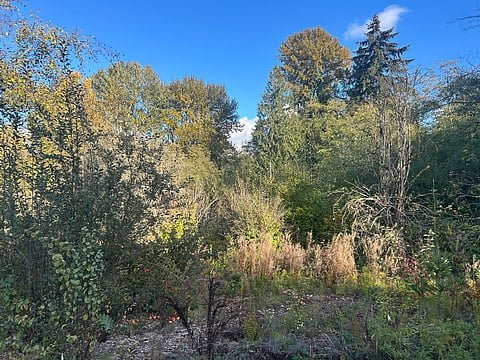
Planting native trees. Removing blackberry bushes and other invasive plants. Cleaning up litter. These are some of the goals of a community effort to restore the 29th Avenue pocket forest in West Seattle on Halloween.
Organized by the Green Seattle Partnership (GSP) and facilitated by the Delridge Neighborhoods Development Association (DNDA), the restoration is a free event, and experience isn't required to participate. Volunteers will receive training in restoration activities and safety procedures, and organizers will provide tools, gloves, and light snacks. People will meet at 29th Avenue Southwest and Southwest Brandon Street.
According to Caroline Borsenik, environmental programs director at DNDA, Delridge requires restoration more than other parts of the city due to its complicated history. "Delridge was redlined back in the day, and so it was just not invested in. It was able to be used for industry and dumping more so than other neighborhoods," said Borsenik. "A lot of our forests here have a history of logging and mining and all kinds of disturbances that have happened over the last 100 years."
GSP began in 2005 with a mission to better care for Seattle's urban canopy through growth and restoration efforts led by local communities and Tribal Nations, with the help of volunteers.
"[The partnership] allowed us to do really collaborative work and kind of hold two goals at once: One, to restore and improve the health of forested parklands across the city, and the second goal — to really do that with community, recognizing that we weren't going to have one without the other," said Lisa Ciecko, ecology team manager at Seattle Parks and Recreation (SPR), the lead agency for GSP.
GSP was recently named a World Restoration Flagship by the United Nations Environment Programme (UNEP) and the Food and Agriculture Organization (FAO). The program honors restoration initiatives the U.N. considers among the best examples of large-scale and long-term ecosystem restoration.
The 29th Avenue pocket forest cushions the banks of Longfellow Creek, one of only two urban tributaries of the Duwamish River still acting as habitat for spawning salmon. About 3.5 miles long with headwaters at Roxhill Bog, the creek flows through the neighborhoods of Roxhill, Delridge, and West Seattle before running into the Duwamish River.
The restoration efforts in the 29th Avenue pocket forest support the ecological sustainability of the Coho salmon who run through the creek, mainly from September through December, to lay their eggs.
Road runoff has harmed Longfellow Creek's water quality, exposing coho salmon to 6PPD-quinone, according to Puget Soundkeeper. The chemical forms when 6PPD, a tire additive, reacts with ozone, according to the Washington State Department of Ecology.
"Restoration of the forest along Longfellow Creek helps it act as a better buffer so it can help absorb stormwater that carries a lot of the pollutants, helping filter that out before it enters the creek," said Borsenik.
The plants also help maintain optimal water temperature. "The salmon specifically need cooler temperatures of water, so having plants around the creek helps cool the water, especially as our temperatures continue to rise," Borsenik said.
DNDA has been facilitating restoration efforts along Longfellow Creek since 2016. "When we initially started working there, it was phase zero, so that means there was no restoration work that had happened there before. It was largely covered with blackberry and did not have a very good diversity of native plants," Borsenik said.
Because the land has wetter soils, the newly planted foliage thrives. "The plants have been doing very well out there," said Borsenik. "It looks like a completely different site. The plants have just really taken off and now it looks like an actual forest."
For those who can't participate in the upcoming restoration effort, Ciecko recommends people get out in their neighborhood park. People can also stay tuned for the launch of GSP's new website, which will have links to educational materials and its YouTube channel.
Borsenik also suggests that Seattle landowners consider planting native species. "Being considerate about what you're planting in your yard is important because a lot of things that you plant in your yard can end up in the forest unintentionally," said Borsenik. "If you're planting native species at home, that helps the wildlife that depend on those specific species."
Event Details
Forest Restoration at 29th Avenue Pocket Forest
29th Avenue SW & SW Brandon Street
Oct. 31, 10 a.m.–1 p.m.
No Paywalls. No Billionaires. Just Us.
We're building a newsroom rooted in community, not corporate backing. Help us raise funds to hire our first-ever full-time reporter and grow our capacity to cover the South End. Donate today.