
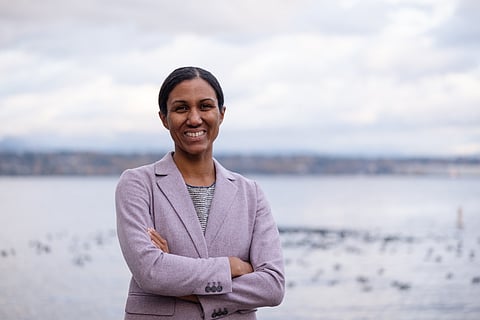
Living in District 2, Repping All of Seattle: A Q&A With Councilmember-elect Dionne Foster

On a recent afternoon in Kubota Garden, Seattle Councilmember-elect Dionne Foster met up with the Emerald for a walk-and-talk interview. Foster, a resident of District 2, recently beat current Council President Sara Nelson for District 9, one of the city’s two at-large council seats.
Foster will be sworn in January 2026.
In her interview, Foster, who served as the executive director of the Washington Progress Alliance, talked about the hidden gems of District 2, how community-led organizations in the district pioneer solutions to problems affecting other parts of the city, and how she plans to serve all of Seattle.
This interview has been edited for length and clarity.
LB: Where are some of your favorite places to go in District 2?
DF: I go to Onda [Origins Cafe & Roastery] a decent amount in Hillman City. I love it there because they have glass windows all around, so it's really nice in winter when you need some light. I love The Station. My kid went to El Centro de la Raza for preschool and that was our spot because I used to take him to school, and then I’d go over there and get coffee and get on the train, so I still love going back there. We also have great donuts [in the district]. Whenever there’s no line, I always stop into The Flour Box.
LB: What do you think people in other districts might be surprised to learn about D2?
DF: One of them for me is the Rainier Beach Urban Farm and Wetlands. I think that’s one of the most hidden gems in the city. The other thing I was thinking of was that I was on a call with some folks who are in the Yesler area — CID/ Capitol Hill — and they're working on some neighborhood safety projects that are inspired by and informed by a neighborhood safety project that was done in Rainier Beach: A Beautiful Safe Place for Youth. Maybe not surprising, but the way that things that are happening in District 2 have already informed other projects that other folks are doing in parts of the city is kind of cool!
LB: What does it mean to you to live in D2, but represent the entire city?
DF: I think you get to understand through understanding your neighborhood. I also think that there's a way that you can, through your lived experience with the people that you interact with, find those connection points. My job coming in is to represent the entirety of the city. For some instances, that means being guided by the data, and looking at that in a way where I'm clear who is impacted by any given policy. But I also want to be able to have that lens [on] how I'm looking at policy, and I think that lens is shaped by my experience living in District 2 for ten years. It's like this interesting “both/and” thing.
LB: From a policy perspective, can you talk about what it could mean for D2 to have someone sitting in an at-large position?
DF: We as a city have a goal to achieve Vision Zero, which is to get to a point where we're not having traffic fatalities by 2030. I think that's the right goal for us to have, and I think it connects to the fact that we need to be investing in transportation. My job as a councilmember is to be working towards that vision.
Two of the streets that have the highest number of traffic fatalities are MLK and Rainier Ave South, which are in District 2 and travel throughout, with MLK going into District 3. That’s the way I see the connection. We have to think about where we need to make changes in order to make progress on those citywide goals. Part of it is District 2, but there are other streets like Aurora Avenue and Fourth Avenue, so I have to think about all of those places as it relates to achieving those goals.
LB: Before Tammy Morales left City Council, she accused her fellow councilmembers of "impacting the way that the legislative department as a whole works in a way that is very undemocratic" by "stifling First Amendment rights, scrubbing Central Staff memos, [and] gaslighting community members who disagree with them." She also spoke about the repeated police presence Sara Nelson allegedly arranged to be there on days when policy affecting D2 was to be discussed. Have you thought about how the new council might need to go about repairing some of the harm done to D2 residents in order to gain back trust from that community?
DF: It’s my job to make sure that anytime somebody takes time off from work and shows up at City Council that they feel like that they are welcome and that they're able to tell us as elected officials how any policy that we're considering impacts them or the stake that they have in it. And even before that, people should feel that they are invited, and that if they do engage in the process, that it's going to be meaningful. It starts with the campaign you run. The way you run influences the way that you govern, so going out and seeking input from people, whether it may be shared or different, is work that I've started during the campaign and will continue on council.
For District 2 and for other parts of the city where you have large proportions of folks of color, low- or middle-income folks, and diverse languages, there’s been a lack of accessibility. That's always something that you can see or people will tell you they feel or have experienced, and so I absolutely think there's a huge responsibility to be accessible and open and work to build those connections with people who have been excluded from participating in government.
LB: Have you thought about how you might collaborate with [Councilmember] Alexis Mercedes Rink and [Councilmember] Eddie Lin on serving the needs of D2 residents?
DF: Myself and Councilmember Rinck [who serves District 8, an at-large district] have a responsibility as citywide electeds, and I also think part of that responsibility is connecting to the district electeds. I got to know Eddie and Alexis through campaigning together. The way I can see that working is being able to know from him and from constituents what things should I be tracking in their districts. That’s important. I think it's meaningful to make sure that we are not just relying on him, but that I'm showing up myself, or having my staff attend things as well. It goes back to the thing I was saying before: When it comes to any of our goals that we set for Seattle overall, we want to make sure that we're thinking about how to best achieve those goals and who we need to make sure that we are hearing from in that pursuit.
Foster will be sworn in Jan. 2, 2026.
No Paywalls. No Billionaires. Just Us.
We're building a newsroom rooted in community, not corporate backing. Help us raise funds to hire our first-ever full-time reporter and grow our capacity to cover the South End. Donate today.
