
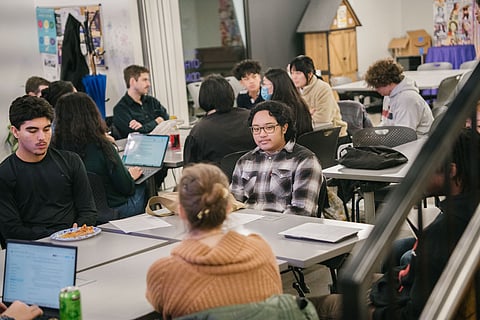
South End Youth Speak Out at Seattle Mayoral Listening Session

Around a dozen young people, most 24 and younger, gathered in Othello on Jan.10 to share their perspectives at a listening session hosted by the mayor's transition team and the Washington Bus, the largest youth-led civic engagement organization in Washington state. Comments from the session may be considered as Mayor Katie Wilson develops her policies.
The event was one of three youth listening sessions planned during the mayor's first 100 days in office, with other sessions held in Capitol Hill/Central District and South Park/West Seattle. Students at the University of Washington will host a session on Jan. 21 at the Husky Union Building.
Participants were asked questions about education, safety, affordability, workforce development, and civic engagement. They met in small groups while a notetaker recorded key points and staff from Wilson's team listened.
Questions for participants included "What gaps exist in the pipeline from high school to college, and how can the city help bridge them? What strategies are successfully protecting student safety, and how should resources for student safety be prioritized? How can young people be more meaningfully involved in shaping policies, programs, and city planning decisions?"
"We talked about the separation between people in my community, especially young people and political spaces," said Lac Tran, a high school senior who lives in White Center. "I've literally seen the last mayor once in his four years."
As a first generation student and a Person of Color, Tran said it's been difficult for him to navigate educational systems. Additionally, he said being civically involved usually meant being associated with a nonprofit organization.
Environmental justice is at the forefront for Russell McQuarrie-Means. He's a second-year student at South Seattle College who was selected to be a part of Wilson's transition team and has been active in the Duwamish River Community Coalition.
As a White Center resident, he said he grew up seeing how the Duwamish Valley's environmental issues have impacted residents living in those neighborhoods. The Duwamish River ranks as one of the most polluted rivers in the country. In 2001, it was declared a Superfund Site by the U.S. Environmental Protection Agency.
McQuarrie-Means noted a 13-year shorter life expectancy for people living in the Duwamish Valley compared to wealthier parts of Seattle.
"That has always been at the forefront of my mind when working in this; it's always been [about] finding a way to get more of a voice in South Park, in Georgetown, in the valley," McQuarrie-Means said.
Some of the concerns brought up were the lack of outreach to youth from the city about existing programs and opportunities, access to workforce development in high school for those who don't want to attend higher education, and unaffordable housing in Seattle unless you live with parents or roommates.
For Matt McIntosh, the community relations manager for Wilson who sat in at these listening sessions, it was clear that affordability is a key issue for youth.
"The issues that we're going to try to get results on — affordability, safety, protecting our city from federal attacks — those all show up in youths' lives too," McIntosh said.
Bailey Medilo, who works at the Washington Bus, described the listening session as a way for young people to use their lived experiences to recommend potential solutions to the mayor.
"Through this work, we can push the needle on the presence of young people in local government and make a real case for continued engagement with youth in Seattle," Medilo said.
Medilo said notes collected during the listening sessions will serve as "receipts" that the community can use to hold the mayor accountable if changes aren't made.
No Paywalls. No Billionaires. Just Us.
We're building a newsroom rooted in community, not corporate backing. Help us raise funds to hire our first-ever full-time reporter and grow our capacity to cover the South End. Donate today.
