
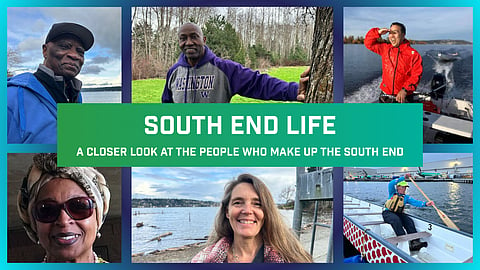
South End Life: A New Vision for the Pritchard Beach Waterfront in South Seattle

The Pritchard Beach Bathhouse sits on the southeast shore of Lake Washington, but long before white settlers came to the region, a village sat there. The Coast Salish people who called it home were known as Xacuabš, "people of the large lake." Duwamish Tribe Chief Sealth's eldest daughter Kikisoblu, known as Angeline to white settlers and with a namesake street in Columbia City, was born in the Pritchard Beach area. After treaties forced Indigenous residents out of Seattle in the 1800s, white homesteaders moved in and built a bathhouse in 1930. The city took over the land a few years later, and in 1996, it built the current building.
Now it's 30 years later, and a group of people want to reimagine how the community could use the Pritchard Beach space in the future. Some wonder if a waterfront center might fit into that vision.
A steering committee of 15 members, who have experience in fitness, water activities, art, city administration, and programming, will use a $5,000 Small Sparks grant from the Department of Neighborhoods to conduct outreach and hear what the community would like to see in the space. A survey is available for community members to weigh in on what types of activities could fill the public park. Community forums and meetings are scheduled for March 7 at Rainier Beach Community Center and April 11 at Pritchard Beach Bathhouse to discuss possible uses for a waterfront center.
In a statement, Zachary Pullin, Department of Neighborhoods communications director, wrote that the grant can support "the first stepping-stone for projects in making sure community voices are heard, documented, and centered as ideas take shape. When communities lead with their vision, our job is to help create the conditions for those conversations to happen in meaningful and accessible ways."
Here are some of the members on the project steering committee.
Multinational championship rower Bill Pickard moved to Seattle from New Hampshire decades ago, attracted by the region's natural environment. A resident of the Central District, he was a founding member of the George Pocock Rowing Foundation, whose mission was to develop the sport of rowing in the Pacific Northwest. Pickard went on to help establish rowing programs in Renton, Kenmore, Mount Baker, and more. He participated as a volunteer in the Rainier Beach Link2Lake Be'er Sheva Park project when it began in 2017. While working on Be'er Sheva, he grew to believe Rainier Beach was well-suited for a water-based program because, he said, 1,600 children go to schools within walking distance of the park.
Pickard has identified barriers to accessing water-dependent activities, which can include transportation, costs, and more. An organizer of the swimming lessons program at South Shore PK-8 School, Pickard knows that the inability to swim is also a barrier to children participating in water-related activities.
"Institutionally, people set up systems, and if a group doesn't fit the system, then they don't get to participate," Pickard said. "We've got to figure out a way to get around barriers, raise money, and work very hard to develop coaches from the community."
Royal Alley-Barnes is an artist who has served in senior leadership roles at the City, including in the City Budget Office and Parks and Recreation. They also served as executive director of the Langston Hughes Performing Arts Institute.
"Southeast Seattle is one of the most vibrant elements of the city proper, and young people are the reason that it has such a vibrancy," Alley-Barnes said. "The city, in its general nature, needs to caretake these young people. We need to be looking at their physical health, mental and emotional growth, social skills, academic life skills, long-term health; all of these things are what can really make community. When you're looking at a waterfront center, there's an opportunity to invest and converge all of these priorities to our young people."
Alley-Barnes continued, "I have seen our young people make positive decisions and decisions that were not quite as positive. And it's very clear to me that when young people can gather in a positive place that has a continuance and goals that are focused on them, they make much more positive decisions. And so that's what brings me to this idea and this project of a waterfront center."
Bull Stewart is the founder of Columbia City Fitness Center and Stewart Performance Center. He grew up in Mississippi during segregation and never had the opportunity to participate in water activities.
"At 68, I don't know how to swim, but I want to play an important role for the kids that don't know how, to help them get fit for the water, and give them the opportunity to do so," Stewart said. "People say, 'Bull, how can you be a part of this steering committee if you're afraid of water yourself?' Well, that's why I want to be a part of it. Because I want kids to know that there's an opportunity. I want them to have the experience and opportunity that I did not have."
Cori Myka is co-founder and owner of Orca Swim School in the Pritchard Beach area. She's been teaching swim classes for children and adults for nearly 30 years, but she has focused on working with adults for the past 15.
"Instead of telling people what to do with their arms and legs, we're telling people to first tune in to how they're feeling. If they're feeling calm, or if they're feeling anxious, that's going to reflect in the quality and the way that they move their body," Myka said.
Myka reflected on the process to come for the Rainier Beach waterfront center project.
"My biggest interest [for the project] at this point is I want to know what the community wants and thinks. There may be visions of watercraft, but I hold them lightly at this point, because it's important for us to tune in and listen and give people an opportunity to share their ideas."
Lesley Blyth is the founder and head coach of WAM Dragon Boat Club, which runs out of the Renton Rowing Center. She says a dragon boat program can be easy and cost-effective, which could make it a good option for a potential waterfront center. A dragon boat requires 20 paddlers.
"The boats are pretty stable, so you can go out in a pretty wide range of conditions. You don't have to be particularly fit, you don't have to be a certain size, you can get on a boat and get the instruction and go out and have a great time," Blyth said. "You can participate at a recreational level, and there are many competitive opportunities."
"The beauty of the [dragon boat] is working together. It's not 20 paddles; it's one stroke, one goal, one team," Koichi Kitazumi said. He's a founder of Seattle Sake Paddling Club, which includes dragon boat, outrigger, stand-up-paddling, and kayaking activities out of Leschi South Moorage. He says swimming isn't a requirement for dragon boat racing since people wear life jackets.
Kitazumi recounted an event that highlighted the importance of increasing access to experiences on Lake Washington.
"One time, I had a bunch of middle schoolers in our boat. As we were pushing off from the marina, one of the students screamed and said, 'What's that?' She pointed to a blue heron that was just sitting on the edge of the dock," Kitazumi said. "She grew up just on the other side of the hill, and she never saw a blue heron in her life. After that, I thought, 'We have a lot of work to do. We need to make sure [people] know they have access to Lake Washington and water activities.'"
Hulet Gates is the president of the men's department at Seed of Abraham Pentecostal Church in Renton. Gates is originally from segregated Birmingham, Alabama. He recounted that he was 13 when four girls were killed by a bomb blast at 16th Street Baptist Church in his hometown. He arrived at the University of Washington in 1968 and says he was cut from the Huskies basketball team. Shocked, he sought out another sport: rowing. He was the only Black rower in a lightweight eight boat, which had an unbeaten record.
"The idea of crew — rowing on the water — was never put before me [until arriving in Seattle]," Gates said. "It was an avenue to connect with people on a lot of different levels. It turned into a great community for me." He added, "It put me in a position to learn something that I would not have: the opportunity to get to know Juanita, Bellevue, and going around Mercer Island. Besides working hard, it gave me an opportunity to appreciate the beauty of just gliding along this liquid."
Upcoming Events
A community survey is gathering feedback and ideas on the use of a possible Rainier Beach waterfront center.
Saturday, March 7
10 a.m.–1 p.m.
Rainier Beach Community Center, 8825 Rainier Ave. S.
Opportunity to see a draft proposal and talk about ideas for the Pritchard Beach space.
Saturday, April 11
2–5 p.m.
Pritchard Beach Bathhouse, 8400 55th Ave. S.
The Rainier Beach waterfront center steering committee will present a proposal that's been updated with community feedback.
No Paywalls. No Billionaires. Just Us.
We're building a newsroom rooted in community, not corporate backing. Help us raise funds to hire our first-ever full-time reporter and grow our capacity to cover the South End. Donate today.
