
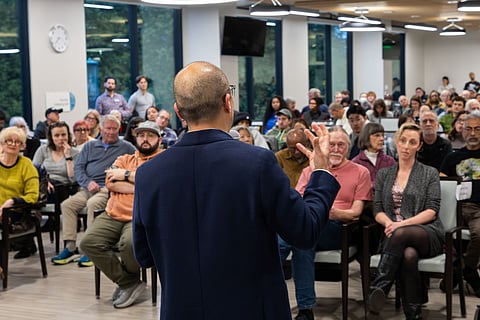
A Tale of Two Meetings: A Public Safety Gathering in Beacon Hill Grows Raucous, While a CID Event Remains Calm

Two South Seattle communities held recent meetings to address public safety in their neighborhoods: one in Beacon Hill and another in the Chinatown-International District (CID). Both meetings featured elected leaders and city officials who took questions from residents. But they shared little else in common.
The meetings were held on two successive nights, April 21 and 22, and their tones were vastly different. In Beacon Hill, a packed house of attendees shouted their disapproval of the city's response to homelessness. Meanwhile, in a lightly attended meeting in the CID, people sat quietly as presenters spoke.
North Beacon Hill Town Hall
On April 22, Seattle City Councilmember Eddie Lin held a Public Safety Town Hall at the Beacon Pacific Village Apartments. Panelists included Lin, Deputy Mayor Brian Surratt, and members from the Seattle Police Department (SPD), the City's Community Assisted Response & Engagement department (CARE), and the Unified Care Team, and they would occasionally answer questions from the audience. Over 150 people attended, and the mood was passionate, sometimes angry, with heated emotions often directed at the City's handling of the homeless encampment at Dr. Jose Rizal Park. Many jeered at city officials and other speakers.
The first two questions in the nearly two-hour town hall revealed two distinct factions in the room.
First, Wilbur, a Beacon Hill resident who works in behavioral health outreach, asked how the City plans to protect vulnerable homeless populations and increase shelter beds for domestic violence survivors. The panelists' answers focused on prosecuting abusers and expressed general platitudes about increasing addiction and mental health services. The audience remained quiet.
Next, Genevieve Courtney, a naturopathic doctor, talked about how she began organizing in the area because her dog was stabbed by an unhoused person at Dr. Jose Rizal Park. While she spoke about the City's lack of response to encampments and her desire for the City to use Ricky's Law to "force people to go to detox," most in the crowd cheered. When a panelist responded, many jeered and called for mandatory treatment of arrested homeless people.
The interaction ended with one man in the audience saying, "They're a danger to themselves and everybody else, but it's your responsibility. If you don't start doing something, we will start doing it ourselves."
And from there, the tone of the meeting was set.
The majority of commenters voiced stories of being too afraid to go to the park or local bus stops, of seeing people using drugs and exposing themselves in public, and of how they felt their neighborhood had changed recently, with the situation escalating over the past six months. Many blamed the police for not arresting dealers and substance users, and the City for not forcing treatment.
Cody, the weekend night security guard at Beacon Pacific Village Apartments, received the most audience support. He spoke about experiencing violence from homeless people at work and how drugs were "killing everyone around here."
Some attendees expressed compassion and empathy for unhoused people. Some said they conducted outreach, provided food and other care, and conducted cleanups at or near the encampments. But when they spoke, others yelled.
"We can't go in and arrest everyone," one commenter said.
"Bullshit," yelled a woman.
"They're our neighbors. They live here," said someone else.
"No, they're not," another woman responded.
Adrian, who lives near the Red Apple Market, gave one of the last comments, addressing people who shouted. "Poverty is coming for all of us. … I pray to God, the day that you're in need, you don't encounter somebody to shout at you the same way that you're opening your mouth in here."
By the end of the meeting, no palpable solutions were offered. But there were two announcements: One policy announcement came from Davonte Belle of CARE, who said the department was working with the King County Jail to notify the department when people were released. And the second announcement came from SPD South Precinct Capt. Heidi Tuttle, who called for another longer meeting with the community.
CID Public Safety Meeting
On the previous day, April 21, the Chinatown-International District Business Improvement Area (CIDBIA) held its monthly public safety meeting at the Chong Wa Benevolent Association. The meeting brought together City departments, including SPD and the Department of Neighborhoods, and nonprofits, such as REACH and We Deliver Care, to discuss their work in the CID, and preparations for the World Cup. Roughly 20 people attended, and the atmosphere was quiet, respectful (especially toward the interpreter), and informative.
The CID meeting was heavy on presentations, and speakers included Christopher Yip, public safety manager for the CIDBIA, who spoke about the safety ambassador program; Trey Campbell of We Deliver Care; members of LEAD (Let Everyone Advance with Dignity, aka Law Enforcement Assisted Diversion) and CoLEAD; and officials from the Seattle Office of Economic Development.
Campbell discussed how, in March, We Deliver Care engaged with 353 different people and had 175 de-escalations, with those interactions involving "clearing storefronts and interceding when there might be a conflict." Members from CoLEAD said that since the summer of 2025, there have been 7,649 encounters with people in the CID, resulting in 81 receiving temporary shelter.
SPD West Precinct Capt. Marc Garth-Green received the most questions when he spoke about crime in the CID and SPD's efforts to arrest dealers, illegal vendors, and EBT fraudsters. He also discussed how the World Cup may lead to the displacement of unhoused people from Pioneer Square, which could impact the CID.
Green told the Emerald how the City, including SPD, will launch a pilot program within Pioneer Square during the World Cup to "identify chronically unhoused people … and get them services." He also said there will be no sweeps in the CID during the World Cup.
Karen Salinas of REACH spoke last, discussing the challenges of assisting chronically unhoused people within the current system. In March 2026, REACH talked with 80 people in the CID about shelter and housing needs, but it helped only one person obtain permanent housing and three others enter shelters.
When asked whether that was due to a lack of housing or a refusal of services, Salinas said it is a systems issue: not helping people out of their "survival state" and addressing their behavioral health needs. "It's not about people not wanting [services and housing], it's 'How are we getting them to access them?'"
Editor's Note: This article was updated on April 27 to clarify a statement made by an attendee at the North Beacon Hill town hall.
No Paywalls. No Billionaires. Just Us.
We're building a newsroom rooted in community, not corporate backing. Help us raise funds to hire our first-ever full-time reporter and grow our capacity to cover the South End. Donate today.
