
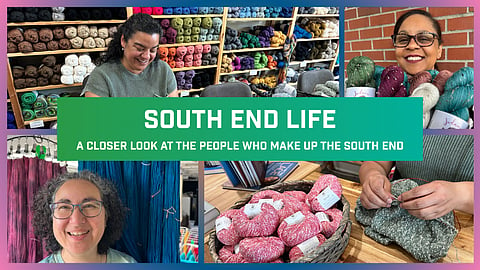
South End Life: South End Fiber Artists Knit Community Together

Destiny Itano flows through a brightly lit Georgetown basement, with glass jars and stainless-steel vats on one side of the room and colorful skeins of yarn hanging from overhead beams on the other. Itano is busy preparing dyed yarns for the upcoming Local Yarn Shop (LYS) Tour from May 13–17, one of the biggest events for yarn arts in the region. Now in its 20th year, the tour features 25 shops from South King County to Bellingham. Each shop offers its own crochet and knit patterns, yarn discounts, and a passport to have stamped for possible prizes.
The tour's longevity highlights how knitting and crochet aren't just hobbies for grandmas anymore. The craft is becoming popular with younger generations, and Seattle boasts eight yarn stores. In the South End, two shops are run by BIPOC.
"Do I feel represented in the fiber arts world as a person of color? No. That's the reality," said Itano. They know the experience of going to a craft circle, being the only person of color there, and "feeling different, not 100% comfortable."
They continued, "We're here, and we've been doing the craft the whole time. We're not represented, in part, for the reasons that we often don't feel represented in all kinds of places, which is that the focus always lands on white people." Itano wants to create a space that's comfortable for everyone.
Itano co-owns West Seattle's Seattle Yarn shop and a separate business that focuses on creating hand-dyed yarns, Huephoria Fibers. Itano grew up in Beacon Hill and, as part of a citywide busing program from the late 1970s into the 1990s, they were bused to West Seattle schools every day for "school desegregation."
Their craft is influenced by their grandma, referred to as "obaachan," who crocheted projects with wild color combinations. "My grandparents were [Japanese Americans incarcerated during World War II] and lost everything. When they came out [of camp], they were poor. We stayed poor. We needed to make things, like clothes. When I was a kid, I resented having handmade things. Coming to love things you make yourself has been an important experience for me. Now it feels powerful to make what I want and make it look how I want it to look, and fit my body the way I want it to."
During the pandemic, the knitting community surrounding Seattle Yarn created a GoFundMe for the store to cover rent and other costs. "Going into this, I don't think we fully realized the power of a small business. I don't mean that in terms of economic power, but in connections with the community," Itano said.
Itano says they've seen their customers finish projects, find their community as a new transplant to the city, or go through devastating grief at the shop. "We get attached to people, and they get attached to us in ways we weren't expecting. It can be emotional. I better understand now how important small businesses are in communities and how much they keep us in community. I feel both proud to be able to be that, and I also feel the weight of that."
In Burien, Arlinda Garcia knits up a spring sweater at her shop, B Town Yarn. She's been stocking the store with wool and notions for the upcoming fiber arts event since last year, when the tour drew 600 customers to the store. When Garcia was younger, she learned to crochet pieces for a "granny-square blanket" with her mom and sisters. Then, in 2019, she purchased the shop when she found it for sale by the former owner.
Garcia says she likes to witness the breadth of creative approaches to working with yarn colors and textures. "I'll see people pick up yarn combinations I would never think to put together, and they'll show me finished pieces that are creative and look great," Garcia said. "There's a lot of conversation, teaching, and sharing of knowledge — a lot of cheering for each other, whether someone has finished a cardigan or a small square or if they have to take apart a project."
Garcia, who was one of 11 siblings growing up in Skyway, says her mother is an important influence in her life. "Money was not abundant. She always kept things going. When she wasn't working, she was being a mom to us," said Garcia. As one of the older children, Garcia helped with housekeeping, making meals, and looking after the younger ones. Garcia recounted that despite how busy her mom was, "she didn't say 'no' to me when I decided to join sports or try for college." Now, Garcia's mother, Martha, helps run the shop. "It's been fun to work with her and see her as a professional woman — not only as Mom," said Garcia.
Jessica Whitmore, of Jadawoo Designs, dyes yarns in Tacoma, and her products are at several shops in the region. She also worked with Garcia to dye the line of colors for B Town Yarn. The name 'Jadawoo' comes from what was written on her high school running race bib. Her nickname was "Jada," and "woo" was added "because you need a little 'woo'!" Whitmore chuckled. She was inspired to start dyeing yarn when she couldn't find the colors she wanted for a project she had in mind for her husband. She tried dying yarn to fit her vision for knitting projects, and her passion grew as she gave away yarn to friends who would work up beautiful pieces.
As Whitmore grows her business, she dreams of partnering with organizations to teach people how to dye yarn as a skill they can build on and to bring more people to the industry. Whitmore grew up in Yakima before settling west of the Cascades. "I worked at McDonald's from when I was in high school for 13 years. I had the opportunity to work with a wide variety of people. There were high school students, women raising families, and men taking shifts there for a second job. We're all people," Whitmore said. "It helped me see people who didn't have the opportunity to try other things or didn't see their self-worth. I'd like to offer help through my work. I'd like to give back."
Itano, Garcia, and Whitmore stitched together names and resources of fiber artists of color, some of them local:
No Paywalls. No Billionaires. Just Us.
We're building a newsroom rooted in community, not corporate backing. Help us raise funds to hire our first-ever full-time reporter and grow our capacity to cover the South End. Donate today.
