
Why Chrissy Shimizu Sees the Wing Luke as Key to the CID's Future

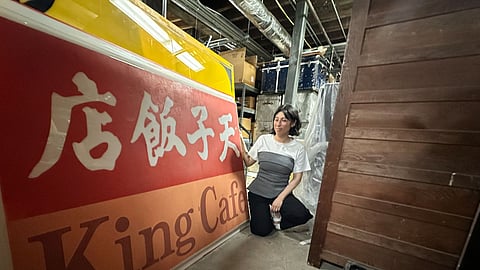
As Christina "Chrissy" Shimizu, the new executive director of the Wing Luke Museum, walked through the museum's large basement, she caught her breath. There, among the old suitcases and lion dance costumes, was a sign for King Cafe, a dim sum shop that closed in 2004. Shimizu exclaimed, "This was one of my favorite places to go when I was little. They had the best egg tarts, a dumbwaiter between the upper and lower floors, and the owner gave me a Dum-Dums lollipop every time I went there."
Shimizu, who was formerly the executive director of Puget Sound Sage and a current resident of the South End, took the helm at the Wing Luke in May. Shimizu organized with the CID Coalition in the past and sits on the board of Asian Counseling and Referral Service. Shimizu's father's side of the family, who are Japanese American, have been in Washington State for generations; her mother, from Tennessee, is white. Her grandparents were sent to Japanese American incarceration sites throughout World War II and left for Japan post-war, only to face more discrimination in Japan because of their U.S. background. Her father, who was born in Japan after the war, emigrated with his parents back to the U.S. at 13, and he later commuted from Edmonds to the family's second-generation shiatsu massage practice in the Chinatown-International District.
Shimizu spoke with the Emerald about what she brings to the museum.
This interview has been lightly edited for length and clarity.
How did the distinction between life in the CID and Edmonds impact you?
I had a really rich connection to the CID, and also had a childhood growing up in Edmonds. I felt identity angst growing up, of not fully understanding why there was such a separation between my life in Edmonds and the community I was able to experience through my family and their ties in the CID. It wasn't until much later that I was able to develop a language and more political analysis to understand those differences, heal a lot of that, and put some context around my family's experiences — why they would talk about certain things, or why they wouldn't — even my father's experience, how challenging it must have been for him to internalize the way racism impacted his life, having moved here in his teens. I grew up feeling incredible pride in my family and its leadership in the community, and then in Edmonds, shame, that I needed to fit in. There were harder moments where I have to forgive myself for making fun of my dad's accent, or the ways that I made his life harder through my own challenges and how those showed up.
There's so much power in this museum that can provide space for cultural belonging, cultural pride, and for being able to access information about our histories in context, so young people can go through [stories and information] on their own. It's helpful for my father as well, who had far fewer resources. I think about how we can make more of this available, because a lot of stories aren't told in a family because of trauma or other things.
What memories have influenced your perspective and the way you'll approach your work at the Wing Luke?
One thing that's really important about this neighborhood is how intergenerational it is. I was able to grow up with many [community] aunties and uncles. As an example, Dr. Kusakabe was my dentist, and he took over his father's practice. One day, when I was at the dentist, his father walked in. He said, "I knew your grandfather." My grandfather had passed away when I was 6 months old, so I never knew him, and Dr. Kusakabe [senior] began telling me this story about my grandfather, while I'm lying in the dentist chair with my mouth open, while his son worked on me, and I'm getting teared up because I'm hearing this story about my [grandpa] from someone who knew him.
The CID has a fragile ecosystem. We're so lucky that this is a living neighborhood that supports working-class immigrant communities to be able to live and work here and to have small businesses in it that serve our communities. In an instant, this community can be displaced and could become the facade of a CID or a strip mall. Having those experiences of aunties and uncles, of going into shops, hearing and holding the stories of this community is what drives me to protect this. We're fighting for neighborhood preservation and for our cultural permanence, and carrying that torch is something that I take very seriously. I'm going to continue to create space for it and continue to pass it down.
What are the biggest challenges the Wing Luke and the community are faced with? And what role does the Wing Luke have in the neighborhood?
Arts and culture organizations across the country are still rebounding from the cascading impacts of COVID and loss of admission revenue, of changing federal funding priorities, and of political scrutiny. The Wing is no different. What's unique is that we are also part of this neighborhood's ecosystem. We're the second largest economic driver in the neighborhood. Our ability to act as an economic engine for the neighborhood was built into the design of the museum. We don't have a cafe. We encourage people to eat at neighborhood restaurants and explore [through food tours]. The neighborhood is an extension of the museum, and without the neighborhood, the museum is an island.
We also have a new, large light rail stop coming into the neighborhood. With light rail comes real-estate speculation and density. We want to see density around new transit, but we want to make sure that this neighborhood is able to be at the forefront of the vision for our community and how it continues to grow. We want to preserve the current residents' ability to live here in the future. We want the CID to remain an immigrant and working-class community for the next 100 years, because without people on the streets who are speaking many different languages and living here who want to go to the tea shops, buy their groceries, shop at the stores, eat at the restaurants here, the neighborhood will change dramatically, like the Chinatowns in Portland or Vancouver, British Columbia. The museum played a role in helping get the City's equitable development initiative off the ground. Cultural preservation is intricately tied with neighborhood preservation.
We'll celebrate the opening of the Eng family home this summer. Being able to take land out of the speculative market and keep it in permanent community ownership and control, so that we can be stewards of this neighborhood and its stories for the long run, is a way that the museum should continue to think about our role.
Is there a story about transformation and healing you can share from the walls of the Wing Luke?
During my very first week of work at the Wing in 2017, I was called down to the theater. A student group came in from one of the schools that we partner with. Apparently, some of the youth had vandalized the building, tried to light it on fire. Rather than pressing charges, the museum worked with their school principal and had the students take a tour through the museum and experience our exhibits. They hadn't been inside before. They were told to write letters of reflection, so these students, young boys who were Black and Brown, were sharing their reflections about what they learned from walking through our exhibits, and about the shared experiences that the Black community and the Asian community have.
Their reflections were that this is a sacred building, and that they were so sorry for their thoughtless actions, and so appreciative that the museum made the decision to build [the concept of] repair and implement transformative justice into the response instead of punishing them. The principal cried, and said this could have played out very differently, they could've gone to juvenile detention, but instead, they were able to reflect together on so much more.
What would you say to people who have thought of visiting but are timid to because it centers the Asian American experience that they aren't a part of?
First, we're on Duwamish land. I invite people to come see why the city of Seattle looks the way it does today. It's because of Chinese, Japanese, and Filipino labor. The story of the neighborhood, and the story of the museum, shows how their labor went into the transformation of this city and has been undervalued and invisibilized.
The museum houses a part of U.S. labor history and immigrant history that is still present in the turning on and off the taps of bringing immigrants in for labor. We're seeing it right now with the heightened attacks on immigrants and their deportations. Before the Asian groups were the enslavement of the Black community and forced removal of Indigenous communities.
The Wing is a hometown gem. There are amazing tours through our historic hotel and through the neighborhood. I hope people come and learn and feel our shared American history and be part of imagining what the future of us can be.
This article is published under a Seattle Human Services Department grant, “Resilience Amidst Hate,” in response to anti-Asian American, Native Hawaiian, and Pacific Islander violence.
No Paywalls. No Billionaires. Just Us.
We're building a newsroom rooted in community, not corporate backing. Help us raise funds to hire our first-ever full-time reporter and grow our capacity to cover the South End. Donate today.
