
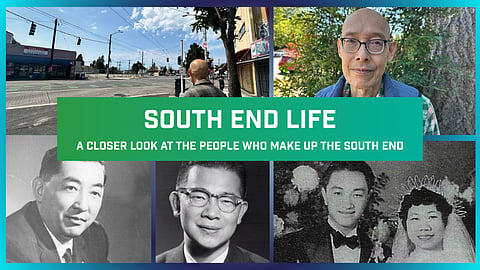
South End Life: How Beacon Hill Became a Home for Local Asians

Ron Chew enjoys running. He's also dedicated his life to recording local Asian American history. He's shepherded the Wing Luke Museum, edited the International Examiner, currently serves as the state president of the AARP, and is the author of My Unforgotten Seattle. He knows Beacon Hill well since he's lived in the neighborhood for over half a century. Sometimes he runs by El Centro de la Raza, which used to be the old Beacon Hill School, where he went to school. On other days he swings past the Beacon Hill Junction. Owen's Pharmacy, where a Latin grocery is now, was where he picked up comic books. The Beacon Hill library was also at this intersection.
Property ownership, a practice that displaced countless Indigenous people, was brought to this region by white settlers. Like the Central District and the Chinatown-International District (CID), Beacon Hill was shaped by discriminatory redlining practices, where Asians, Black people, and many Jewish people were excluded from accessing loans to purchase houses. Most areas of Seattle — except designated "red" zones, like in the International District, the Central District, Beacon Hill, and Rainier Valley — barred people of color from owning property. Legal documents (restrictive covenants attached to specific properties) also noted that the land would not be sold to these groups from the early 20th century until the 1960s. With this history, it's no surprise that Beacon Hill, with 25,000 residents today, is home to 70% people of color. Census numbers show that 40% of the community identifies as Asian.
Beacon Hill represents the diverse and layered migration histories of the Chinese, Japanese, and Filipino communities who were impacted by the U.S.'s historical thirst for inexpensive labor throughout the 20th century. The Emerald sat down with Chew to talk about Beacon Hill and more.
This interview has been lightly edited for length and clarity.
YK: How did Beacon Hill become Beacon Hill as we know it today?
RC: Residential segregation is a huge part of the social history of America. You had Black sections and white sections of many towns. The same applied for other groups: Manila towns, Chinatowns, the Barrio. That's why you have the Chinatown-International District, because a lot of people couldn't live in other places. It was a ghetto. In the mid-1800s, many Chinese arrived in the U.S. during the Gold Rush and to build the transcontinental railroads. By the 1870s, Chinese women were barred from arriving with a stereotype that they immigrated as sex workers. In 1882, the Chinese Exclusion Act stopped any new Chinese entry into the U.S.
Along the West Coast, anti-miscegenation laws kept Chinese men from marrying outside of the Asian race, so for over 60 years, Chinese workers were single men living in all these old, brick apartment buildings in Pioneer Square and CID. Men came first to work, and then women came later. The CID holds both the history of trauma — because you're basically incarcerated in a neighborhood — you also have the power of support and cultural memory by being with people of your own background. The Central District and Beacon Hill are the two neighborhoods adjacent to the CID, so they're the first places where Asian Americans moved to.
[For Chinese Americans,] the pressures to move out of the CID became stronger after a major immigration reform in 1965 got rid of discriminatory immigration exclusions and quotas. Until then, men worked, gambled after-hours. and hung out. Women are the civilizing influence, you know. The newly immigrated women didn't want to be living in these little apartments, The women were: "You're coming home. We're gonna make a meal. You've got kids coming," so it changed the character of the community profoundly.
YK: What about other Asian communities?
RC: The Japanese American community began pushing out of the CID even earlier than the Chinese, because the Japanese women came here as picture brides from the late 1800s. They would also have their children, who had birthright U.S. citizenship, become the property owners of land. Many people think all Asians have the same history. It's not the same. It's why the betrayal for the Nisei, when they were incarcerated, was so profound, because they were Americans.
When people moved out of the CID, the Central District was less of a barrier to break through because the Black community was already there. Beacon Hill had areas where racial covenants with [certain] properties wouldn't allow the lot to be sold to people of color. Here's where the Japanese American story is interesting.
RC: There's a guy by the name of James Matsuoka. He was a farmer in Kent who was incarcerated at Tule Lake during the war and then came back with his family. When he returned, he partnered with a white friend to found International Realty in the CID in the 1940s. Although there were already some Japanese families on Beacon Hill, he told me, as a realtor, he made a conscious decision to show homes on Beacon Hill to Asians. He was involved with the Japanese American Citizens League and the Jackson Street Community Council, which was a multiethnic coalition of African Americans, Japanese Americans, Chinese Americans, Filipinos who fought for a number of things [including] pushing back against residential segregation. He was involved in repealing [the Washington State Alien Land Law] from the late 1800s, which barred Asians from owning land.
YK: Redlining was about access to loans, right? How did local Asians finance purchasing homes?
RC: Redlining was a big issue for Asians. That's how United Savings and Loan was established in 1960. It was acquired by Washington Federal Savings [in 2003], but you can see the branch office still in the CID. That was the first Asian American Savings and Loan Company in the continental U.S. Robert Chinn founded it, and its purpose was to secure loans for Asian Americans, who at the time couldn't receive a loan.
RC: It wasn't until the late '60s and '70s that the restrictive covenants really lost their efficacy. A lot of folks I interviewed during my oral history projects were [only] able to acquire their homes on Beacon Hill by having white friends buy the houses for them, and then purchasing the house from [the white friends].
Wing Luke was a [Seattle] City Councilmember who fought redlining by writing legislation and advocating for the open housing ordinance. It was like a 10-year struggle to ban redlining and housing discrimination in Seattle. It passed in 1968 around the same time Martin Luther King Jr. was assassinated. Wing Luke was also a pioneer in historic preservation. He campaigned to preserve Pioneer Square, CID, and Pike Place.
YK: Your family purchased a house on Beacon Hill, but you spent your first couple of years in the University District. Tell me about that.
RC: The CID is often considered the only place where Chinese people lived, but that's not true. I was born in the U District because that neighborhood was filled with Chinese laundries. It was because of all the students. Back then, you couldn't go to class with wrinkled cotton shirts. They would have their clothes pressed.
My dad and my uncle had a hand laundry in the University District not far from where Wing Luke's family and others had these businesses. The laundry was washed at commercial sites, and "hand laundry" meant we pressed and finished clothes. We also made minor repairs and sewed on buttons. My mom and my aunties worked there, too. They heated heavy irons on hot coal stoves [to press clothes]. We lived in houses which were subdivided into apartments.
At a time of anti-immigrant furor like now, It's important to keep in mind that this country can't thrive without immigrants and refugees. You can't just yank them out. We need to accept the reality of what the U.S. is. This country is different from what many people imagine it is.
Got an idea for a South End story you'd like to see us cover? Let me know: Yuko.Kodama@SeattleEmerald.org.
This article is published under a Seattle Human Services Department grant, “Resilience Amidst Hate,” in response to anti-Asian American, Native Hawaiian, and Pacific Islander violence.
No Paywalls. No Billionaires. Just Us.
We're building a newsroom rooted in community, not corporate backing. Help us raise funds to hire our first-ever full-time reporter and grow our capacity to cover the South End. Donate today.
