
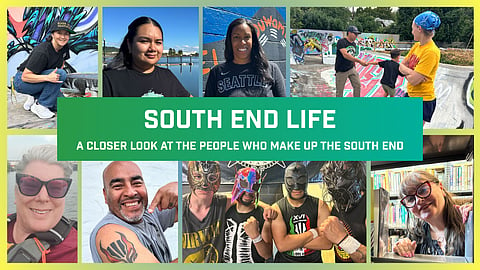
South End Life: South Park Celebrates Summer With Two Festivals on One Day

Kayak rides along the Duwamish River; timed trials and best tricks for skateboarding; lucha libre. These will be some of the highlights of an upcoming dual event: South Park Summer Party (SOPASUPA), organized by Cultivate South Park, and the Duwamish River Festival, put on by the Duwamish River Community Coalition (DRCC), have been summer event mainstays in South Park for years. After a sobering cancellation of the Duwamish River Festival last year because of increased apprehensions about and aggression by ICE, both events will come together on Aug. 8.
"We've had a year to train ourselves in how to respond, and we've been working together with SOPASUPA for a safety plan this year," said Maggie Angel, community engagement and communications specialist at the DRCC. Duwamish River Festival, a celebration of Seattle's river with environmental education engagement, commemorates its 19th anniversary this month. SOPASUPA celebrates South Park and highlights the area's small businesses. Crystal Brown, the organization's executive director, said, "It's our first time collaborating on this event. It's exciting to learn, grow, and partner more closely with DRCC."
Here are some of the people behind and highlights of the two festivals.
Maggie Angel arrived in South Park when she was a toddler. She got involved in the DRCC's Duwamish Valley Youth Corps in her teens. Angel says she was excited to learn about the Duwamish River. "I never had swimming lessons or access to [bodies of] water before. I wanted to go in [the water] and learn more. Then I learned that it was polluted. Everything I'm doing for work, I know will benefit my daughter's future. I'm advocating for a healthier community, so my daughter could one day do the same for her family."
The DRCC was established in 2001 when the Duwamish River was deemed a Superfund site. Originally called the Duwamish River Cleanup Coalition, the organization is active in monitoring air pollution, because of the neighborhood's high rates of asthma. It's also working with Habitat for Humanity and Sea Mar to prevent displacement and is addressing the deportation flights out of the neighborhood's King County International Airport - Boeing Field.
Crystal Brown got involved with the South End when she started working with kids at the former Rainier Community Center and then eventually began teaching at the Giddens School. "It's through my work in these spaces that I learned how impactful you can be and how every person you work with and see is tied to people who care about them." Brown now works for Cultivate South Park, which provides art and movement programming by community members who want to share their expertise and hobbies.
"There were baseball fields and tennis courts throughout the city, but there's been a stigma with skateboarding. Skating is such a healthy and fun activity with a great community. I wanted more safe places to skate," said Kim Schwarzkopf. For decades, skateboarding has been prohibited in many areas. Schwarzkopf got into skateboard organizing when the city relegated skaters to one isolated park in Interbay. Schwarzkopf was part of a movement in the 1990s where local skateboarders met with city councilmembers to advocate for more skate parks.
Given this background, it's no surprise that Schwarzkopf became one of the founding organizers for River City Skatepark, also referred to as Stargate or Portal because of its doors to the four directions. "In the early 2000s, some students were getting busted for skateboarding up at Concord Elementary School. The community found out, came together, and started the idea for this."
James Klinedinst, senior project manager at Grindline Skateparks in West Seattle, became interested in skateboarding at 12. "I got into concrete construction because it's what I like to skateboard on. The construction possibilities are limitless," said Klinedinst. He worked with Grindline founder Mark "Monk" Hubbard on many skate parks, including River City Skatepark, before Monk passed away in 2018. "[Monk] designed and built hundreds of skate parks worldwide, but this was his masterpiece because it was local. He based it on sacred geometry. He lived down the street and really got into making this [skate park] unique and challenging to skate," said Klinedinst. The skate park is well-known among skateboarders internationally. Klinedinst said Monk told him you can "unlock the portal" if you skate over all the doorways in a row.
Kelsey Costello, Tlaloc Espinoza, and Orion are a family that lives behind the skate park. "We pass through here on the way home from school. It's quiet. People come here and skate during the day. Sometimes there are youth and teenagers, and there's a group of men in their 40s who come here after work hours," said Costello.
Espinoza said he picked up a BMX bike to ride through the skate park. "It's not a city park. It's cared for by the community."
"In skateboarding, failure is really celebrated. You can't learn something unless you first fail. If you take a slam [big fall], people are like, 'Hell yeah, that was sick.' That was so addictive to me," said Carlee Heger, Seattle chapter director of Skate Like a Girl. She found the group at age 18 and has been involved for nine years. "At 17, I went to Judkins Skatepark and there were five or six girls there. I'd never been to a skate park where there were that many girls before. There was so much camaraderie among the women in that space. Women, nonbinary people, trans people bring a lot to spaces, and it's important for sports with mostly cis men to have more of this diversity." For SOPASUPA, Skate Like a Girl will offer free lessons to people 17 and under, of any gender.
Cari Simson, co-founder of the River Access Paddle Program (RAPP), has always loved paddling in the Seattle area. During the pandemic, she and Lee, the other co-founder, talked about how trash in the Duwamish River increased during the pandemic. The two started RAPP with funds from Seattle's Office of Sustainability and Environment (OSE). The program offers an opportunity to learn about and engage with the Duwamish River through paddling tours and monthly cleanups. They also encourage people to become Duwamish River kayak guides by offering adult and youth kayak safety guide training.
"You're able to paddle in this really dynamic landscape, a tugboat will go by, and then you might see an otter and a blue heron. I love this river," said Simson.
Jose "Profesor" Gomez, founder of Lucha Libre Volcanica, climbs into a boxing ring, giving direction to students in Spanish as they tumble on the wooden platform and jump from the ropes. The training occurs twice a week in Tacoma. Lucha libre is a form of professional wrestling from Mexico where wrestlers, or "luchadores," wear masks, often representing animals or other symbols.
Matches are usually battles between the archetypal técnicos and rudos (heroes and villains). Técnicos are known to use quick, aerial moves and play by the rules, while rudos are known to use slower power moves and break the rules. "The movements in lucha libre are like the language of this art. It's like a dance," said Gomez. Volcanica is the only lucha libre program in the Pacific Northwest.
Halcon Negro, a luchador with Volcanica, has been with the group for more than a decade. He's known for his jumps and aerial moves. "Lucha Libre is very athletic, and it's a beautiful sport. It's different from American-style [professional] wrestling that's a little slower, lumbering, showing the power through body slams. Lucha libre is so graceful, and there are these beautiful masks and costumes, so colorful." Halcon Negro is third-generation Mexican American, and his entire family participates. "I didn't grow up speaking Spanish, but Profesor Gomez teaches the traditional way. He only uses Spanish in the ring, the universal language of lucha libre."
Lupine Bybee is the supervising librarian at The Seattle Public Library's South Park Branch. She's been working there for over 13 years and is moved by seeing kids who grow up in the library come back as adults. "We know many people who come in by name. Sometimes people come in and they'll share a little bit about their day. It's important that we know them, and they know us as a trusted place to go and ask questions." The Seattle Public Library's bookmobile will be at the Duwamish River Festival. Bybee's book recommendations: The Hacienda by Isabel Cañas and Mexikid by Pedro Martín.
Duwamish River Festival and SOPA SUPA (South Park Summer Party)
August 8, 2026, noon to 5 p.m. All events are free
Locations:
Duwamish People's Park 8700 Dallas Avenue S.
South Park Small Business Area 14th Avenue South and South Cloverdale Street
River City Skatepark 736 S. Cloverdale St
Free Shuttles from Georgetown and South Park. Free Pedicabs between festival locations
Editor's Note: This article was updated Aug. 4 to clarify information about Carlee Heger's involvement in Skate Like a Girl, correct a name and include information about events.
No Paywalls. No Billionaires. Just Us.
We're building a newsroom rooted in community, not corporate backing. Help us raise funds to hire our first-ever full-time reporter and grow our capacity to cover the South End. Donate today.
