
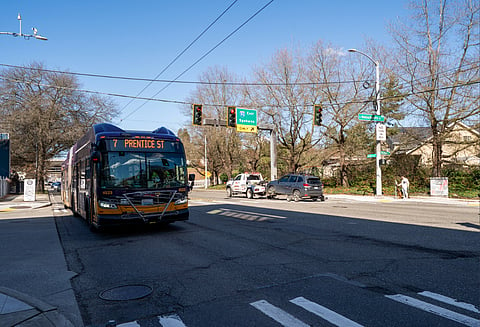
Metro Plans to Replace the 7 Bus Line in 2032. Riders Already Have Concerns.

In 2032, King County Metro plans to eliminate the 7 bus line and replace it with the RapidRide R Line to improve bus routes along Rainier Avenue South. But even with the proposed change happening years in the future, community members question whether faster service may come at the expense of eliminating local stops that some riders, such as those who are elderly, live with disabilities, or have children, rely on.
The RapidRide lines are part of the county's effort to provide faster, more reliable, and more frequent bus service by using fewer stops compared with typical bus routes. According to Sofia Mastikhina, RapidRide R Line Lead at King County Metro, the introduction of the R Line would reduce the number of stops along the South End route from 67 stops to 45.
"It's one of the most transit-dependent corridors in all of King County," Mastikhina said. "Folks there need the 7 to get to everywhere, from basic services, medical, education, jobs, you name it. People need it, are using it, and Metro's committed to improve it even more so that folks have an easier time traveling along the corridor."
But not everyone sees it that way.
"Cutting the bus stops, it's a big no-no," said Nelia Diaz, senior program manager at the Filipino Community Center.
Route 7 is King County Metro's second-highest ridership route, with more than 11,000 daily riders who utilize the route to get from South Prentice Street to downtown Seattle. It also has the highest ridership of people with disabilities, Mastikhina said.
At peak times, Route 7 runs every eight minutes, faster than the RapidRide standard of every 10 minutes. But according to Mastikhina, the biggest issue with the 7 is reliability. Many of the buses bunch together along the route, making them arrive late or back to back.
"The deployment of ADA ramps is really what takes a little bit longer than in other parts of the county," Mastikhina said. "The operators help folks who are coming in get settled in that priority area at the front of the bus, so those minutes just add up and create that overall bunching throughout the day."
But Anna Zivarts, a Rainier Valley resident and the executive director of Nondrivers Alliance, says she questions how much faster the R Line will be after taking into account how many riders will now have longer travel times because of their stops being eliminated.
"If you've ever walked anywhere with someone who's a senior or uses a walker or wheelchair or [is] blind, travel times are much slower. Even if you have a young kid, it's really hard to get a stroller on the buses because they're so crowded," Zivarts said. "That distance may not feel like a big deal to someone, but it can feel really different to different people."
Diaz, who frequently uses the bus, says that when she walks long distances in winter, her feet get swollen, and that older adults like her cannot walk far, especially those who use walkers or have a disability.
Zivarts said, "It feels like they just want to be like, 'We're going to improve travel times by eliminating transit service potentially for a whole segment of people who slow down the bus too much,' right? And that just doesn't feel aligned with our values as a county."
Mastikhina says there's a minimum standard for how far away stations should be from each other to make travel times faster, but even though this standard exists, King County Metro will take into account local context and community input.
RapidRide buses first began operating in 2010 with the goal of having buses function similar to light rail by running at frequencies of 10 minutes or less, 24 hours a day. Metro used to have a Route 7 Express that would have higher frequency during peak hours. That service was retired in fall 2014 because of systemwide service cuts due to a budget shortfall.
Planning for the R Line began in 2019 but was paused because of federal funding cuts due to the COVID-19 pandemic. Since then, Rainier Avenue South has changed significantly. There's more housing density, and the city has added bus-only lanes and transit signal priority at some intersections, which have helped improve the speed and reliability for buses, Mastikhina said.
Metro says it does not currently have estimates of the potential travel time savings. Currently, during the weekday morning peak period, it takes approximately 54 minutes to travel from South Henderson Street and Rainier Avenue South to Third Avenue and Pike Street. However, during other weekday hours and on the weekends, the trip is shorter by up to roughly eight minutes.
"I'd love to see that data and [see King County Metro] make the argument that this is the investment Rainier Valley needs," Zivarts said.
Metro held community input sessions throughout August to reintroduce the project to the community. The transit agency is currently in the design phase and is working toward receiving approval from the King County Council through an alignment ordinance to confirm the general route and location of the bus stops.
The ordinance could be considered between October and November or potentially next year, said Carrie Avila-Mooney, Metro's director of strategic transit integration and partnership.
But Zivarts says she's worried there won't be enough time to provide community feedback.
"They're basically asking the council to vote on eliminating stops without any promised time savings, which is guaranteed to make trips longer and harder for people," Zivarts said.
Diaz expressed a similar belief.
"Not everybody [has] a car, so there's a lot of people riding on the bus," Diaz said. "There should be community input. That's the best. But then, if they can keep the bus 7, that's my preference, that's a good thing."
Zivarts would like to see other investments in the South End, such as more transit options going down to cities like Renton, Tukwila, and Kent, more bus signal priority and level boarding, and better draining along Rainier so that when it rains, people can stay dry.
"There's so many other places that are really hard to get to without driving in Rainier Valley," Zivarts said. "I would rather see an investment to ease some of those travel times."
No Paywalls. No Billionaires. Just Us.
We're building a newsroom rooted in community, not corporate backing. Help us raise funds to hire our first-ever full-time reporter and grow our capacity to cover the South End. Donate today.
