
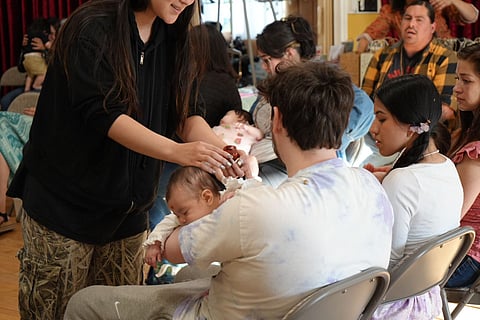
Columbia City Will Be Home to Nation's First Native-Owned Birth Center: Q&A With Camie Goldhammer

In 2028, Columbia City will be home to the nation's first birth center owned by the Native community. Hummingbird Indigenous Family Services (Hummingbird), located on South Hudson Street in the neighborhood, recently bought the former Seattle Home Maternity birth center space, just a few blocks away on South Ferdinand Street. Seattle's Equitable Development Initiative gave close to $2.2 million to Hummingbird to support its purchase of the birth center and renovations.
In Washington State, Indigenous maternal mortality rates are more than seven times higher than rates for white mothers. The majority of these cases are preventable through better access to culturally responsive medical care and support services. Hummingbird offers culturally congruent support and care for Indigenous moms. The organization is also piloting a no-strings-attached guaranteed basic income project, offering a group of Indigenous mothers financial support from pregnancy until their baby's third year.
The Emerald spoke with Hummingbird's founding executive director Camie Goldhammer (Sisíthuŋwaŋ-Waȟpéthuŋwaŋ Oyáte) about the organization. Goldhammer is also a licensed clinical social worker and an internationally board-certified lactation consultant and full-spectrum Indigenous doula.
This interview has been lightly edited for length and clarity.
YK: Tell me about what has influenced your approach to your work with Indigenous mothers.
CG: I describe myself as a suburban Indian. I grew up in Issaquah. My dad is my Native parent. My mom is non-Native. I was very close to my dad as well as my [paternal] grandma. My grandma taught me a lot about what it means to be a Dakota woman, to care for people and to learn about culture and our background. There were a lot of challenges too, because colonization impacted Native people for generations. Many people in my family went to boarding school, which resulted in varying degrees of cultural disconnection.
My Indigenous activism started in high school. Our high school mascot was the Issaquah High School Indians, and I worked on changing that. In my junior year, the football team had an impromptu pep rally. They cut down a 300-year-old [Indigenous] story pole in Beaver Lake Park, set it on fire, peed on it, and all the things. This fueled me to fight. I always felt strongly about serving my Native community.
When I became a mom almost 18 years ago, breastfeeding was a formative experience for me. When I breastfed my daughter for the first time, I recognized that a healthy attachment between a Native mom and her Native babies is the antidote to colonization. That's when I went full force into supporting Native moms when they're pregnant and caring for young children.
YK: Could you tell me more about this concept of breastfeeding as an antidote to colonization?
CG: Culture is typically our food, our spirituality, our language, and our connection to land. Learning this is almost always through the mother, especially in the early years. When we look at colonization and the methods used to try to destroy us, there were a lot of attacks on mothering, like separating children from their mothers and their teachings. It's about cutting the attachment to a mom, which destabilizes the child's sense of security. Colonization created unhealthy attachments. It promoted fierce independence and a lack of security, which increases fear and [the perspective of] scarcity.
My favorite definition of security is the belief that when bad things happen, good things will follow. For many of us, the good thing that followed was the thing that mom did, like you fall and skin your knee. It hurts. We can't prevent those hard things from happening, but it's the hugs, the loves, and the “Are you okay?” that are formative. A lot of times we focus on the health of the children, but in my opinion, the best thing to do for the children is to take care of their mothers.
YK: Tell me about Hummingbird's guaranteed basic income program.
CG: It's called the Nest, and it's a pilot program. We've been funded to provide a guaranteed basic income to 150 Indigenous moms. They enter the program sometime in their second or third trimester, and they receive $1,250 per month, no strings attached, through their child's third birthday. It comes to a little over $45,000 over the course of three years, plus however long they were pregnant. At the child's third year, we open a $5,000 529 college savings account for the child as our investment into the next generation. We started enrolling 15 moms a month in August of 2023. Our first baby turned 3 in July. Our last baby turns 3 in October 2027. Each month, kids turning 3 come in for their exit celebration.
All of the families have access to Hummingbird's culturally congruent wraparound services if they want them. We've found that most people in the Nest engage in services and that's where we've seen the greatest impact.
YK: What have the outcomes been?
CG: We have a maternal mortality rate of zero. We believe that the combination of our services can eliminate the maternal mortality crisis. We've seen very low prematurity rates and less hypertension. They experience more financial, housing, and food security. Maternal mood disorders are reduced. There are higher breastfeeding rates, which promote a stronger attachment and connection with their babies. Almost all the moms in the Nest took time off after they had their babies to bond and recover. That's something many families are unable to do.
I also met a Nest mom and dad at their baby's exit celebration, and I asked if they were worried about not having the monthly income anymore. The dad told me that because his wife was in the Nest program, he didn't have to hustle for a second and a third job to make ends meet. With that ease, he was able to join a union apprentice-training program. He said he was graduating to a journeyman job the following month, which would bring in more income than the Nest program.
YK: I heard Hummingbird has a research and evaluations department that's referred to as "data sovereignty." What does data sovereignty mean?
CG: Data sovereignty came out of the idea that we need to protect data about ourselves in the same way that we need to protect our land and our bodies. When evaluations or studies are done [about Indigenous communities] the outcomes almost always live at large institutions and universities that are not managed by Native people. We should be answering questions that our community is asking, not what a professor somewhere else is probing. We have a team of five Indigenous researchers and evaluators and we publish articles.
We evaluate our own services, and we're working on other research too, like an Indigenous, perinatal, mood-disorder screening tool. The two tools most used now are not great at screening perinatal mood disorders in people of color. We want to create a tool that will work for Native moms. We find that so many are suffering in silence. We're also conducting a large, national, reproductive justice landscape review for the Native community.
YK: Tell me about other Hummingbird programs.
CG: We have home visit programs. All of them are community-designed and voluntary. The visits are driven by what the family wants and are meant to meet the family's goals.
We have doula home visits during pregnancy and up to three months post-partum. We also have Pilimakua home visits, which start as early as 27 weeks into pregnancy and up to the baby's third birthday. ["Pili" is the 'Ōlelo Hawai'i word for "connection." "Makua" is the Kānaka Maoli tradition of generational caregiving.] These visits center around three pillars: understanding infant and child development; caregiver mindfulness and self-compassion; and culture and language reclamation.
An example of a visit could be that a family heard from their pediatrician that their child should start solid foods at 6 months. The Hummingbird team might share information about what to watch for in the child's development progress, which can show the baby's ready, like a pincer grip to hold food and when they stop tongue thrust, which is their way of expelling solid food. For caregiver mindfulness, the mother can ask how solid food might affect the relationship between mother and baby. With language and culture reclamation, the home visit might include a conversation about looking up what your people have given for the first food, because cultures throughout the world often have a first-food ceremony.
We also have the Indigenous emotional wellness program for moms who are experiencing perinatal mood disorders. Our two peer counselors in the program offer non-clinical support. Another title for them is "Indigenous Emotional Bestie." They're meant to offer help in conjunction with a therapist or a clinician and other services at Hummingbird.
YK: Tell me about the importance of the birth center for the community.
CG: We need alternative birth spaces. We have many families that are just not cared for properly at hospitals and choose a birth center for many different reasons, including comfort level, proximity to a hospital, and living situations.
We're excited about the birth center. The building was home to Seattle Home Maternity Service. The founders, Suzy Myers and Marge Mansfield, purchased it in the late 1970s, and they ran the Seattle Midwifery School out of its basement before it became a licensed birth center in 1983. Thousands of babies have been loved and cared for there together with their moms. It has good energy and good medicine in it.
No Paywalls. No Billionaires. Just Us.
We're building a newsroom rooted in community, not corporate backing. Help us raise funds to hire our first-ever full-time reporter and grow our capacity to cover the South End. Donate today.
