
In the Recent Election, Young People Mobilized Voters in the South End and Central Washington

This past year, Sara Ikeda worked with the nonprofit Washington Bus to get people to fill in their ballots. The organization, known as "the Bus," focuses on developing young civic leaders and building a base of young, informed voters. Ikeda, a 19-year-old University of Washington (UW) student, believes young people can help influence politics. "Students and younger people need to have their voices heard by people in power and people who have the power to vote," said Ikeda, who participated in the Bus' Youth Endorsement Council. (Editor's Note: The Emerald co-sponsored an Oct. 24 candidate forum held by Washington Bus.)
The Youth Endorsement Council researches initiatives and candidates to recommend for the election season based on the group's values. The 2026 Washington general election included three initiatives that stood to impact the lives of the state's young people, two of which didn't pass: I-645, which would've repealed the "Millionaires Tax," a repeal that would've likely reduced resources for state education; and I-001, which would've required schools to disclose information to parents about their child's access to school health services, including mental health services.
But the third initiative, I-638, passed. It bans trans girls from participating in girls school sports and requires girls who do take part to undergo a medical verification of their "biological sex," which can result from a blood test, an oral swab, or a genital exam. The initiative is set to become law on Dec. 3, but a coalition of organizations, including TransFamilies and ACLU of Washington, plan to battle the initiative in court.
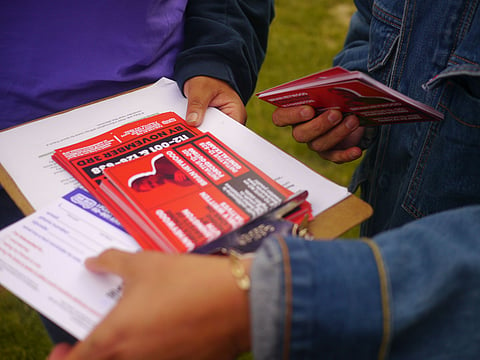
Hundreds of the Bus' young people between 16 and 35 coordinate annual campaigns to speak to state legislators; canvass door to door; and call and text voters in King County, Central Washington, and Spokane.
Here are some of this year's cohort of hundreds of young organizers who pound the pavement with the Bus.
The Power of Organizing and Canvassing
"Seeing the power in the youth vote — how many youth voted and got registered this year — is moving," said Briseldy Hernandez-Ramos, a Bus fellow and campus lead with the nonprofit as well as a UW graduate student studying policy and social work. About 42% of registered Washington voters ages 18 to 24 turned in their ballots this year, up from roughly 18% last year. More than 55,000 young people in Washington registered to vote.
Hernandez-Ramos learned more than how to phone bank and canvass; the Bus also brought in organizers to speak about fundraising and how to budget for campaigns. Union representatives also shared their organizing perspective. From there, Hernandez-Ramos developed her own narrative around the initiatives on the ballot. "In order to talk with your neighbors, you need to communicate how the initiative is connected to yourself and the community," said Hernandez-Ramos. "This can determine how the conversation will go."
In southeast Seattle, she says she observed the community as more united in caring about similar issues. She would hear about people actively engaging in issues, organizing in the community, and even running for school board. When Hernandez-Ramos canvassed in Green Lake, she found fewer people wanted to open the door, and when they did, they often expressed concern about how election results would impact their property taxes.
Hernandez-Ramos grew up as a daughter of immigrant farmworkers in Central Washington, so when the Bus canvassed in Sunnyside, Washington, she related to the area and people. She recommended the Bus translate materials about initiatives into Spanish. She spoke with orchard owners about how initiatives would affect their property taxes and talked with farmworkers about fair wages. Hernandez-Ramos registered 20 people to vote there. Canvassing goes more smoothly, she says, when the canvasser speaks the same language and can culturally relate with the community. "I was fueled by the power and support in the neighborhood," she said.
Reaching Out to Immigrant Communities
Hassen Beynah, who was a Bus field canvasser, recently graduated from UW and aspires to study law. In his second year as a field canvasser, he knocked on up to 90 doors a day in South Seattle and Yakima.
"My biggest takeaway from canvassing door to door is people are more responsive to personal contact than to texts and phone calls," Beynah said. When he described the initiatives, some people asked, "Are you making this up?" Beynah and his canvassing partner reassured people and added, "It's going to affect your kids."
Beynah says canvassing in South Seattle, with its immigrant community, offered opportunities to talk with people who hadn't voted before and their young-adult children. They discussed the right to vote and how to vote, in addition to what's on the ballot.
But Beynah says canvassers take safety precautions. They wear bright purple Washington Bus T-shirts and go into the field in pairs. They're trained to notice behavioral cues of people they speak with. "If you leave when they look busy, they'll appreciate you more," said Beynah.
Beynah says he's involved in politics because of his late father, who experienced a lot of change in Somalia over his lifetime and, after arriving in the U.S. in 2011, kept up with the news and articles on U.S. foreign policy. His father passed along this passion. "I want to study law and policy and work in community nonprofits because [these organizations] helped me and my family when we first came here," said Beynah.
Seeing How Political Processes Impact Lives
Thien-Nhi Nguyen is a high school student who grew up in the South End. Nguyen joined the Bus' Youth Endorsement Council, which researched candidates and created the Bus' 2026 Primary Endorsements.
Nguyen says she started watching candidate debates while in the fourth grade. At that time, Donald Trump was a first-time presidential candidate who talked about building a border wall. "Some of the things candidates say are egregious and out of touch," said Nguyen.
When canvassing door to door, Nguyen described a number of people in the 37th District bringing up concerns like reliable public transportation, environmental health, the increased cost of living, and immigration enforcement. "Listening to people's concerns connected politics with the impact of policies at a human level," said Nguyen. "Canvassing grounds me in the reality of how political processes impact us."
A Gen Z View on Online Gaming and Trans Role Models
As a member of the Bus' 2026 Youth Endorsement Council, Ikeda researched candidate backgrounds and tracked demographic information about residents visited by Bus canvassers.
Ikeda says online culture informs her generation. She's made friends across the country through online gaming and has a friend whose classmate was deported. She also heard about ICE surveillance in Bellingham. "[Politics] definitely directly impacts us right now," said Ikeda. "These immigration policies are taking away our friends."
Ikeda says she was particularly disappointed in the vote to ban trans girls from school sports. "Students under 18 are directly affected by the results of an election, though they can't [vote yet]," Ikeda said. "Many older people didn't grow up looking up to artists and social influencers with a transgender identity like our generation," added Ikeda, referring to popular transgender artists among college students, like Underscores, Jane Remover, and Daine. She wondered if the outcome of the vote would've been different if more transgender athletes and people who compete alongside them had spoken out against I-638.
What's In Store for 2027?
According to the Bus, hot issues for the 2027 election season will be a statewide data center moratorium, climate superfund legislation that holds polluters accountable, regulations on generative AI tools students might encounter in K-12 schools, and protecting financial aid for college students.
The nonprofit also hosts Bus Underground, where young people can get guidance on how to advocate for issues that interest them.
Got an idea for a South End story you'd like to see us cover? Let me know: Yuko.Kodama@SeattleEmerald.org.
No Paywalls. No Billionaires. Just Us.
We're building a newsroom rooted in community, not corporate backing. Help us raise funds to hire our first-ever full-time reporter and grow our capacity to cover the South End. Donate today.