
COLUMN | The Millionaires' Tax Won't Block the Sonics' Return
Washington state is on the brink of taking a substantial leap toward fixing our upside-down tax code and requiring our wealthiest residents to contribute more. With the passage of Senate Bill 6346, nicknamed the "Millionaires' Tax," lawmakers are finally addressing one of the most regressive taxation systems in the country — one that has long forced low-income Washingtonians to pay a far greater share of their income in taxes than their higher-income counterparts.
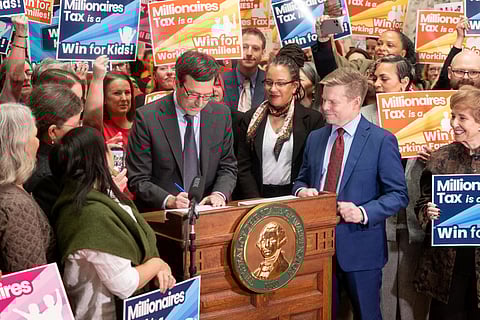
This tax, which was signed into law this week by Gov. Bob Ferguson, places a 9.9% tax on long-term capital gains and annual income above $1 million, would also direct revenue toward incessantly underfunded public investments.
Unsurprisingly, Republican lawmakers have already announced plans to repeal it. As is often the case when policies threaten concentrated wealth, some lawmakers are working overtime to convince everyday people that what benefits the wealthy benefits everyone, and that asking the rich to pay their fair share will somehow harm us all.
I, for one, am exhausted by this narrative
The fearmongering has evolved from "this bill will get tied up in litigation" to "if they tax the rich, they'll eventually tax the poor." But the truth is, lower-income Washingtonians are already paying more than they should. High state and local sales taxes disproportionately burden those with the least, since they spend a larger share of their income on taxable goods. In fact, the lowest 20% of households pay roughly four times more of their income in taxes than the top 1%.
More recently, critics have even suggested that this tax could jeopardize efforts to bring the Sonics back. This is a particularly manipulative and desperate argument, given the deep and lasting loss felt across Seattle and the state when our beloved team was stripped away from us nearly two decades ago. This tactic arrives just as the NBA has announced it is exploring expansion in Seattle.
Lawmakers like Jim Walsh are stoking fears that this tax could derail that possibility, even though most states already have income taxes and still manage to attract and retain major franchises. California, for example, remains one of the most desirable destinations for professional athletes despite having some of the highest personal tax rates in the country.
We've also been hearing the familiar claim that wealthy residents will simply leave the state. But if someone wealthy is willing to relocate solely to avoid paying taxes, so that we get nothing from taxing their income, then technically we will get the same thing we get from them now. And frankly, I believe many wealthy Washingtonians are not so shortsighted. From those who remain, the tax is projected to generate roughly $3 billion annually once fully implemented in 2029.
As written, the bill will also expand eligibility for the Working Families Tax Credit, increasing the number of qualifying households from about 350,000 to an estimated 810,000. That's a significant boost for lower-income residents who need it most.
Additionally, 5% of the revenue from the Millionaires' Tax will go toward the Fair Start for Kids Account, which funds childcare and early learning. Washington ranks fifth in the nation for childcare costs, and this investment would help increase access, cap copays, and provide support for providers, offering real relief to families across the state.
The bill will also fund long-overdue, common-sense measures like free breakfast and lunch for all public school students. It includes sales tax exemptions on essentials like diapers, hygiene products, and over-the-counter medications. At the same time, a new 0.1% public safety sales tax, which began this year, will bring Seattle's total sales tax rate to 10.55%, among the highest in the country.
These benefits are especially meaningful in areas like South Seattle, where there are higher concentrations of low-income residents. The South End experiences significantly higher rates of food insecurity than other parts of the city and county, as well as higher rates of children relying on free school meals. Investments in childcare, universal free lunch, and tax relief on essential goods will go a long way in supporting these communities.
Although the tax has been passed and signed, it's far from settled. There will be bumps in the road and its opponents, like the tech industry millionaires who fought it, will continue to leverage their deep pockets and outsized influence to make it disappear. But this is a monumental shift toward bringing some semblance of sanity to our tax code. And while 99.75% of Washingtonians won't pay this tax, the benefits for families and communities across the state are significant.
These past few weeks have offered us a rare glimmer of hope for two things that not so long ago seemed like distant dreams: that in a few short years, we might be both taxing the wealthy and rooting for the Sonics once again.
Editors' Note: Gennette Cordova does contracted digital content work for state Rep. April Berg, who is responsible for the revamped version of the Millionaires' Tax discussed here. While this column is not part of her work for Berg, that work has informed this perspective.
Gennette Cordova is an award-winning writer and communications strategist focused on advancing racial equity and community-driven change. Rooted in amplifying underrepresented voices, she seeks to challenge dominant narratives and connect issues to broader movements for justice.
No Paywalls. No Billionaires. Just Us.
We're building a newsroom rooted in community, not corporate backing. Help us raise funds to hire our first-ever full-time reporter and grow our capacity to cover the South End. Donate today.

