
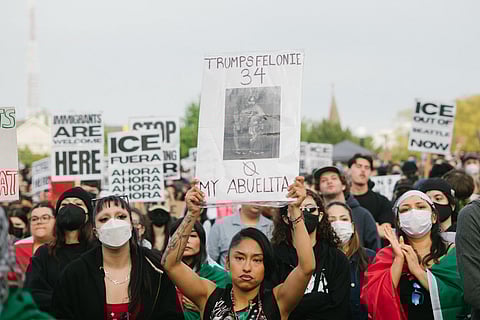
COLUMN | When ICE Hits Home

Ursula is 3 years old, the same age her mother, Fiona, was when she came from Mexico to the United States. Ursula’s grandfather first came to the U.S. back when workers traveled easily between the two countries. After the 1994 North American Free Trade Agreement (NAFTA) caused economic disaster in Mexico, by allowing U.S. businesses to relocate to Mexico without any accountability to local governments or culture, thereby decimating local businesses, Ursula’s grandparents decided to permanently settle close to siblings and community already living in a coastal Puget Sound town. Working temporary jobs as well as working as housekeepers and in local restaurants, they built a life.
In 1995, Ursula’s grandmother went back to Mexico to visit and care for her ill mother. Five months later, Fiona was born in central Mexico. Increased restrictions on immigration between Mexico and the U.S., passed in 1996, kept Fiona and her mother away for three years until they were finally able to return and reunite with her father in the U.S.
Fiona was a studious child. Reading — books, magazines, anything — and writing fed her curiosity and imagination. A makeshift desk set up in a small space behind a door served as her childhood space to write.
Her first memory of something being different about her family comes from being told to hide and be quiet when there were knocks on the front door. She says she was 4 or 5 years old when she first felt adults’ fear. It was many years before she learned what that fear meant.
In high school, she applied for work at a nearby shop, aced the interview, and was ready to start her new job. The application asked for a Social Security number. Not knowing what that was, she wrote in a series of numbers. The shop manager called to tell her the Social Security number she’d entered came up as invalid. Fiona realized then the source of the adult fear underlying her childhood: She didn’t have a Social Security number; no one in her family did. Without one, they couldn’t enter the employment market. They were forced to find ways to make do as entrepreneurs or by finding unregulated work.
The U.S Congress repeatedly defeated opportunities for comprehensive immigration policies, including spelling out the status of children who were brought to the U.S. without accepted documentation. The Dream Act was first introduced in 2001, when Fiona was only 4. It would have allowed those children to live and work in the country legally and build a path to full citizenship. It bounced around Congress for more than a decade until, after its failure yet again in 2011, President Barack Obama issued an executive branch memorandum, the Deferred Action for Childhood Arrivals (DACA), on June 15, 2012.
DACA set the parameters for children brought into the U.S. before 2007 to gain the legal ability to live and work in the country. The federal government simply required those individuals to complete a form, provided they had not been convicted of any felonies or serious misdemeanors. Unlike the Dream Act, DACA offered no pathway to becoming a citizen. It was simply limited to providing the right to live and work in the U.S.
Fiona was 15. With full faith in the promise of the U.S. government, she signed up for DACA. This entitled her to a social security number and removed the dark curtain between her and the ability to participate in society without that adult fear she had grown up with.
DACA made Fiona feel like she could have purpose and follow her dreams. She did well enough in high school to be enrolled in the Running Start program at her local community college. She wrote prolifically and became editor of the school news publication. Journalism was the clear and chosen path feeding her curiosity and passion for learning and writing. She soon transferred to the local university’s journalism program.
After college, she received an internship and three-year fellowship at the local newspaper of record, wrote for a major regional news organization, won a major award, and wrote for another local news organization. She took short adventure breaks to do stints on a fishing boat in Alaska.
Most important of all to her, three years ago, she became a mother to energetic, curious, whip-smart Ursula. Born a U.S. citizen, Ursula has all the rights her mother does not. She will be able to travel internationally, something Fiona longs to do but cannot because of DACA restrictions. Like Fiona, Ursula will pay taxes, but unlike Fiona, she will be able to receive Social Security retirement benefits. Fiona sees U.S. citizens buying property in Mexico, living there tax-free, while she pays taxes here that she will never benefit from.
And perhaps most importantly, Ursula will be able to vote and select someone to represent her values and interests in the city, county, state, and country where she lives, which no DACA recipient or other non-citizen can do. After 26 years in the U.S., Fiona pays taxes without representation.
Fiona says she loves the U.S. and loves Mexico. Both cultures have formed her. As Irish Americans celebrate St. Patrick’s Day and other cultural milestones are marked by music, dance, food, and drink, she and her family have always celebrated their connection to Mexico.
The one thing she does not want to pass down to Ursula, the one thing she cannot control, is the visceral knowledge of adults’ fears. As we sit in my living room, where she recounts her 29-year life journey, this is what brings her to tears: the thought of taking her daughter into that dark corridor of fear she experienced as a child.
As she anticipates one possible aftermath of her upcoming DACA-required biometric check-in at the Immigration and Customs Enforcement (ICE) field office, she is broken by the pain being caused to children throughout the country: those whose parents are being abducted without cause and those who sit alone, without their families, in detention facilities.
She knows her well-established family and friends will rally to care for Ursula if she is detained, but her own memories of childhood fear and otherness haunt her. She cannot understand how anyone with a conscience can cause a child that pain; how an entire society can stand by and watch it happen.
“I’m her person. What will happen if I’m not there for her. … Ursula loves dancing, singing ’Happy Birthday.’ She loves her cat. She loves roughhousing, to a fault. She loves karate, but she also loves unicorns. She’s just a great kid. I’m so lucky to be her mom. She makes me so happy. I know things are going to be okay, but if things were to go to the worst… I need her. She needs me. … Despite how much I worry about her, I know she’s a tough girl. ”
Fiona’s message to Ursula: “She was always my one priority, and if I fought for anything, it was for her. I did everything within my power to be sure we are together again. That I was always fighting for her.”
CBS News reported in February that ICE has detained more than 261 people who registered for DACA last year. Though the article states that “statistics indicate the vast majority of DACA recipients taken into federal immigration custody during that period had criminal records,” we know the current federal administration has redefined “criminal” to include being in the country without documents, a Catch-22.
The article goes on to say, “They were granted temporary work permits and deportation protections after passing background checks and meeting several requirements, including coming to the U.S. before June 2007, not having serious criminal histories and graduating from an American high school or serving in the military.”
Individuals with DACA status have to re-register every two years and pass those same background and biometric checks. Every time. Every single time. The administration would have us believe 261 DACA registrants became criminals after receiving and repeatedly renewing their DACA status.
Like Fiona, DACA registrants are asking to fulfill their lives in the country they have known as home most of their lives. Despite the way their families were marginalized. Despite their own childhood and adult fears. Despite the restrictions placed on them. They want to stay. They want to contribute the knowledge, skills, and talents gained by being part of our education, economic, and social systems into building the aspirational “more perfect Union” envisioned by the Preamble to our Constitution.
Fiona wants to stay. To raise Ursula to love the country of her birth. To celebrate their native cultures. To not fear adult fears.
Author’s note: Fiona and Ursula are not their real names, but they are very real people.
Lola E. Peters (she/her) is semi-retired from a 40-year-plus career as an organizational development and training professional. She has written many articles and opinion pieces for the Emerald™ and other publications and published two books of poetry and a book of essays.
Editor's Note: This article was updated on April 17 to include the author's bio.
No Paywalls. No Billionaires. Just Us.
We're building a newsroom rooted in community, not corporate backing. Help us raise funds to hire our first-ever full-time reporter and grow our capacity to cover the South End. Donate today.
