
OPINION | Coyotes in the 'Hood? Yes, Please

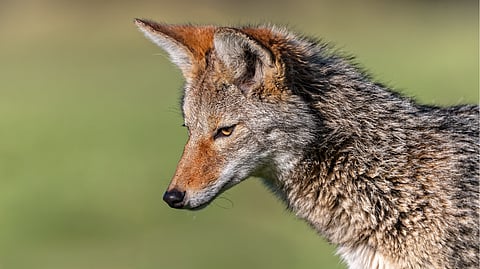
I recently spied a coyote bounding up a short flight of stairs into my yard in Rainier Beach. It was the middle of the afternoon and I was about to walk my little dog. We stood in awe instead of shrinking back in horror.
The coyote was more afraid of me and (literally) high-tailed it away.
Coyotes in the 'hood? Welcome, I thought, please come back.
That's not exactly the sentiment usually expressed in social-media posts about coyote observations in Skyway, Kubota Garden, Seward Park, and points in between. Some even heard the eerie howls of the so-called song dogs. I'd been reading the posts for years with envy, hoping for a sighting of my own.
In contrast to my reverence and excitement, people were more inclined to bad-mouth the animals: Evil in the vicinity, hide your children and pets.
"Too bad that there doesn't seem to [be] anything the authorities can do … about controlling population, like trapping & removing them or euthanasia for them," Joanne commented on a post in the West Seattle Blog.
Hers is not a novel idea. Project Coyote, a conservation nonprofit headquartered in Marin County, California, calls the coyote "North America's most persecuted wild carnivores." The organization's science advisory board pulled together U.S. Department of Agriculture Wildlife Services data and state hunting and trapping figures to estimate that more than 500,000 coyotes — or virtually one per minute — are killed annually in the U.S.
"However, since most states don't require any reporting, it is likely an underestimate," Nadia Steinzor, Project Coyote's carnivore conservation director, wrote in an email.
The coyote's transgression? By extrapolating relatively rare interactions, humans have judged Canis latrans as threatening, a competitor for resources, and, generally, up to no good — all rationales for eradication. Listen carefully and you'll hear echoes of language often directed at our marginalized human communities.
Christopher Schell is a Black urban ecologist who has studied coyotes his entire career. Once an assistant professor at the University of Washington at Tacoma, Schell is now on the faculty at University of California, Berkeley, and operates the Schell Lab, which "studies relationships among human and nonhuman organisms in constructed spaces." Schell grew up in Altadena, California, where coyotes were part of the landscape, so he has become particularly attuned to the similarities between the way people might talk about these animals and him as a Black man.
Call them "song dog" whistles.
"It became more and more apparent that the ways in which language was used to describe the coyotes was coded, and it was very similar to the ways in which language was used to describe Black communities, immigrant communities, communities of color, low-income communities," Schell said during a recent interview over Zoom.
"That polarizing language and the ways in which coyotes have been able to adapt in an environment where they are strongly persecuted is an allegory of the Black experience in America, right? [Black people] literally have taken pig intestines and turned them into chitlins everywhere they go. So that is a hallmark of Black America, a hallmark I can make an argument for immigrant communities across the United States. It is the hallmark of those that are deemed unworthy or unbelonging or unbecoming of the spaces that are controlled by those that are in power. And those that are in power tend to be the wealthy, white hegemonic system that then tries to completely control the narrative into one."
That conflating, gaslighting narrative creates certain negative assumptions for certain kinds of people and species of animals that might otherwise be considered benign for others.
"Anything that that animal does outside of what is perceived to be normal will be perceived as a threat," Schell said. "If an animal sits down and watches you, perceived as a threat. If the animal is following you while you're jogging, perceived as a threat. If that animal is sort of baring teeth at a dog, perceived as a threat. Even that last one, most folks will say that animal is rabid or maybe it is too habituated, but it's also very possible and likely that that animal is protecting its offspring."
This dissonance has bothered me since forever. You might say the sensitivity is baked into my DNA. The hallmark of my Japanese American community, after all, is the forced removal during World War II for the crime of looking like an enemy most never even met.
I've regularly photographed Barred Owls in Seward Park, considering them the perfect gateway birds for urban dwellers. A couple years ago, I went from the smiling faces of human families beholding the wondrous sight of young owlets at the park to listening to the U.S. government constantly discuss the birds as "non-native" and "invasive." Ultimately, the U.S. Forest Service elected to lure and shoot Barred Owls to help the Spotted Owl.
A compelling example of competing viewpoints assigned to similar traits or behaviors is the reverence in which Native American cultures hold the coyote. In Native American lore, coyotes are described as cunning, change agents, tricksters, as violators of norms, deceitful, and even selfish. They are both heroes and anti-heroes whose spectacular failures unveil valuable life lessons. They also are natives of this state and the rest of North America.
Urban coyotes are often described as "slinking around," wily (and Wile E.) meant negatively, and scavengers, but in a pejorative sense that does not match reality. The diet of coyotes in Seattle is dominated by fruit, then rabbits, according to the Seattle Coyote Study, led by Sam Kreling of the University of Washington. Schell and the Seattle Urban Carnivore Project were also part of the study. Chickens are next. Cats are No. 4 in coyote consumption but are likely overcounted because the study looked at genetics revealed in scat and one cat likely was shared by a family of coyotes, instead of one cat per coyote.
Rats and mice closely follow — pest extermination the coyote provides free of charge.
Though man has encroached on their habitat, poisoned them, trapped them, and shot them from helicopters, the coyotes' strategy over centuries of hitching themselves to people has proved utterly successful. Their adaptability is awe-inspiring; in the face of mass killings, coyotes will increase the size of their litters, switch mating pairings, and adjust their ranges. Still, in the "wild," a coyote not only is hunted by humans (every state in the union allows unlimited killing of coyotes, per Project Coyote), it is lower on the food chain than the likes of bears, cougars, and their close cousins, the wolf.
In the city, the coyote is the apex predator and can find cover and sustenance. It "only" has to worry about traffic, rain, and getting shaded on social media.
"Coyotes are all over our city all of the time," according to Kreling, who recently founded Common Ground, a nonprofit to help people live more harmoniously with urban wildlife. "They are often seen throughout the city, and while many do frequent parks, many also spend a lot of time in densely urbanized areas. These areas have a lot of potential food from rats and rabbits to our human trash."
Seattle's coyote population is undetermined. In a 2021–2023 study, Kreling counted 73 by genetics but says that number could be considered a minimum. Since then, coyotes have returned to West Seattle and, of course, others may have escaped genetic detection.
As I was driving to the gym the morning after my midday sighting, I saw the coyote again. A driver stopped in the middle of the road, joining me as transfixed by the magical spotting. I decided to follow it down a hill. I fumbled for my iPhone, but only managed a butt shot. For days, I drove around with professional camera gear in the car but didn't see it again.
When I relayed this to Mark Jordan, a Beacon Hill resident who is the co-lead of the Seattle Urban Carnivore Project, he set me up for disappointment.
"Typical carnivore behavior is to have a large home range that you kind of move around in," Jordan said during an interview in his office at Seattle University. "They probably don't want to exhaust any particular food source."
To some extent, that's the coyote's way of not overstaying their welcome. As any person of color in this faux-liberal city knows all too well, it can be a short leap from newcomer to undesired. Then the fearmongering and displacement begins.
Related Event: Seattle Urban Carnivore Project Public Talk
Mark Jordan, a professor at Seattle University, will discuss the project on Tuesday, June 9, at 7 p.m. at the Lakewood Seward Park Community Club.
The South Seattle Emerald is committed to holding space for a variety of viewpoints within our community, with the understanding that differing perspectives do not negate mutual respect amongst community members.
The opinions, beliefs, and viewpoints expressed by the contributors on this website do not necessarily reflect the opinions, beliefs, and viewpoints of the Emerald or official policies of the Emerald.
Glenn Nelson is a Japanese American journalist and lifetime South Seattle resident who founded The Trail Posse and has won numerous national and regional awards, including for the Emerald, for his writings about race.
No Paywalls. No Billionaires. Just Us.
We're building a newsroom rooted in community, not corporate backing. Help us raise funds to hire our first-ever full-time reporter and grow our capacity to cover the South End. Donate today.
