
OPINION | Neglected Traffic Medians on Rainier Avenue South Point to Inequity in the South End
I'm a proud resident of Rainier Valley. My partner and I regularly walk around Othello Park, Pritchard Beach, and Seward Park. We often run into friends and neighbors when we're out and about. We love the South End and the warm community that lives here.
Yet when I venture to other parts of Seattle, I can't help but notice resources and development present in other places that are absent here. The neglected traffic medians on Rainier Avenue South are a daily, visual reminder of that inequity.
Last year, the Seattle Department of Transportation (SDOT) announced the construction of "landscaped" traffic medians with trees along Rainier Avenue South to reduce collisions along the corridor. This was welcome news for improving road safety. South Seattle had the highest number of fatal collisions and serious traffic injuries from 2020–2024 compared to other areas of the city.
A specific promise of this project involved more trees, reflected in a Seattle Times headline that declared "Seattle's next move to slow Rainier Avenue: Plant trees in center lane." Trees clean the air, cool temperatures in hot months, and add beauty. At a time when South Seattle is losing tree canopy faster than other areas, I looked forward to this creative approach to increase the number of trees along Rainier. Landscaped areas also help to instill neighborhood pride, attract small businesses, and build wealth in areas that have historically been redlined.
Residents watched the construction of these medians, and then we waited for the landscaping and trees … and we're still waiting.
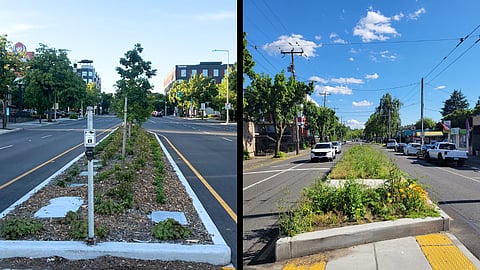
The construction ended a half-year ago. And yet the median on Rainier Avenue South and South Kenyon Street has no trees, shrubs, or landscaping. What remains is a patch of tall weeds.
One median on Rainier Avenue South and South Thistle Street has two small trees, while the median on Rainier Avenue South and South Spencer Street has a single small tree. Neither has any other shrubs or landscaping, and both are full of weeds.
I contacted District 2 Seattle City Councilmember Eddie Lin multiple times to ask about the plan for the weed-infested plots, but I got no response. I also emailed SDOT on May 17, and an SDOT representative replied on June 26 that the team that created the medians was unable to get irrigation installed in any of the three traffic medians. A ground-cover seed mix that was put down hasn't become established. As for the median by South Kenyon Street that did not get a tree, there's a SPU mainline under it, which prohibits the planting of a tree. It will be limited to ground covers.
It makes me wonder about the amount of planning that went into this project. Was there no way to understand the barriers to installing irrigation in advance? When did the existence of an SPU mainline that prohibits planting become known? And was there any thought about planting drought-tolerant plants, like lavender, instead of a seed mix?
It would be one thing if this is how every traffic median project in Seattle was handled. But I drove through Ballard the other day and saw gorgeous, new landscaped medians with trees, shrubs, and landscaping bark. A cheerful SDOT video touts how the newly planted medians there added "dozens of trees" and makes the area "more appealing." Meanwhile, the Rainier Avenue traffic median project that had a Seattle Times article announcement is not even listed in the current or completed projects on SDOT's website.
The different outcomes of these two projects make me think of other differences between South Seattle and Ballard along race and socioeconomic lines. The South End is home to a majority of Black and Brown folks compared to Ballard, which has 74% white residents. The South End also has twice as many people as Ballard who have an income 200% below the poverty line. The average annual income in southeast Seattle is $69,000 compared to Ballard's average of $96,000.
The Rainier Avenue South traffic median project was an opportunity for the city to show South End residents that we deserve beautiful spaces just as much as other neighborhoods. We can see that Seattle is able to provide trees and landscaping for transportation projects in wealthier and whiter parts of the city. Instead, the difference highlights some of the inequities we already feel on a daily basis.
Seattle should deliver on its promise and finish landscaping the traffic medians it built on Rainier. After all, this was SDOT's idea. Creative solutions are possible even if trees cannot be planted. Drought-tolerant shrubs and a sculpture or art installation representative of the South End community would be a wonderful way to fill this space.
I encourage residents to keep tabs on SDOT and Councilmember Lin to ensure the beauty we were promised blooms in the South End. South End residents deserve beautiful, green spaces just as much as Ballard.
The South Seattle Emerald is committed to holding space for a variety of viewpoints within our community, with the understanding that differing perspectives do not negate mutual respect amongst community members.
The opinions, beliefs, and viewpoints expressed by the contributors on this website do not necessarily reflect the opinions, beliefs, and viewpoints of the Emerald or official policies of the Emerald.
Jillian Altizer is a resident of Rainier Valley. She is a director of human resources at a manufacturing company, treasurer of the Lake Washington Human Resources Association, and an executive committee member of the Seattle King County NAACP. Jillian is a passionate gardener with a degree in organic agricultural systems and minor in soil science from Washington State University.
No Paywalls. No Billionaires. Just Us.
We're building a newsroom rooted in community, not corporate backing. Help us raise funds to hire our first-ever full-time reporter and grow our capacity to cover the South End. Donate today.

