
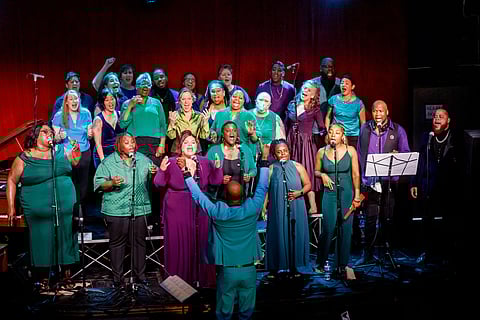
Resounding Love, a Social-Justice Choir, Builds Bridges Through Song

When Cindy Ogasawara, co-CEO and president of Resounding Love Center for the Arts (RLCA), helped create a social-justice choir several years ago, the mission was clear: "From the very beginning, we [agreed that] what we don't want is just another choir where people come together and think this is gonna be like Sister Act 2, and they get to clap, wear robes, and have fun," explained Ogasawara. "This is going to be something where we do deep work together — across racial barriers, across faith barriers — where anybody can come into this organization if they're willing to do the work of social justice, in addition to singing."
Ogasawara cofounded RLCA with co-CEO and artistic director Marshan Moultry in March 2020, at the beginning of the COVID-19 pandemic lockdown.
"Pro tip: Don't start a choir at the beginning of a global pandemic," said Ogasawara. "We thought, 'Oh, this COVID thing — maybe in three or six months, we'll be able to sing together in person.'" Instead, the choir practiced for two-and-a-half years on Zoom before having the opportunity to rehearse in person.
And soon, those interested in church-based music — "We sing primarily from African American musical styles like gospel spirituals, R&B, and civil-rights protest songs," said Ogasawara — will be able to hear Resounding Love in person.
RLCA will host a fundraiser concert on Saturday, Feb. 1, from 7 to 9 p.m. at Renton IKEA Performing Arts Center. Proceeds from the live concert will directly support Resounding Love, RLCA's multiracial, interfaith, and LGBTQIA-embracing social-justice choir. The concert's theme, "Love Is Resistance," was chosen to encourage and inspire the fight for love, inclusion, and justice.
Ogasawara remembered that starting Resounding Love virtually presented challenges that struck at the heart of how most choirs learn music.
"We couldn't actually sing on Zoom, so what we would do is Marshan would teach the parts with everybody else on mute. He would sort of demonstrate how to sing them, and he would sing all the parts: soprano, alto, tenor. Then he would record each of those parts, and we would upload them to a digital library where everyone could access them," explained Ogasawara. Using Moultry's teaching materials, choir members would practice their parts at home.
"When it came time for us to make a video of the song, everyone would record themselves on a device at home with one AirPod in, listening to the track, and then we had to stitch all of those individual videos together into a Brady Bunch [-style] video," Ogasawara said.
Zoom time on Tuesdays helped build relationships and trust among choir members, which was essential in upholding the choir's mission of cultivating racial healing and respecting the diverse identities of choir members through the preservation of social justice values.
"2020 was the [year] of George Floyd, Ahmaud Arbery, Breonna Taylor, and all these terrible, terrible things leading to a global uprising around racial justice. People were in deep grief, fear, rage, and sadness so, it was it was a lifeline for so many of us, particularly our African American siblings who were especially grieving all of this," said Ogasawara.
Osagawara and Moultry both came to realize that perhaps what they were trying to create might not be best supported in a religious context.
"We met in the church and decided to move [the choir] out of church because this was too important to keep in a church setting, where so many people don't feel comfortable. More than not feeling comfortable, so many people have been vilified, demonized, and rejected by their church families — or even their real families — for being who they are," Ogasawara said.
Ogasawara clarified that the organization's social justice requirement for its members is not community service hours or extracurricular charity, as the choir designates time and resources to perform free concerts for organizations like Mary's Place. Instead, it is the awareness that real harm can be done to one another that inspires the organization's model to make bolstering social justice values mandatory for its members. "You have to participate in the connective activities. You have to participate in the trust-building, the relationship-building, and the vulnerable work of being a full human, in addition to memorizing and performing the music. They are not negotiable for us," she said.
When a choir member is harmed by the actions of another choir member, Ogasawara said it is immediately addressed. "We have a very strong accountability ethic in our choir where when harm is perpetrated, even unintentionally, we don't brush it under the rug. We name it and address it, and we have had lots of hard conversations with individuals in the choir who, whether they were aware of it or not, or on purpose or not, may have caused harm to someone else, especially across racial lines," explained Ogasawara.
If a choir member is not willing to repair the harm done, Ogasawara said another conversation must be had. "'These are our values, and we are going to hold you to them, otherwise Resounding Love may not be the space for you,' and that's okay because we want to make sure that we are again protecting our members, protecting those who are most vulnerable, and who inhabit multiple marginalized identities," Ogasawara said.
RLCA's fundraiser concert is one of its biggest streams of income. Proceeds from the "Love is Resistance" concert will go directly to supporting operations at RLCA, like staff salaries for its seven part-time staff members, equipment, COVID tests, air purifiers, and its scholarship program that pays membership dues for economically vulnerable choir members.
The concert will take place Saturday, Feb. 1, 7–9 p.m., at Renton IKEA Performing Arts Center, 400 S. 2nd St., Renton. Tickets can be purchased online on Eventbrite.
Editor's Note: This story was updated on Jan. 28 to correct a misspelled name.
The Emerald's arts coverage is supported in part with funding from 4 Culture and the City of Seattle's Office of Arts & Culture. The Emerald maintains editorial control over its coverage.


No Paywalls. No Billionaires. Just Us.
We're building a newsroom rooted in community, not corporate backing. Help us raise funds to hire our first-ever full-time reporter and grow our capacity to cover the South End. Donate today.
