
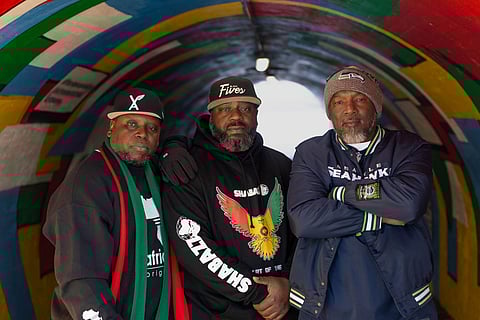
After 30 Years, Black Anger Returns on Seattle Hip-Hop Compilation

It's been nearly 30 years since Black Anger, the seminal underground Seattle hip-hop group, put out any music. But that changes today, Feb. 20, when the compilation album "Two-Oh-Sicks" is released.
The Seattle nonprofit 206 Zulu is behind the recording, which celebrates the organization's 22nd anniversary. The nonprofit has released previous compilations highlighting notable figures in PNW hip-hop for its 10th and 15th anniversaries. This one comes a couple years after the big 20th because executive director and co-founder Khazm Kogita didn't want to rush.
"We're just trying to raise awareness for the greater communities to be aware about some of these artists," Kogita said.
There are 15 local artists, including Kogita, who performs under King Khazm, and Black Anger, who contributed tracks.
"A lot of these artists are kind of reflecting a lot of different sections of the hip-hop community, past, present, and future," Kogita said.
Black Anger represents the earlier days of Seattle hip-hop. Kindu Shabazz, his brother Sayeed, and their friend Asim Hashim, better known as E-Real, formed the group as teenagers during the 1990s in Tacoma. Eventually, they broke out in the Seattle scene and signed with Olympia's K Records, which was the label of indie artists Beck and Built to Spill.
"We performed so much that we never had time to actually record a full-length album because we were always getting ready for shows," Hashim said. "We were really interested in staying in the forefront and giving people the dopest stage show that we could possibly give them."
The trio went on to open for hip-hop legends like Run-D.M.C., the Fugees, and Raekwon from Wu-Tang Clan. They played shows across the region, up in Canada, down in Portland, out in Walla Walla, and over in Boise.
Their last "official" show was in 2000. Kindu and Sayeed moved to Virginia while Hashim stayed in Tacoma. Throughout the past couple of decades they've reunited on occasion, but never got back in the studio.
But when Kogita invited the group to contribute something to the compilation he was producing for 206 Zulu, they jumped at the opportunity.
"We watched these kids grow up because they were coming to our all-ages shows when they were in high school as teenagers," Hashim said. "They always gave us so much love and support."
The group recalls Kogita being at almost all of their all-ages shows and, years later, how he told them that they were part of the reason he was inspired to start a Universal Zulu Nation chapter in Seattle. The national organization is dedicated to fostering the original values of hip-hop and the core elements of the genre like DJing, MCing, breakdancing, and graffiti.
Sayeed explained that the group came up listening and appreciating old school hip-hop artists like The Sugarhill Gang, Grandmaster Flash, and The Furious Five.
"How we perform is what hip-hop is supposed to be, not so much of recording music and releasing music and selling music," Sayeed said. "Hip-hop is live, that's the essence of it, and we kept that tradition."
The trio was committed to embodying the values of hip-hop, focusing on showcasing their craft through their live performances, something they think rubbed off on other upcoming artists around them.
"Seattle hip-hop is conscious hip-hop. I say it's thought-provoking hip-hop," Kindu said. "They're talking about community, the political awareness is there."
It's why they chose a specific song for the compilation. "Big Shout" is a nod to all their fans and the people who've embraced them across the country. It's also a track that gets people moving.
"It's emblematic of Black Anger and what we do when we do our live shows, like you feel that energy when you hear the song, when the beat comes on," Hashim said.
It's one of hundreds of songs the group hasn't released. Despite not being active and not having released much music, their impact on the local scene is clear. In 2007, the group reunited after being asked by local artists Blue Scholars to perform at their record release show.
"They wanted to pay homage to us, because they felt like, 'We learned how to do this thing and do it right from you guys, and we want to bring y'all to open up for us up here,'" Sayeed said.
All three members remain busy in various hip-hop capacities: Sayeed still DJs and produces local artists in Richmond, Kindu has been championing hip-hop education, and Hashim plans to record and release new music within the next year.
They reunited last week in Richmond to film a music video for the compilation track. It'll premier at the Feb. 20 show, since they can't all make it out to perform. It's their first official music video and something they hope can give audiences a little taste of their live performances.
"It feels really good to have done all this work in Seattle, and then to constantly be honored for it," Hashim said.
The Emerald's arts coverage is supported in part with funding from 4 Culture and the City of Seattle's Office of Arts & Culture. The Emerald maintains editorial control over its coverage.


No Paywalls. No Billionaires. Just Us.
We're building a newsroom rooted in community, not corporate backing. Help us raise funds to hire our first-ever full-time reporter and grow our capacity to cover the South End. Donate today.
