
The Green River Killer Murdered Dozens of Women. A Photographer Aims to Remember Them.

Content Advisory: The following article contains references to violence against sex workers and sex trafficking of young people.
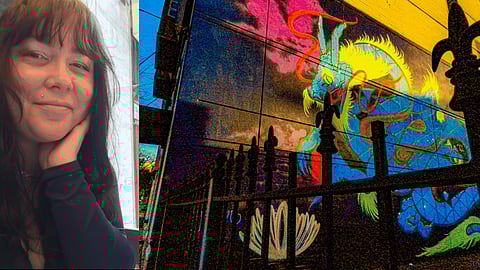
Laura LeMoon never planned on becoming a photographer, but she thought visual images might help people understand a difficult topic: violence against sex workers. Specifically, LeMoon focused her lens on locations where victims of serial killer Gary Ridgway were found or last seen. Over the course of four years, she visited spots throughout the Northwest, from the shores of the Green River and areas in Kent, Auburn, and Federal Way to North Bend, Maple Valley, Enumclaw, and even south of Portland, Oregon. All told, her journeys resulted in 49 photos.
The photos make up "What the Earth Knows," a new exhibit that opened March 3 at Lottie's Lounge in Columbia City. On Saturday, March 7, LeMoon — artist, writer, and now photographer — will be on hand for an artist talk.
She describes the images as "a series of landscapes in negative space," and the impetus to take photos of dozens of scattered sites was personal. "What inspired the show is my experiences as a sex worker with violence from the system, the institution," LeMoon said.
"I think in many ways, there's always been somebody out there who's trying to kill us," she said. "It just happened that once there was a guy who was convicted of killing 49 women, maybe 100 in reality, but there's always people out there trying to kill us every day. And they do frequently."
Ridgway, also known as the Green River Killer, is one of the country's most notorious serial killers. He evaded arrest for nearly two decades, causing one of the longest and largest serial murder investigations in U.S. history. After his arrest, Ridgway admitted he targeted women he thought were "prostitutes" because he believed "he could kill as many of them as [he] wanted without getting caught." Now near the end of his life, he receives palliative care in the King County Jail. Three women who are still missing — Kassee Ann Lee, Kelly Kay McGinnis, and Patricia Ann Osborn — and listed on the King County Sheriff's Office Green River homicides investigation website are presumed to be Ridgway's victims.
LeMoon has been doing sex work for almost two decades, which she does in addition to a regular nine-to-five job. A nine-to-five, she says, can be inflexible and difficult to manage, particularly due to her mental-health disabilities. "There's a lot of discrimination — I have been fired multiple times because of my writing, my articles, and because of my support of adult consensual sex work," she said.
LeMoon entered sex work at 18, after she was trafficked in New York, because, she said, the work felt familiar. Some of Ridgway's victims were underage, which meant they were considered victims of sex trafficking, a separate class of victim from the sex workers Ridgway said he targeted. Wendy Coffield, who was 16 at the time of her death, is believed to be Ridgway's first victim.
"A lot of the girls Gary Ridgway killed were of lower income, so poverty and other factors like generational trauma, racism, sexism, transphobia exacerbate the potential for exploitation," LeMoon said, adding that the girls had been in the child welfare system, which failed to protect them.
In 2024, the National Foster Youth Institute found that 60% of child trafficking victims interacted with child welfare services at some point in their lives. The National Network for Youth's website states that 1 in 5 runaways and homeless youth are a victim of human trafficking and that 68% of youth who had either been trafficked or engaged in survival sex had done so while homeless.
"People don't realize how little rights children have," LeMoon said.
Jaelynn Scott, executive director of the Black trans feminist organization Lavender Rights Project and recently announced candidate for the 37th Legislative District, Position 2, said that at the time of Ridgway's murders, the people he targeted didn't have lawmakers, concerned community members, or others empowering them to organize to protect themselves. Scott said the best way to protect sex workers from gender-based violence is legislation that aims to support them. "It also means being very careful with deals that aim to catch people who cause harm but put people who do sex work in further harm's way because our justice system is not fair."
According to information from the Yale Global Health Justice Partnership and the Sex Workers and Allies Network (SWAN), there is no evidence that indicates criminalization of sex work functions as a successful deterrent to buying or selling sex. Instead, evidence suggests that partial or full criminalization of sex work makes the industry more dangerous by driving sex workers into more isolated locations and impeding the use of harm reduction strategies. It increases risk of exposure to HIV and other sexually transmitted infections. Criminalization also makes it more risky to report violence and abuse from clients, managers, and law enforcement, as sex workers fear they will incriminate themselves.
"The best people to come up with the solutions for sexual violence, violence against women, missing and murdered women of color, are people who have been survivors, their families, and the community that loves them," said Scott.
In the meantime, LeMoon said sex workers will always continue to stick together, protecting themselves and one another: "What I know of my community is that we do have each other's backs regardless of whether there's a Gary Ridgway out there or not."
"What the Earth Knows" is on exhibit at Lottie's Lounge. An accompanying artist talk will take place on Saturday, March 7, from noon to 2 p.m.
The Emerald's arts coverage is supported in part with funding from 4 Culture and the City of Seattle's Office of Arts & Culture. The Emerald maintains editorial control over its coverage.


No Paywalls. No Billionaires. Just Us.
We're building a newsroom rooted in community, not corporate backing. Help us raise funds to hire our first-ever full-time reporter and grow our capacity to cover the South End. Donate today.
