
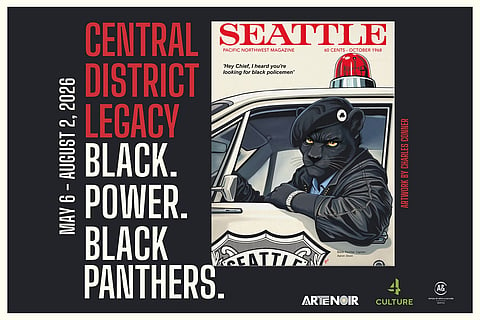
REVIEW | Arte Noir Exhibit Gives Seattle's Black Panthers 'Their Flowers'

Nestled in Midtown Square at the busy intersection of 23rd Avenue and East Union Street, Arte Noir has served as a hub for Black artistic, educational, and cultural power in the Central District for five years. The gallery and gift shop's current exhibit, "Central District Legacy: Black. Power. Black Panthers," reaches beyond widely recognized aesthetics of Afros, raised fists, and smooth black leather garb to include direct quotes from people who lived through decades of change and evocative artwork from Black artists across the country. The show, which runs through Aug. 2, highlights the history of the Seattle Black Panther Party and honors the organization's legacy as both an architect of community in the 1960s and an enduring cultural force within the CD.
Like most Black innovation, Seattle's Black Panther chapter was forged by necessity: Throughout the late 1960s and '70s, chapters of the Black Marxist-Leninist organization sprouted in response to nationwide Jim Crow laws that persecuted Black citizens with practices such as redlining in cities. While the flagship organization held rallies and gave speeches focused on building economic and political power, Black Panther principles in praxis supported all aspects of Black life. Local chapters were an embodiment of community survival, providing armed protection from white supremacists, education, and food to families.
The Panthers' presence also helped to create pressure that forced Seattle's white establishment to grant more equitable access to public life, "turning the CD into a community of cultural, political, and human vitality. Our unity defeated segregation!" explains Leonard Dawson Jr., a Central District elder, in a quote featured in the exhibition.
Contributing visual artist Toni Toney, who is based in Montgomery, Alabama, spoke about the inspiration behind her work in the showcase and her gratitude that the curation effort for the exhibit stretched nationwide. She relished the opportunity to submit to "Black. Power. Black Panthers" after immersing herself in the culture of Oakland, California, several years ago, where the first Black Panther Party chapter was founded in 1966.
She shared, "Several aspects of their work spoke to me as an educator. The government doesn't give [the Panthers] credit for starting the Free Breakfast For Children program. I wanted to educate visitors to the exhibit and give the Panthers their flowers for having the foresight to create [something so valuable]."
Her mixed-media piece depicts a Black youth eating at a table, with a poster for the Free Breakfast for Children program in the background. Toney also enjoys incorporating subtle digs and Easter eggs into her art. "I used security envelopes on the background of my collage as a jab at the government's effort to 'protect' [their Black citizens]," she shared in a phone interview with the Emerald.
"Black. Power. Black Panthers" features select quotes from lifelong CD residents that describe the group's impact on Black life in the CD, along with eye-grabbing visual art in various media, to evoke themes of a Black American consciousness united in struggle and strength, with an unwavering emphasis on self-determination.
The exhibit shows that the fight against gentrification is equally a fight against the erasure of a people, community, and culture. Its lessons "couldn't be timelier," said Marcus Mitchell of Arte Noir, "with the housing crisis and displacement of majority Black families from the CD." He added that "people are often surprised when they visit [Arte Noir], they don't think there are Black people in Seattle. But there's so much art, culture, and music here. Seattle is home to some of the greatest Black musicians [like Quincy Jones and Jimi Hendrix]!"
In words featured in the exhibit, Daudi Abe and Stephanie Johnson-Toliver give assurance that the CD's Black legacy will live on. According to Abe, "parks, landmarks, community, and determination ensure [the CD] will always have a Black presence." After all, "the eternal soul and essence of our Blackness reside here," says Johnson-Toliver.
"Central District Legacy: Black. Power. Black Panthers" is on view at Arte Noir through Aug. 2.
The Emerald's arts coverage is supported in part with funding from 4 Culture and the City of Seattle's Office of Arts & Culture. The Emerald maintains editorial control over its coverage.


No Paywalls. No Billionaires. Just Us.
We're building a newsroom rooted in community, not corporate backing. Help us raise funds to hire our first-ever full-time reporter and grow our capacity to cover the South End. Donate today.
