
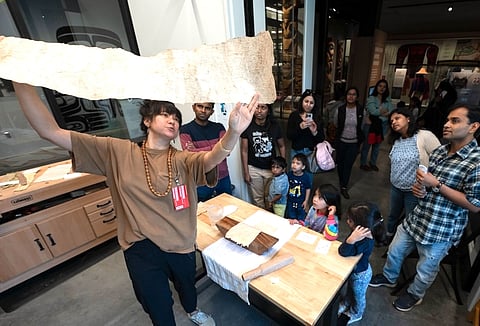
South End Artist Malia Peoples Makes Kapa for a New Generation

For the last four years, South End-based artist Malia Peoples has familiarized herself with an ancient practice: making kapa. Kapa is a traditional Hawaiian cloth made from processing the inner bark of the wauke plant, indigenous to the subtropical regions of mainland Asia. The plant was brought to Hawaiʻi by early Polynesian settlers thousands of years ago.
Traditionally used for bedding, clothing, and ceremonial items, kapa can be made to be warm, durable, and water-resistant. These days, Peoples blends custom with modernity by using traditional techniques for making kapa to create contemporary articles of clothing in her attempt to make the practice accessible to BIPOC communities and to share its healing power.
"There's a kihei, which is a cape, also pāʻū, which is a skirt, and that would be for hula. There's also a malo, which is a loincloth for men. They've also used kapa in burial practices and even in birthing practices, like catching the baby when it comes out," said Peoples.
Peoples will share the art of kapa making with attendees at What's Good Fest in Hillman City on Aug. 8 and at the Othello Park International Festival on Aug. 9. (Editor's Note: The South Seattle Emerald is a sponsor of What's Good Fest.)
Peoples, who identifies as Indigenous, is Kānaka Maoli (Native Hawaiian), Hakka American, and white. She is the Indigenous Pasifika storytelling artist in residence at Hummingbird Indigenous Family Services in Columbia City, and, through funding from 4Culture and Artist Trust, Peoples offers free demonstrations, workshops, and stamped art-making activities for all ages at street fairs, libraries, museums, and other community gathering spaces.
Currently, kapa is used less for everyday clothing. "I haven't found a way to make everyday wearable pieces. Someone approached me one time and was like, 'Hey, can you make a pair of board shorts?' and that's not what this would be about. It's not the appropriate fabric for extended use in the water," Peoples said. "[Traditional kapa makers] had techniques that I have not learned on my journey yet for making it water-resistant."
Instead of shorts and shirts, Peoples prefers to make other modern things out of kapa, like bucket hats and scrunchies.
"Right now I've been exploring headwear a lot since I'm obsessed with hats, because my hair just doesn't do what it needs to do here in Washington state. Also, other modern things like scrunchies or anything that people can connect with and trace back to our older practices. I'm trying to open doors with these more modern, nontraditional forms," said Peoples.
Peoples said she's come across others who don't understand or support her style of kapa making, who argue that the practice should remain closed and as traditional as possible.
"It's complicated because there are a few different groups of people I've come into contact with over the years, and some [believe] we must keep it traditional. We must keep it hidden and protected. We must control who practices and who tells people about this practice."
Peoples, however, belongs to a different camp who want to revitalize the practice and share it with the world. "Let's move it forward. Let's do new things with it. Let's encourage things like perhaps someday turning it into an industry again, because it was a large industry historically for our people," she said.
This article is published under a Seattle Human Services Department grant, “Resilience Amidst Hate,” in response to anti-Asian American, Native Hawaiian, and Pacific Islander violence.
The Emerald's arts coverage is supported in part with funding from 4 Culture and the City of Seattle's Office of Arts & Culture. The Emerald maintains editorial control over its coverage.


Editor's Note: This article was updated on Aug. 7 to include photo-credit information.)
No Paywalls. No Billionaires. Just Us.
We're building a newsroom rooted in community, not corporate backing. Help us raise funds to hire our first-ever full-time reporter and grow our capacity to cover the South End. Donate today.
