
Zia Mohajerjasbi on 'Know Your Place' and a Changing South Seattle

Zia Mohajerjasbi, a Seattle-based Iranian filmmaker, has made a career creating music videos for the likes of Macklemore, Gabriel Teodros, and more. Mohajerjasbi wrote and directed the award-winning short film, Hagereseb, about a 10-year-old Eritrean boy named Abai who searches for batteries for his Casio keyboard. Abai wants one final music lesson with his older brother before the brother is sent back to Eritrea indefinitely.
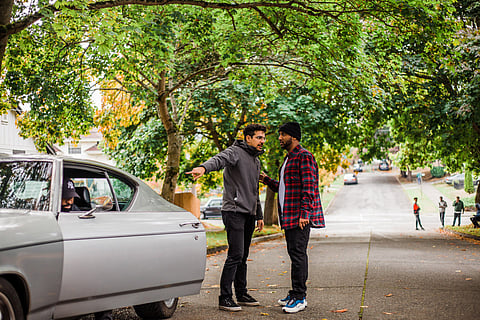
In 2022, Mohajerjasbi premiered his feature debut, the award-winning Know Your Place, which screened at the Seattle International Film Festival and the then-Ark Lodge Cinema in Columbia City. The film follows a young Black teenager as he journeys throughout a changing city to deliver a package.
Now, four years later, Know Your Place returns to the South End to screen in the same historic building where it was shown years before, this time at the Tasveer Film Center on Aug. 6.
Mohajerjasbi agreed to take a walking tour in the Central District, starting at Central Cafe and Juice Bar across the street from the now-closed Tana Market. The route included stops near 26th Avenue South and East Alder Street, 27th Avenue South and East Yesler Way, 26th Avenue and East Cherry Street, and more. Along the way, he spoke about making "Know Your Place" and the places that became a central focus for the film.
This interview has been edited for length and clarity.
Why is telling stories such as this important to you?
Zia Mohajerjasbi: When I was 6 or 7 years old, my dad took me to see The White Balloon by Jafar Pahani at the Seven Gables Theater. That film was the first I'd seen in Farsi, the language we spoke at home. It was so of the world as it was lived; the stakes are relatable, the anxieties of the kids are relatable, the way the elders talked sounded exactly like family. The confluence of all this gave me the realization that people made films. I get that seems obvious, but hear me out: I was 7. Up till then, my favorite movies were Pete's Dragon, Mel Gibson's Hamlet, The Wiz, and The Dark Crystal.
Anyway, I had this profound realization watching The White Balloon that someone else, not in the images, not in the story I was looking at, was also saying something. Something was being done by humans not pictured that also made the film what it was. And I was like, "Yup, whatever that is, I wanna do that." I think about that film all the time. The stakes aren't anything more, anything bigger, or exaggerated than life's own terms. It really is one of the cornerstones that shaped how I thought about the story for Know Your Place.
What is your relationship to Seattle?
ZM: Seattle is home. I love the Pacific Northwest. I love trees. I love the rain. As the climate catastrophe accelerates, I honestly wish it rained as it used to. Nothing is frozen in time, and as a city, Seattle feels like a stark example of that. As a filmmaker, I might take a snapshot in my mind, somewhere to anchor a scene in a neighborhood on a particular day, when the light looked a certain way, or when structurally something became clear in a script and then you work to realize that vision of whatever the thing is, but by the time you bring that into the world, the thing you pictured is already different. The building on the corner is gone.
The season has changed, so the light is entirely different. The people that lived on that block all moved, and developers have their sights set on putting up … wait for it … a mixed-use six-story building with corrugated metal siding and colorways that feel as if they were picked by placing a Roomba on the floor and going with the first three color swatches it touches. Life is just like that, and I feel like how I experience the city is constantly evolving. Contracting, expanding, shifting.
Many of the third spaces I used to frequent have gone away; people have passed away, moved elsewhere. The way folks gather, or not as much, has also changed. So my relationship with the city feels a bit different now. I feel less anchored in any one area.
You film at all these locations; the abandoned building, the grocery store, the building with estate sale, etc. What is the significance of those buildings, and why did you feel like it was important for you to film there?
ZM: Some of the spaces that weren't abandoned in the film are abandoned now. Tana Market on Cherry? That was a busy spot, and the owners permitted us to shoot during regular business hours when customers were still coming in and out. Now that whole building's boarded up, slated for redevelopment.
To me, an abandoned building is a signifier of so many things about place, and of people, and the workings of systems — often to harmful effect. Where is the building in question? What kind of building is or was it? Did people used to live there? Who used to live there? What or who is there now? Who gets to be there when it becomes something new? Why do some people get to stay and others have to go? Who matters? Who says who matters?
Why is it important for the South End/CD to be the central focus of your film?
ZM: I feel like stories are intrinsically tied to place, and my own experience of Seattle was profoundly impacted by the community I found through Hidmo in the early 2000s at 20th and Jackson. My homie/sister, Rahwa Habte, owned and ran that spot. Hidmo felt like the crossroads of the whole city. It was an Eritrean restaurant doubling as a community space where, on the surface, you might stop by for lunch, but actually connect with folks from all parts of the city, meet up with friends, make new ones, scheme on art, and be in community. What Rahwa offered through Hidmo was truly a gift to the city during those years.
Moving from the North End during undergrad to Beacon Hill, and spending the majority of my time with friends in the CD and at Hidmo, specifically, it felt like finally feeling seen. That was incredibly important for me as a filmmaker: to feel a part of and connected to my city and people around me in a way that reflected how I wanted to tell stories and what stories I was interested in telling.
Why is bringing the film back to the South End so important?
ZM: So many of our cast members and locations are South End-based. With Tasveer reopening a cinema in Columbia City, it's exciting to have a venue to share the film, in its theatrical format, where it was largely made. We rehearsed on Beacon Hill, filmed several scenes just off Rainier, and many of our cast members are South End residents. For a film that is so rooted in place, it feels like completing the circle to be able to show it locally to audiences who call this part of our city home.
The Emerald's arts coverage is supported in part with funding from 4 Culture and the City of Seattle's Office of Arts & Culture. The Emerald maintains editorial control over its coverage.


No Paywalls. No Billionaires. Just Us.
We're building a newsroom rooted in community, not corporate backing. Help us raise funds to hire our first-ever full-time reporter and grow our capacity to cover the South End. Donate today.
