
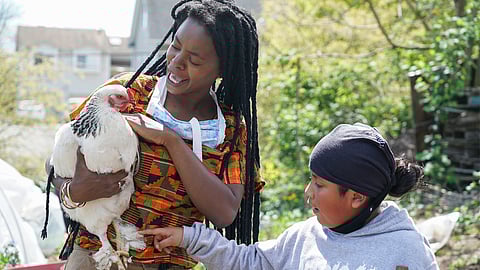
South End Groups Provide Food and Farming Opportunities for Youth

In recent years, Seattle's South End has seen an uptick of organizations seeking to return to the land through culturally specific farming, food preparation, and food distribution, amid an economy rife with food insecurity. Among them are those focused on bringing younger generations with them — including Young Women Empowered (Y-WE) and Nurturing Roots, which create opportunities for teenagers and young adults to work on the land itself, as well as Dope Culture LLC, which creates opportunities for young people to work in a kitchen. In 2025, these three organizations received a boost to their work through the Seattle Department of Neighborhoods' Food Equity Fund, which gave 18 community-led groups awards of up to $100,000 each "to advance projects that increase equitable access and opportunities to grow, learn about, and/or eat healthy, affordable, and culturally relevant foods." (The Food Equity Fund recently announced that in 2026, $1.45 million in funding will be shared by 23 groups, including Y-WE and Nurturing Roots.)
Dope Culture is first and foremost an events production company, but since 2022, Dope Culture's CEO, Anthony Tibbs, has shifted his events production experience to host a monthly pop-up at Langston Hughes Performing Arts Institute called Community Soul Feed. The event provides free food; services, such as haircuts; and other resources local community members need, such as donated clothing. Though the event is hosted out of a Black cultural space, all are welcome.
Tibbs shared that he has been doing similar work for a long time, in part inspired by work his father used to do at the kitchen in the Randolph Carter Family and Learning Center, a Catholic community service center in the Central District. From a young age, Tibbs' first summer youth program job was with his dad, and they provided lunches for community centers. At the end of their shifts, they would bag up any extra food and give it away to those in need.
Now, the Community Soul Feed also includes a component called Young Life, which creates space for young people to learn about food. Tibbs' wife, Shantell Tibbs, creates the curriculum and teaches a small cohort of youth who now receive a small stipend for participation, thanks to the Food Equity Fund, through which Community Soul Feed received $99,850.
"We focus on unhoused people's families, and then we kind of zeroed in on a lot of our youth," Tibbs said. "We teach them how to clean food, how to shop for the food, food safety, how to store the food, how to prepare the food [and] serve it."
Part of the impetus for creating Young Life was that the Community Soul Feed naturally attracted a lot of unhoused youth, and Tibbs saw a need to teach them on a deeper level.
"We find them, just in the neighborhood, in the streets, and [through] word of mouth," Tibbs said, noting that he used to live in a low-income building alongside many youth who expressed interest in the event. "I'm like, 'Hey, come on. We got some resources. We got some socks for you … get your good, clean haircut and get a hot meal. You don't have to worry about anything. … Everything is free.'"
While Community Soul Feed is based out of an enclosed space, Nurturing Roots and Y-WE work more directly with the land itself. The bulk of Nurturing Roots' programs are centered around food, gardening, environmental justice, and wellness, while Y-WE also has a host of programs in arts, culture, and other activities; its environmental justice portion is but one aspect of its larger programming.
Workforce development has recently become a central focus of Nurturing Roots' work. Its new workforce training program, Future Food Systems (FFS), will educate young adults ages 18 to 22 to "explore unique and underrepresented careers in the local Seattle food system," according to Nat Mengist, development coordinator. The program is supported by $85,260 from the Food Equity Fund.
"In addition to food producers and distributors, these careers will include but are not limited to: commercial composting facilities, wastewater treatment centers, greenhouses and nurseries, vertical gardens, community kitchens and sustainable restaurants, nutritionists and dietitians, and even holistic health practitioners," Mengist continued in a written interview with the Emerald.
Nurturing Roots began FFS due to requests from former participants of its "Know Your Roots" (KYR) program. KYR is a 10-week advanced food justice program for high schoolers that centers racial justice. Through workshops, field trips, job shadowing, and more, the KYR program covers everything from food apartheid to food sovereignty. FFS fulfills a need from graduates of KYR who desire to become even more involved.
"We hope youth will gain more passion for promoting racial justice and confidence to pursue new careers in the local food economy," said Mengist. "We will encourage participants to ask questions like, 'How might we further embed culturally-sustaining food into the local Seattle food system?' and 'How might we generate funding streams for ourselves to fill gaps in the food system?'"
Justice is also a focal point of Y-WE's work. Through its GROW program, the nonprofit offers three free farming and food justice programs for youth in their teens and early 20s, based out of Marra Farm in Seattle's South Park neighborhood. Two sessions take place during the school year, and one summer internship provides deeper training for fewer individuals. All of the programs are supported by $96,500 through the Food Equity Fund.
According to Y-WE's Environmental Justice Programs Coordinator Lara Ruegg, each session has a different focus that is aligned with the season. In spring, the youth prepare the garden for planting in the following year; in summer, the group learns about gardening practices, facilitation skills, and environmental education; and in fall, the larger group works together to reap the benefits of all that was grown during the summer and start putting the garden to bed for the winter.
But while the program gets youth's hands in the dirt, it's not all hard work, and the quantity of food the youth "produce" is not important. The program facilitators say that showing up is enough.
"A lot of the things that we do have to do with herbal medicine — what the Earth can teach us, and … checking in with our bodies, checking in with the space, [and] feeling grounded in the space," Ruegg commented, adding that the youth sometimes even take naps in the garden. "A lot of times, we'll just kind of wander through the garden and ask the kids, 'What do you think we need to do today?' and [do] whatever is drawing them. … Sometimes there are things that are kind of pressing, but no one's drawn to them," Ruegg continued, "so we just kind of let it sit for a while."
18-year-old Anelalani Auwae Dekker has been involved with GROW since 2020, but grew up with siblings in Y-WE's programs beginning as early as 2014. Joining the program during the COVID-19 pandemic allowed her to find a deeper connection to the land, food, and to an overall sense of justice.
"I feel a lot more comfortable now growing my own food and harvesting it and eating it rather than going to the grocery store," she commented. "I learned a lot about environmental justice and environmental racism and how that's affecting the produce here too, and the wildlife here. I think that's really valuable to me and how I go about what I'm going to do with my connection in nature next."
Born and raised in Seattle, high school senior Gabriella Peredo has been joining Y-WE programs since the summer of her eighth-grade year. Participating in GROW has allowed her to continue a family legacy of gardening, become friends with a more diverse friend group, and understand farming through an environmental justice lens.
"I found that environmental racism and environmental justice isn't exactly a topic that you get to learn about unless you choose to learn about it, and [it's] something that a lot of people should be learning," commented Peredo. "When I first entered here, I saw a lot of diversity. I realized that Y-WE's mission is to have inclusive spaces for young people, specifically our young people who are minorities and they don't get as much of a priority compared to other kids."
What success means is different for each organization — and feels different for each participant.
"We are thinking of success for this project as meaningful and specific benefits for youth who experience the most food, health, and economic disparities," said Mengist of Nurturing Roots. "Some quantitative indicators of participant success we are interested in include the percentage of participants reporting increased career confidence and increased interest in local food systems careers; we also hope to track job placement outcomes and increased professional networks through both self-reports and growth on LinkedIn."
Nurturing Roots plans to host regular virtual office hours in the future, in order to offer continuing guidance to participants after they have left the program and move into the workforce development process.
Ruegg of Y-WE comments that the success of GROW can be seen in the number of youth who return year after year, as well as the way the program grows through recommendations and word-of-mouth.
"Last week, we did a beautiful gratitude circle where they were talking about how much they appreciate the land and how much they appreciate the water … so that's the success for me," said Ruegg. "And just hearing some of the folks that keep coming back year after year. They're so excited to share about the things that they learned in previous years."
For Tibbs, the idea of people coming back to assist with Community Soul Feed is also a marker of success. Two of his former youth volunteers are now close to 18 and go to the University of Washington, but they still return to help serve, volunteer, or even do their homework in the shared space. Other stories of Community Soul Feed's impact come from those that they serve.
"I've had families out of the tiny homes community come back and tell me how much it meant to them that they depended on [Community Soul Feed]," Tibbs shared. "They thought it was a big deal that they got to come over there once a month, bring the whole family, and not have to worry about anything. They knew it was always a hot meal, and they knew we were going to be there."
For youth participants, these programs help them gain insights into their future prospects as well as help them reflect on their own lives.
Peredo, who has been a Y-WE GROW intern three times, shared, "Growing up … we didn't have a lot of money, so I remember as a child volunteering at the food bank with my brother. That's how we got food. … As I got more involved in this program, I felt I learned more about how important it is to get your nutrition and the significance of what fresh produce can really offer people."
"Since there's no grocery store in South Park in the summer … we have a specific mission to donate any food that we can to South Park," she continued. "That made me realize that what I want to do in life is help people. … Y-WE is really what inspired me to get into that."
The Emerald's environmental reporting is funded in part by the City of Seattle's Environmental Justice Fund.

No Paywalls. No Billionaires. Just Us.
We're building a newsroom rooted in community, not corporate backing. Help us raise funds to hire our first-ever full-time reporter and grow our capacity to cover the South End. Donate today.
