
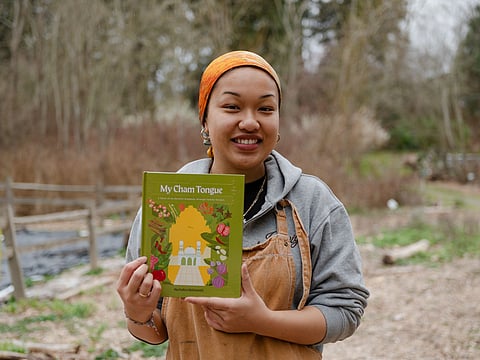
In a New Cookbook, Author Nurhaliza Mohamath Serves Up Cham Cuisine and Culture

Ever since Nurhaliza Mohamath was a child, she has been collecting family recipes. "When I was really little, and I'd be at my grandma's house, I would follow her around the kitchen, draw the different things that she was making, and [afterward] I had a little cookbook," she said.
Mohamath, whose family owns Salima Specialties, a halal restaurant in Skyway that serves Pan-Asian street food, comes from a long line of people who love to cook — and to eat. In an act of cultural preservation, Mohamath offers her new cookbook, My Cham Tongue, to her community and to the world.
"I think food is such a huge part of everything — whether it's history, culture, learning, politics, or liberation," said Mohamath. "As a Cham person, this is something that I wish that I had when I was growing up, so there's a big part about this that is educating our youth about where they come from."
My Cham Tongue is a two-part experience. It opens with a condensed history of the Cham ethnic group in Cambodia, including the regions the Cham people occupy, their languages, and some cultural customs. The book's second half is a compilation of 10 recipes of authentic Cham food, complete with photographs.
Mohamath says the idea for My Cham Tongue came one day in 2021 while she was helping out at her family's restaurant. "Pan-Asian street food is accessible and easy for people to get introduced to the Cham community, but a lot of the dishes at Salima's aren't Cham foods. It's teriyaki, it's phở, it's nasi goreng; it's cultural influences of Cham food, but a lot of these are not really at the core of Cham cooking," said Mohamath. "That was the thesis question that really started this project — 'What really is Cham food?' — and [finding the answer to] that set me on a journey."
Mohamath started creating with no clear vision for the project. "I didn't really think it would be a cookbook, but it turned out to be," she said. "I thought it was going to be a digital format kind of thing."
All Mohamath knew for certain was that she was on the brink of making something that could become a useful tool. "I realized this is something that could be really important for my family, my community, and it hasn't really been done before," she said.
"The book pulls you into a deeper story — it's not just food. This is me documenting an existence of a people," Mohamath said. "In this day and age, people don't know that the Cham community even exists or what our culture is."
Mohamath chose to begin the cookbook with a condensed history of the Cham ethnic group. The lack of visibility of the Cham community can be tied to the Cambodian genocide, which was uniquely devastating for the Cham community.
"When any sort of world disaster happens, minorities get hit first," Mohamath explained. "The Khmer Rouge genocide killed millions of people, Cambodian Khmer people included, but because Cham people were a Muslim ethnic minority, we were disproportionately targeted by that genocide. Millions of Khmer people died, but the majority of the Cham population … bloodline-wise, were executed and ethnically cleansed."
Mohamath says that despite her being born two decades later, that history is a part of her, a part of her identity she can neither strip away nor forget.
"I think it's written in my DNA. It's something that is passed on. It's like when we think about the Vietnam War and [that being] the reason that there are so many Southeast Asian refugees in America — but people don't know that Cham people were almost wiped out, and that also was such a huge part of history. People forgot about Cham people in the entire conversation of global history," said Mohamath.
Away from the motherland and decades beyond the violence and death, Mohamath says a lot of Cham people today are thriving in diaspora. "The largest ethnic enclave is here in South Seattle, and there's other pockets of community in Olympia and California. There's a smaller Cham community on the East Coast. There's diaspora in Australia, France, New Zealand," said Mohamath.
"A lot of Cham people are thriving and have a bunch of kids now, and we're at the point now where these kids don't know where they came from. They don't know their culture, they don't know their history, they don't know their language, and they don't know what to point to, to recognize, 'Yeah, I'm Cham!'"
No Paywalls. No Billionaires. Just Us.
We're building a newsroom rooted in community, not corporate backing. Help us raise funds to hire our first-ever full-time reporter and grow our capacity to cover the South End. Donate today.
