
Black Earth Day Gains King County Recognition. What It Means for the South End.

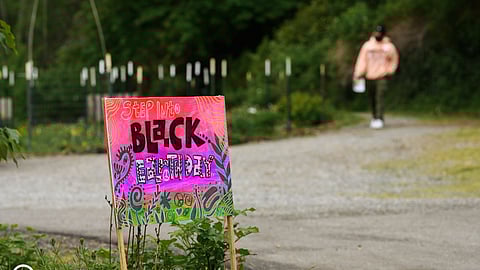
On April 22, 2022, the Urban League of Metropolitan Seattle partnered with Black Farmers Collective and Nurturing Roots Farm to host Seattle's first Black Earth Day celebration at the Black Farmers Collective's small urban farm on Yesler Terrace.
At the time, Nirae Petty — a policy advocate and then-staff member of Urban League of Metropolitan Seattle — was bringing environmental justice into the work taken on by the nonprofit's newly formed advocacy and community engagement team, which she directed. Petty focused her undergraduate studies on the policies of sustainable development and did her own research into "intersectional environmentalism," a phrase coined by environmental communicator Leah Thomas in a 2020 Instagram post that Thomas would later expand into a book.
This helped Petty see how environmentalism "was a very white- and wealthy-led movement that was more focused on planet than people," she said. "And I also knew the underlying erased history of Black people at the forefront of the environmental justice movement." For instance, in the late 1970s and early 1980s, Hazel Johnson in Chicago and Robert and Linda Bullard in Houston educated their communities about the environmental hazards they were exposed to and led campaigns to combat toxic projects. But Petty felt that the impact of those and other Black leaders in the environmental movement remained underappreciated.
So, in addition to incorporating environmental justice into the Urban League agenda, Petty said, "I also wanted to make sure to celebrate and honor the history of the environmental justice movement." With a little discretionary money from the nonprofit's programming fund and support from other Black-led environmental organizations in Seattle, she and her team were able to pull together the first Black Earth Day to celebrate the history of Black environmentalism, educate the community, and get people engaged in Urban League's environmental justice efforts. Those efforts aim to address food deserts, spread awareness of the state-level Environmental Health Disparities Map, advocate for more green spaces in Black communities, and expand access to the outdoors to provide people with all the benefits nature affords (reduced depression, improved sleep, boosted immune system, lowered blood pressure, etc.).
"After that first Black Earth Day," Petty said, "we were able to get more funding to do another one, and hundreds of people showed up." The event has only continued to grow since — even outgrowing the space available at Yes Farm, where the first two celebrations were held — attracting people from across the state and spurring spin-offs as far away as Spokane.
This year, just a few weeks ahead of its fifth annual occurrence, King County Executive Girmay Zahilay officially proclaimed April 18, 2026, as a county-wide Black Earth Day to "encourage all residents to join in advancing environmental justice and building a more just, sustainable, and resilient future for generations to come."
This Saturday, Urban League will host this year's Black Earth Day at Genesee Park in Columbia City, from 10 a.m. to 3 p.m., with a mix of activities and festivities. Out the Mud Gardens will be passing out free plants. A caterer will provide free food. Urban League will host workshops around lead and air pollution, and it will have a reading corner for kids with books about Earth Day and environmental justice. And there will be a mix of other activities and vendors while local musical artist Yohiness curates the mood as the day's DJ.
Though this year is the first time the day has gained official recognition from the county, it has been impacting attendees since it started. "People from all over the state come here to dance, to just be around each other, to get resources, to connect," said Kurt Ragin, director of public health and advocacy at Urban League. Ragin attended his first Black Earth Day before he worked for Urban League, and when he saw all of these other Black and Brown Seattleites coming together for this event, to celebrate the Earth and to celebrate each other, he said, "that was just gorgeous to me. I felt safe."
"The importance of Black Earth Day is [that] it shows and highlights Black brilliance in Seattle," said Nick Jeffreys, a community outreach organizer with the Urban League.
And while it's undeniably important to acknowledge the importance of Black leadership in the environmental movement, added Garrett Johnson, another of Urban League's organizers, "we can't do it alone. The Earth is a community, and we need other communities as well" involved in the movement. So, at the same time it's unapologetically Black, Black Earth Day also makes a point of highlighting and celebrating environmental leaders who come from other marginalized communities.
Given the ability for the event she created to help highlight the contributions of activists and community leaders so often left out of mainstream environmental narratives, Petty appreciates the recognition the event has received from the county, but she's simultaneously disappointed with the wording of the proclamation itself.
"Black Earth Day would not have happened without Black Farmers Collective. It wouldn't have happened without Nurturing Roots," she said, but neither organization was mentioned in Zahilay's proclamation. "There were a lot of frontline community organizers that should have been acknowledged as well with it."
Still, Petty feels honored to have helped kick-start this annual celebration and that it's becoming recognized as a fixture of Seattle's Black community. She just hopes it doesn't become something that's purely performative: "I'm hoping that the outcome of institutionalizing Black Earth Day is that folks start to look at the intersectionality of race and environmental justice."
The Emerald's environmental reporting is funded in part by the City of Seattle's Environmental Justice Fund.

No Paywalls. No Billionaires. Just Us.
We're building a newsroom rooted in community, not corporate backing. Help us raise funds to hire our first-ever full-time reporter and grow our capacity to cover the South End. Donate today.
