
A Columbia City Club Helps Kick Off National Effort to Forge Local Connections

Last year, before Nicole Martin participated in an event called an interdependence relay, she would sit on a bench near the Columbia City farmers market and ask anyone who walked by, “Hey, would you like to meet a neighbor?”
She would get mixed responses, from flat-out rejections to curious looks. But every time she connected with someone, they exchanged emails. Martin went on to create an email thread and bcc’ed everyone a summary of who she met that day and what they talked about.
Martin repeated the process over the course of a couple of months. Now, that email list has grown to over 600 people. Then she created the Columbia City Neighbors Club, which meets monthly for potlucks and hosts other events like puzzle swaps or clothing swaps.
On April 22, the Columbia City Neighbors Club kicked off “Declarations of Interdependence Relay,” a nationwide effort that seeks to connect people. Central to the effort is a large wooden box with 50 cubbyholes that will be relayed, or transported, to a gathering in every state. Once received in a state, residents will fill a cubbyhole with an item that represents their community.
The relay was created by Garrett Bucks, an organizer from Milwaukee, Wisc., to celebrate community and connect people doing similar work across the country. Bucks helps people start their own neighborhood groups.
“Right now, the most important work that's happening across this country is not being done with people with huge platforms,” Bucks said. “It is people rediscovering what it means to be a neighbor.”
Bucks said that the pace of disconnection has grown more rapid and dangerous. He calls it an “epidemic of disconnection” characterized by polarizing political times, social media, artificial intelligence, and the aftereffects of the COVID-19 pandemic.
He said that, at times, people starting this type of work can feel lonely and isolated, so he wanted to come up with a way for people to feel connected and supported, to understand they were part of something bigger than themselves.
“If I could not get a nation of gatherers all in one room together, then I could make the room larger by knitting each of their events together,” Bucks said.
Bucks said that the best moments in U.S. history have been when ordinary people take care of their local community and aspire to build a country that loves everyone. The relay coincides with the 250th anniversary of the founding of the U.S. He decided to start in Washington state and travel east, to counter the notion that the U.S. expanded east to west.
“I'm not proud of the story of how America grew, east to west, in so many ways,” Bucks said. ”This is a deliberate reversal of that, that we're reconnecting in a different way than [when] this country was first connected.”
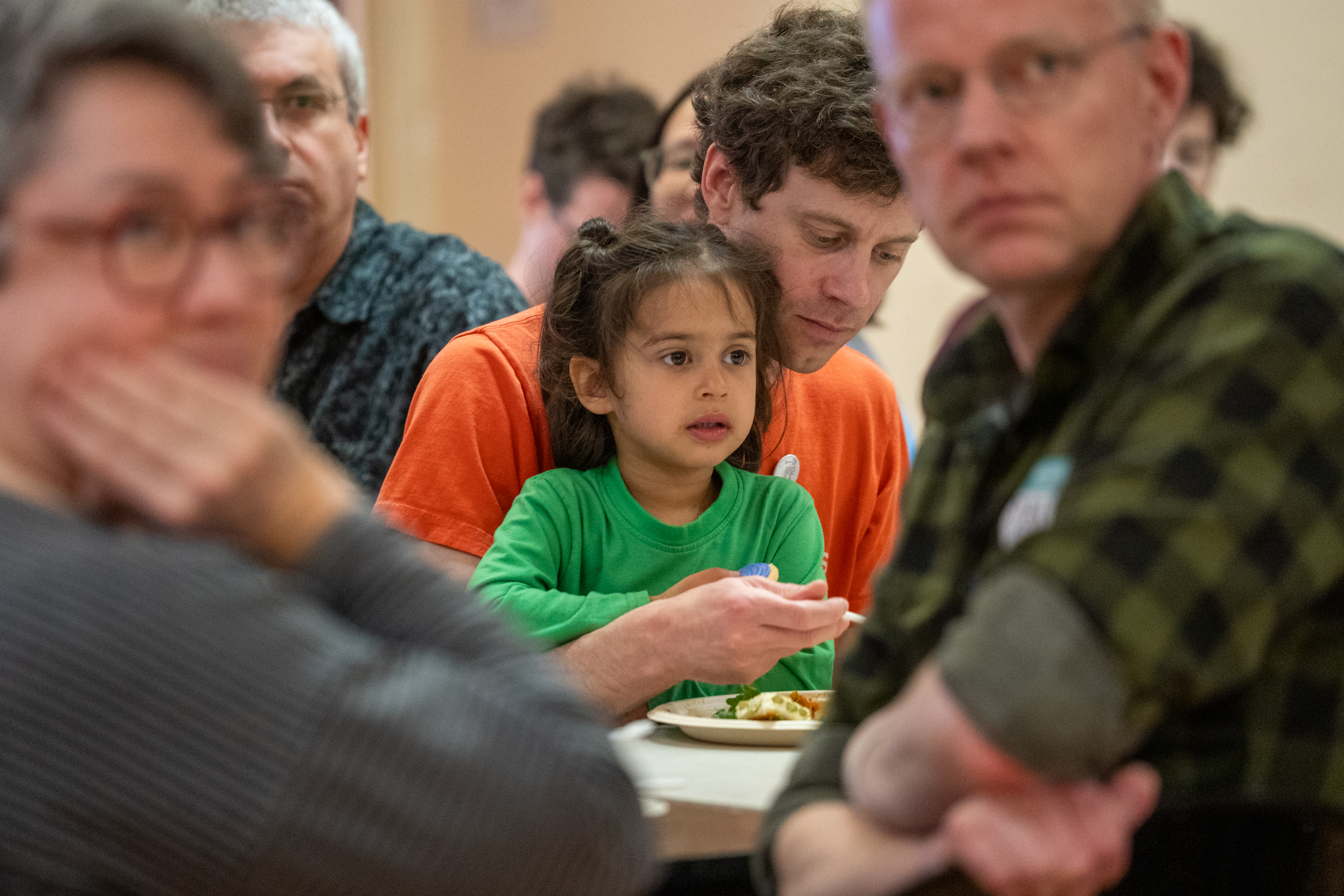
At the relay kickoff, the room buzzed with conversations from a couple dozen people gathered for the Columbia City Neighbors Club monthly potluck, some reconnecting, others meeting for the first time. Kids ran around the room, and neighbors exchanged contact information.
The potluck includes a “community asks and offers” session, where people can share something they need or something they can contribute. People requested tips on how to repair stove hoods and advice on how to take care of a dying plant. Someone offered to share pointers on how to make yogurt. New participants felt emotional about seeing strangers offering to help one another.
“People are really, like, waking up to the idea that we have to care for each other's well-being, and the neighborhood is where we can do it,” Martin said. “Being a neighbor you can do so much together, like when we neighbor together, we have a lot of opportunities to shape our shared future, to recognize our gifts, to recognize the gifts of others.”
The items in Washington’s cubbyhole featured a poem and stickers that said, “I met a Columbia City neighbor today” with an image of a shovel surrounded by plants representing the different ethnic groups living in the Rainier Valley. The illustration is a representation of a statue near the Columbia City light rail station.
Alex Kaehler, from South King County, recently moved to Columbia City because he wanted to live in a walkable neighborhood closer to the city. He said as he’s gotten older, it’s harder to travel far to see friends, so he’s emphasized building local connections.
“We're social animals,” Kaehler said. “No matter how introverted or extroverted you are, you need relationships.”
No Paywalls. No Billionaires. Just Us.
We're building a newsroom rooted in community, not corporate backing. Help us raise funds to hire our first-ever full-time reporter and grow our capacity to cover the South End. Donate today.
