
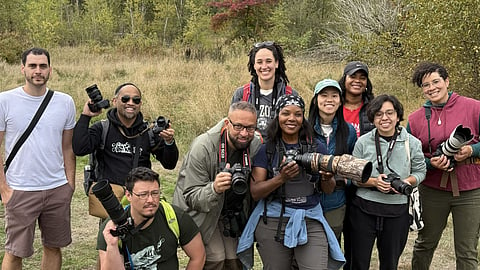
Black and Brown Birders Find Community and Wellness in the South End

SEWARD PARK — On an overcast spring day, a group of Black and Brown birders led by Armand Lucas had finished a jaunt spent spotting aves and raptors along the portion of the Great Washington State Birding Trail that wraps around South Seattle's Seward Park and were returning to the parking lot to depart when a bald eagle plunged into a nearby field, then thrust itself away with wings wide and a flailing form dangling from its talons.
"It's a rabbit!" several of the birders shouted. One laughed in amazement. Another clapped — not at the hare's undoubted horror but rather at the unexpected exuberance of witnessing nature's wonders on urbanism's edge.
"Once in a while we see some unique stuff," Lucas said of the outings he organizes through his group The Urban-Woods Initiative. Once, when his group was out at the Moses Coulee Preserves in Central Washington, "there were some pigeons living out on the cliffs," he said, "and this prairie falcon — and I had never seen a prairie falcon before — came out of nowhere and literally dive bombed these birds."
Between spotting a new species for the first time and witnessing something so startling and dramatic, he added, "I had that moment of 'whoa!'"
Those who partake say the wonder and revelry of birding make it a splendid pastime. The hobby also provides marked benefits for physical, mental, and cognitive health. Time spent connecting to nature is inherently therapeutic, and it also boosts the immune system, lowers blood pressure, improves sleep, and bestows all sorts of other health benefits. Still, for some, the idea of "forest bathing" might on its own sound too gimmicky to engage with. But going out to identify birdcalls, scan rustling branches, track wings fluttering between trees, and occasionally catch the unexpected provides the same benefits, without the stigma. Lucas has experienced this himself. When he appeared in the PBS program Out & Back in 2024, he called birds his "anchor back into the natural space."
Unfortunately, though, as with many outdoor activities, birding has long been inaccessible to Black and Brown people — and has sometimes put them in hostile environments. But today, organizations like Black AF in STEM and Lucas' Urban-Woods Initiative aim to create spaces for BIPOC to experience the joy and beauty of bird-watching.
The Politics of Birding While Black
For most, the murder of George Floyd — and the protests that erupted after the video of his death reverberated through every filament of the social web — dominate their memories of May 2020. Few will likely remember that on the same day Floyd died, a white woman in New York threatened to sic the police on a Black man named Christian Cooper for the supposed offense of requesting she leash her dog, per city guidelines, in one of Central Park's woodland preserves popular among bird-watchers. The video of the incident went viral, and talk of it eventually landed in a group chat called "Black AF in STEM" packed with a hundred or so Black birders and science communicators.
The Christian Cooper incident made many in the group feel, "Oh, it's happening again," said Nicole Jackson, an environmental educator in Cleveland, Ohio. In response, Black AF in STEM grew beyond a group chat into a community organization in its own right, and members directed their feelings around the incident toward getting more representation in birding and related activities, an effort that eventually gave rise to the nationwide Black Birders Week.
Every year, the week has a different theme, and this time round, it was dedicated to Flyways & Freedom, from May 24 to May 30. "So it focuses on the importance of migration and borders," Jackson said. "Nature doesn't have borders, especially when it comes to bird migration." In fact, crackdowns on immigration and the construction of border walls around the world impact wildlife in addition to immigrants, refugees, and asylum seekers. So, this year, "it's about birds and people and how those relationships can better thrive together."
"We all come from somewhere. We're all going somewhere," she added.
Organically Grown Community
While Lucas' group, Urban-Woods Initiative, has a similar goal to Black AF in STEM with its Black Birders Week — to create a space for Black and Brown folks to have safe, comfortable access to bird-watching — its origin story has somewhat less charge.
The excitement of witnessing the predatory impulse of certain birds that Lucas now shares with members of his group was also behind Lucas' obsession with birding when he was a kid growing up in the Bronx.
Think about the soil from which a young birder might sprout, and the five boroughs of New York City's maze of brownstones and skyrises probably won't rise to mind. Yet, one day during Lucas' impressionable youth, while walking around his neighborhood, a red-tailed hawk dove in front of him and struck down a squirrel on the street. Fascination fixed fast in his mind. He was hooked on birds, and with parental support, his fledgling passion grew. "My mom bought me a bunch of bird books," he said, "and she even took me to a bird event in Westchester County."
While Lucas didn't go on to become an ornithologist or some other sort of professional birder, he always kept his love for winged ones alive by volunteering with the Sierra Club and the National Audubon Society, an environmental nonprofit dedicated to protecting birds and their habitats. But birding, for him, hadn't been free of harms, and around the time that Christian Cooper had his "Karen" encounter in Central Park, a pickup truck drove by Lucas while he was out birding, shouted a slur at him, then kept on going, he told KUOW in 2020. The negative experience, however, led to a positive one, because it was through that article that Alison Mariella Désir learned of him and invited him onto Out & Back, he said in an interview with the Emerald. After the episode came out, friends and acquaintances of Lucas reached out to tell him that if he were to start a group and organize bird-watching trips, they'd join. So he did. "It just kind of took off from there," he said.
Since starting in 2024, The Urban-Woods Initiative has organized more than a dozen events through Meetup that have built beyond birding to include herpetology walks, pollinator walks, and even natural photography-focused events. Lucas has even been invited to lead a daylong, youth-focused excursion out to the Skagit Valley through Seattle's chapter of the Audubon Society and its Elevation program to see rough-legged hawks, short-eared owls, and other "winter migrants." And recently they participated in an outing with members of the Muckleshoot Tribe.
Through these events, the group doesn't just provide comfortable space for Black and Brown folks to begin branching into bird-watching and other nature-centric events; it offers an emotionally and intellectually accessible space that hasn't existed before. For most of its history, which focused on discovering new species of birds, naming them, and placing them on the appropriate branch of Carl Linnaeus' Tree of Life, "the whole concept of bird-watching was considered an elitist thing," Lucas said. "So, obviously, diverse communities were excluded from that and don't feel connected to that."
Despite the desire for safety and comfort in community outings, the group hasn't escaped microaggressions. While birding in the Union Bay Natural Area northeast of the University of Washington, Lucas said, "A white guy on a bike comes by and stops and he looks at our group and says, 'You guys make the park feel crowded.' Then he rode off — literally got on his bike and rode off."
Anger filled the next five minutes. After that, they defused the situation with the Black community's sturdiest armor: Humor. Everyone started to laugh, and the incident became a joke that continues to amuse them. "Even to this day, if I see my friend Allen, I'll be like, 'You're making the park feel crowded.'"
Finding ways to extract humor and joy, even in those tense moments, is part of what Lucas feels makes these communal bird-watching walks so special. But also, there's simply the innate reverence and satisfaction that comes from getting out of the endless gray of urban corridors into a green space to bathe in the environment, and it keeps people coming back for quite fundamental benefits to the human spirit, Lucas said.
"It's an opportunity to reconnect with nature, put down our phones, and appreciate some ethereal thing in nature together."
The Emerald's environmental reporting is funded in part by the City of Seattle's Environmental Justice Fund.

No Paywalls. No Billionaires. Just Us.
We're building a newsroom rooted in community, not corporate backing. Help us raise funds to hire our first-ever full-time reporter and grow our capacity to cover the South End. Donate today.
