
How Seward Park Visitors Can Be Better Neighbors to Wildlife
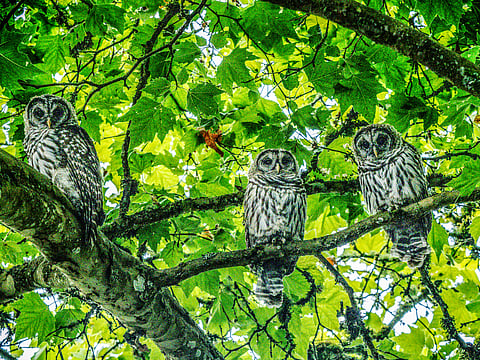
A gray squirrel arrives at a picnic area to take part in baby-stroller hopping, a method of food sourcing where animals pillage human food items, like nuts or potato chips, from a stroller. As the squirrel runs away with its new find, a barred owl watches, keeping its two young chicks warm under its wings. At the same time, two crows scavenge in an overflowing garbage can as a woman with a child in her lap smiles at nearby ducks.
These are the dynamics in Seward Park, home to a diverse range of wild animals who encounter humans that enter their home space. When animals and humans interact, humans have a chance to learn how animals behave — and act accordingly.
People can experience Seward Park in different ways, such as walking dogs, jogging, bird-watching, or wandering its wooded trails. Across its 300 acres, there are 13 designated trails, some of which weave through the 120 acres of mature forest, and a 2.4-mile paved loop for bikes.
Inside the park, there are over 140 species of resident animals: approximately 20 species of mammals (including semi-aquatic) and over 120 species of birds, including nonmigratory birds. Yet Seattle-area birds appear to be in trouble.

Josh Morris, the conservation director at Birds Connect Seattle, recently discovered that the overall local bird population is in decline. Although he says that could be due to many variables, he stresses it's important for people to protect and enhance urban habitats, reduce urban hazards, and support nesting sites and insect populations to ensure there's a healthy prey base for birds.
As people in the area crave more green spaces for recreation and to support their mental health, Morris says it could be useful to designate more laws around certain areas of Seward Park, especially in the park's old-growth forest, to relieve pressure on certain urban species and achieve a more harmonious coexistence with animals.
Naturalist Ed Dominguez recently retired from the Seward Park Audubon Center. He says that during the COVID pandemic, as people stayed home, "the wildlife really reclaimed Seward Park. You'd see them anytime of the day, roaming everywhere on the streets, the upper loop road, on the trails, meadows, because of the absence of humans. As people started to come back to normal routines for a few years, the animals are not quite as prevalent as they were during that time."
But Dominguez says that just because we don't see animals as often now doesn't mean they aren't there. In fact, coyotes have long been in the park, but they're good at maneuvering around people. "They're an important part of our urban ecosystem, and if you see one, you don't have to be afraid of them. Just keep walking where you're going, and the coyote will know what to do to avoid contact with you and go about its business."
But not all animals remain distant. "Food habituation" is the term that Katie Remine uses as the most common behavioral change observed in animals at Seward Park. Remine, the conservation manager from Woodland Park Zoo, is also an active participant in other conservation programs around the globe. She says that "when any wildlife starts to associate food with people, then they will sometimes get pretty comfortable around people. And in a lot of cases, they can get too comfortable around us — and that's when you might end up with conflicts."
In the park, that can involve someone having their snacks stolen by a squirrel, or a young child, hoping to feed geese, being scared away by a mother goose protecting her goslings. But rather than always remaining distant, one solution may be to understand a species' behavior and diet, which can help visitors take better action when conflict arises. In some cases, knowing an animal's behavior can help humans avoid stressful interactions entirely.
This kind of awareness can help raptors. Park visitors love seeing owls. Rats are part of the owl's diet. But humans view rats as pests and poison them with rodenticides. When an adult owl or owlet eats a poisoned rat, the poison can ultimately kill them.
Being aware of this dynamic is part of the delicate coexistence humans can bring to their interaction with the animal world. Because, Dominguez says, "after we recreate in Seward Park, we get to go home. But they remain in the park because that's their home."
No Paywalls. No Billionaires. Just Us.
We're building a newsroom rooted in community, not corporate backing. Help us raise funds to hire our first-ever full-time reporter and grow our capacity to cover the South End. Donate today.
