
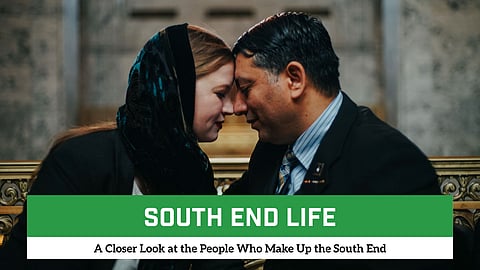
South End Life: New Book on U.S. Veteran Muhammad Zahid Chaudhry, Penned by Wife Melissa, Details His Efforts to Attain Citizenship

U.S. citizenship has been elusive for disabled Army veteran Muhammad Zahid Chaudhry for 25 years. Originally from Pakistan, Chaudhry obtained legal permanent resident status after he married his former wife, Ann MacKenzie, in 2001. He’s navigated decades of bureaucratic paperwork, hearings, and interviews for close to 20 expedited applications for citizenship based on qualified military service, but last year, Chaudhry, a longtime South End resident, was detained at the Northwest ICE Processing Center (NWIPC) for four months. His case is still in the Ninth Circuit Court of Appeals. The Chaudhrys expect judges to review his case in the next few months.
Melissa Chaudhry, Zahid Chaudhry’s wife and mother of their two children, ran for the 9th Congressional District, a race she lost. She recently wrote Service & Sacrifice: One American Soldier's Fight to Defend the U.S. Constitution: The Untold Story of Muhammad Zahid Chaudhry, which was released on Jan. 18.
The Emerald interviewed the couple after the book was released. This interview has been lightly edited and condensed for clarity.
Why did you write the book?
Melissa: When people have been subjected to injustice for a long time by power structures that benefit from us, and we don’t remember what happened and who did it, an act of memory is an act of resistance and sharing. I didn't want this incredible life story to go unrecognized.
My husband's been trying to get national attention on this for a long time, and it didn’t get picked up, because his story exposes the corruption and the anti-constitutional behavior in the U.S. government. I also want to stand in a position of courage and integrity with immigrant communities.
Also, I love Zahid, and I wanted his story to be known, because he's wonderful.
What is the book about?
Melissa: Service & Sacrifice is the story of my husband's life. He was born in Pakistan over 50 years ago and grew up at a time when living memory in Pakistan was still thick with the trauma of the India partition that was a slaughterhouse. I wrote about his childhood and how his grandmother shaped him and gave him a sense of responsibility, duty, and belonging that he carried with him through his entire life: through his time in Australia when he was young, then here in the United States, with his military service that started before 9/11. He was injured as a result of that service. That's why he's in a wheelchair today.
He was also sought after to become an intelligence informant during his service, and he refused, because what was being asked of him was unconstitutional. He's been targeted for that principled refusal. They've tried to deport him for years, culminating in his unlawful detention by ICE for four months and a successful fight to get him home.
They've spent tens of millions of taxpayer dollars going after him, and we haven't told that story from the inside before.
You write about the shift in America after 9/11. Tell me about that.
Zahid: The shift was sudden. Before 9/11, there was always some undercurrent of racism. Being Asian American, we feel it in our communities.
But after that, it was pronounced and obvious.
I remember in 2003, the poison in the air was so pervasive. During my time in the military, [my unit was] getting processed out for deployment. So at Waller Hall in Fort Lewis, a staff person said, “Is everybody here a citizen?” I said, “No, I'm not a citizen.” They said, “Okay, let's get that sorted out right now.” So they took me to the colonel's office and said, “Sir, this whole unit is getting deployed, and this is a soldier in this unit who is not a citizen.” He asked for me to have naturalization processing as for others. The colonel refused. He said, “No, not for a guy named Muhammad.” And that was shocking to me. That was so deeply hurtful. And he told the staff sergeant, “Take this soldier out of my office.”
Melissa: They hadn't created the Department of Homeland Security or ICE until after 9/11. Before 9/11, immigration was processed under the Department of Labor. Now, it's under the Department of Homeland Security. So that shift from recognizing people who want to contribute to America’s workforce versus processing people as threats — that mindset shift became structural quickly.
What does detention look like on the inside?
Zahid: Most of the people in detention were in the blue group, the people who have no criminal record, like me. My uniform was blue. With some minor criminal record, you wear green, and then you have orange and red. Orange and red have to be escorted at all times.
In my blue pod of 116 people (one of three blue pods), it was so bad, even for blue. It was so bad that in one week, two guys attempted to take their lives. I don't have words to describe it.
What’s the worst is not the living conditions. It’s taking somebody's liberty away and putting them in a cage. Mentally and psychologically, it breaks people.
How did you keep your wits about you?
Zahid: It was very hard. I kept it by being a resource and value to other detainees because many couldn't understand English, so I would translate for them, fill out forms with them. Most importantly, I was a mental health specialist in the Army in counseling, and that helped a lot. People would cry on my shoulder. Words can't describe the pain.
What would be your advice to someone who may be afraid of being detained?
Zahid: In my humble opinion: mental strength. You and your family and community need to be able to take this kind of oppression. Immigration is not a criminal offense. It's a civil offense. Do not forget your inherent human dignity. This won't last forever. They can cage your body. They can’t cage your mind.
How did you talk with your children about detention?
Melissa: My daughter, Salma, developed a strong affinity for The Lion King, which makes sense. Here's this young cub who loses his father traumatically and has to figure out how to deal with that. So I used that as a metaphor for what was going on for us. I told her Baba had been taken.
I explained that we had to wait for a meeting with the judge at a special conversation called a hearing at the courtroom. She would say, “Mama, I'm going to help you talk to the judge. I'm going to help you get Baba home.” And then after we did get him home, she said, “I want to be a judge when I grow up.” Hopefully we're instilling that sense of justice and doing good for the next generation. But she's 2. No child of any age should have a loved one snatched away and locked behind bars, especially for doing nothing wrong.
The trauma that is being written into the brains of an entire generation of children across this country is profound.
Zahid: She [asked] me this morning, “Will they take you away again?”
Melissa, what made you decide to run for Congress? You were pregnant and had a toddler with you throughout the campaign. You also had your second child three weeks after the election.
Melissa: I was tired of seeing people in power, people who claim to represent the American people, not living up to that fundamental principle. I have spent most of my life deeply hurt, in cynicism and grief because of what my country has done in my name, and I finally decided to take personal responsibility for making my country live up to its promises. Plus, I had this amazing person at my back [pats Zahid on the back] who has been building political capital and contribution for over 25 years.
It was an uphill road. I was a young progressive challenger in a Democratic race, and the Washington State Democrats came after me — claimed that I had lied about an endorsement, that I genuinely won. We were fighting on all fronts — the Democrats and the Republicans and the extremists who were texting me rape and death threats because I covered my hair.
It was a fascinating time, walking miles a day, flyering. Totally grassroots campaign and funding. From a cold start, no name recognition, and still advanced to the general election, earned over 90,000 votes, and was the first visible Muslim in Washington State history to compete in a general election at the federal level.
Zahid: Salma would be on my lap. I'm in my wheelchair, and Melissa was pushing or pulling my wheelchair up and down the hills in Seattle.
You wrote that Congressman Adam Smith, your opponent in the election, had reached out to you when your husband was detained. What did that feel like?
Melissa: It was emails from his staff. In that moment, the worst possible thing had happened, and to have someone in power be a bridge toward justice was appreciated. His staff reached out to ICE. They were the only ones who were able to get a straight answer why my husband had been taken, and those emails are actually critical evidence in the court case now. That was helpful.
What are your next steps?
Melissa: A lot hinges on the outcome of the decision. The Ninth Circuit could decide on narrow, jurisdictional grounds that there's nothing they can do, or they could look at the full 25-year record and all of the detailed receipts and evidence that we were able to submit and say, “His is a clear case of manifest injustice, and we're going to restore constitutional integrity and the rule of law,” in the form of giving my husband the citizenship he's duly earned by statute, by law, and backdate it to 25 years ago to when he should have had it.
We’re keeping our options open right now. We do not know what the future is going to hold.
No Paywalls. No Billionaires. Just Us.
We're building a newsroom rooted in community, not corporate backing. Help us raise funds to hire our first-ever full-time reporter and grow our capacity to cover the South End. Donate today.
