
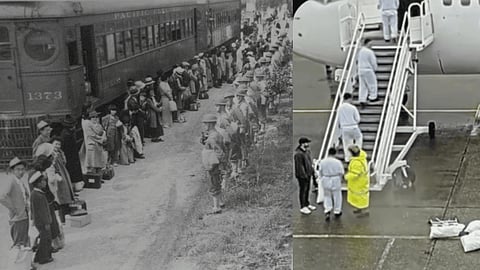
Observing the Day of Remembrance Amid Increased ICE Activity in South Seattle

"The effect of the camp has stayed with me throughout my life," says Joe Okimoto, a retired psychiatrist and former Asian Counseling and Referral Services medical director. Okimoto was incarcerated with his family at Santa Anita Assembly Center in California and later in Poston, Arizona, from ages 3–7. It was an experience that gives him the "capacity to understand and feel the trauma that is being inflicted on these children," he said, referring to children currently detained by U.S. Immigration and Customs Enforcement (ICE). "The experience motivates me for activism."
Okimoto is one of a dwindling number of WWII Japanese American incarceration-camp survivors, and he will speak at a Feb. 21 rally to call for the shutdown of the Northwest ICE Processing Center. The rally will commemorate the Day of Remembrance.
Observed on Feb. 19, the Day of Remembrance is an annual observation of Franklin D. Roosevelt's signing of Executive Order 9066, which authorized the U.S. military to forcibly remove more than 120,000 Japanese descendants from the West Coast to be incarcerated in concentration camps in the country's interior.
In Puyallup and Tacoma, two upcoming events on Saturday, Feb. 21, will mark the observation. The first will be held at the Puyallup Fairgrounds, where approximately 7,500 people of Japanese descent (both U.S. and non-U.S. citizens) were incarcerated for months in horse stalls and other quickly constructed structures, while the U.S. government built an incarceration site in Jerome, Idaho.
After the memorial event in Puyallup, an additional rally will be held at the Northwest ICE Processing Center (NWIPC) in Tacoma to support the detainees incarcerated there today. As part of the commemoration in Tacoma, hand-painted cardboard cutouts of people will be on display. They were made during community gatherings in early 2026. Each figure includes information about the number of detainees flown out of King County International Airport - Boeing Field (KCIA) on a given day, month, or year to build awareness of ICE activities happening in South Seattle.
Many Japanese American survivors of WWII incarceration and their descendants will attend the Day of Remembrance events and assert that history will not repeat itself.
Erin Shigaki is a Central District resident and fourth-generation Japanese American artist whose family had been incarcerated at Minidoka concentration camp in Idaho. Shigaki has been on a flight observation team run by La Resistencia, an undocumented-immigrant-run organization that demands the closure of detention centers and the end of deportations. Since 2023, the organization has regularly counted flights, as well as the passengers who board and deboard those flights, out of King County International Airport - Boeing Field (KCIA).
Shigaki noticed many people she spoke with about the ICE flights didn't know they left from South Seattle. She gathered the community together for four art sessions throughout the area where participants decorated cardboard cutouts of a head and torso. Participants were asked to include imagery of the shackles an actual detainee wears.
"It's a community building project and healing process as we continue to grapple with the mass incarceration of other communities of color, besides Japanese Americans during WWII, who've been touched by this [nation's] obsession with incarcerating Brown and Black bodies that has gone on since the foundation of the country," Shigaki said.
Below are some of the community members who were at a gathering in the Central District's St. Peter's Episcopal Church in late January.
Lynda Joko is an organizer with Tsuru for Solidarity. Her father's family was incarcerated in Poston, Arizona, and her mother's family was sent to Tule Lake incarceration site in California where her aunt died while imprisoned at 12. "The similarities with bad food, poor sanitation, and lack of medical care — the same things are happening today. On top of that is emotional and physical abuse that the detainees tell us directly about when we call them in Northwest Detention Center," Joko continued. "We were removed by buses and trains. Today, immigrants are removed using buses and planes. We were taken away without knowing how long we would be gone, whether we would ever be released."
Barbara Yasui, a member of Tsuru for Solidarity, volunteers in flight monitoring at KCIA and supports solidarity activities. Her background is in early childhood education. "The story of the little 5-year-old boy [Liam Conejo Ramos] who was detained with his father in Minnesota and sent to Dilley, Texas, affected me," Yasui said. "I wanted my poster to look like a Jizo. In Japan, the Jizo is the protector of children."
The Dilley family detention center opened in 2014, following a surge of border crossings of women and children. The Biden administration had ended long-term family detentions in 2021. The Trump administration reopened it in March 2025. Since then, more than 1,300 children have been held at Dilley.
Eugene Tagawa's parents arrived at the Puyallup detention center in May 1942 with two infant daughters. His mother was pregnant with him, and he was born in detention the following month. He was 3 when he left.
"I was very aware that we were poor, because after camp, we moved into public housing in Renton and then while we were there, my father died. And so my mother started doing domestic work, going to people's houses and doing laundry, ironing, cleaning," Tagawa said. "When my father passed, my mom had five kids under 12 to feed."
Emily Yoshioka is a Tsuru for Solidarity Pacific Northwest community organizer. She's fourth-generation Japanese American, and three of her four grandparents were incarcerated during WWII.
"I organize because it's given me language and ways to identify the impacts on my family. There's a strong connection between what's happening now and my family's experience. We can stand in solidarity with communities being targeted, and it's a way for us to heal from the state violence that our families experienced."
Margie Sekijima's parents had been forcibly removed from Seattle and incarcerated at Minidoka incarceration site during WWII. "I'm here to protest the unjust and cruel treatment of immigrants in this country, which reminds me of the way Japanese Americans were treated in 1942 to 1945. … It's best to keep my anger and despair [in check] with busy hands, with like-minded people, to let others know we're not going to sit and let this go by here in Seattle, in Minneapolis, in Dilley, Texas, or anywhere. You can't help but note, with few exceptions, the people [in detention] are Black, Brown, even yellow, and on occasion, red. This is racism at its most malignant."
Kiku Hughes is a fourth-generation cartoonist whose mother's family was incarcerated at Tanforan, the former racetrack in San Bruno, California, before being sent to Topaz concentration camp in Utah.
"Since I'm mixed, I grew up not knowing if I could call myself Japanese American — an arbitrary feeling of 'I don't know where I belong, where I fit in' — but I did know my family's [concentration] camp story, and I know how that's affected me," Hughes said. "Tsuru brought the camp story to the present and showed me that I'm connected to this moment in history. I have a connection to this fight right now."
Hughes researched the Japanese American experience during WWII while writing and illustrating graphic novels and shared a takeaway. She talked about the FBI taking fathers from families, leaving children and mothers without knowing how to keep the family stable after a caregiver and income-earner was gone. She also reflected on her grandmother's experience.
"One of the ways you could get out of camp was to apply to college. She was 16, so she skipped some grades. She couldn't bring her parents with her, so she was separated from her parents, moved to New York, all alone," Hughes said. "I can't imagine how terrifying it would be for any teenager, let alone somebody who's been incarcerated for a year and a half, and who is Japanese American in a time when that's not a safe thing to be. That's how our family was separated."
Harriett Cody is a retired King County Superior Court Judge who participated in the event. "I read about an individual who had completed his entire naturalization process. He had passed the test to become a citizen. He went to immigration court for his final court appearance, to sign the document that would allow him to take his oath of citizenship. He was grabbed by ICE before he could go into the courtroom," Cody said. "Immigration using people's court appointments to capture them without a judge hearing the case, and issuing a deportation order or dismissing the case without due process … is using an immigration court date as bait."
As Stan Shikuma worked on his cardboard cutout, he said, "In King County, flights out are through our publicly owned airport. ICE contracts Sky Service as the fixed base operator (FBO) to service and fuel the planes. If no operators or airlines are interested in working on these contracts, it would make it harder for ICE to use this airport."
Day of Remembrance Events, Saturday, Feb. 21
Puyallup Valley JACL Day of Remembrance Program
10 a.m.: Washington State Fairgrounds Expo Hall, 110 9th Ave. S.W., Puyallup; Free Parking at Gold Parking Lot
Tsuru for Solidarity & La Resistencia Solidarity Day
1 p.m.: Northwest ICE Processing Center, 1623 E. J St., Tacoma
This article is published under a Seattle Human Services Department grant, “Resilience Amidst Hate,” in response to anti-Asian American, Native Hawaiian, and Pacific Islander violence.
No Paywalls. No Billionaires. Just Us.
We're building a newsroom rooted in community, not corporate backing. Help us raise funds to hire our first-ever full-time reporter and grow our capacity to cover the South End. Donate today.
