
From the Black Panther Party to Labor Rights, Local Organizers Prioritized Building Coalitions

Seattle is no stranger to multicultural and international coalition building. The Central District's Black Panther Party (BPP), the local labor movement, and many others, including the 'Gang of Four' activist leaders Bob Santos (founder of InterimCDA), Larry Gossett (former King County Councilmember), Bernie Whitebear (founder of United Indians of All Tribes Foundation), and Roberto Maestas (founder of El Centro de la Raza) all addressed the needs of local communities. They built coalitions because, as Michael Woo, former executive director of the Legacy of Equality Leadership & Organizing (formerly known as the Northwest Labor and Employment and Law Office), put it, "No one ethnic community of color was sizable enough to be impactful."
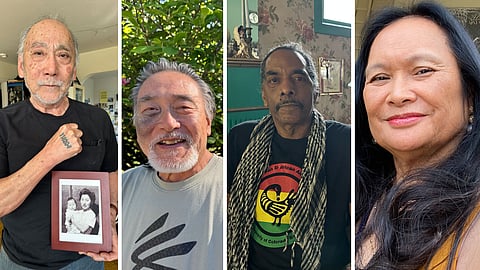
"Looking back at how we've built movements in the past is important as we organize a broad front against this administration's attacks on our communities," said longtime Seattle community organizer Cindy Domingo. With that in mind, she's put together "Solidarities: Black Liberation and Asian American Activism in the PNW," a May 9 gathering that celebrates the local Seattle Chapter Black Panther Party Legacy Group. The event will feature numerous speakers, including Woo, Seattle Chapter Black Panther Party Captain Aaron Dixon, Mike Tagawa, and others.
Together, they'll present a mini history event about how local groups worked together.
Seattle Chapter Black Panther Party 1968–1978
In 1968, the Seattle chapter of the Black Panther Party (BPP) was established, and Bobby Seale assigned Dixon as captain of the local chapter. The national BPP was created to protect and serve the Black community and was clear in its demands, with a foundation rooted in a 10-point plan. In Seattle, BPP members included several Asians, like Mike Gillespie, a Filipino American trumpet player, and Mike Tagawa and Guy Kurose, both Japanese American.
Tagawa, a Vietnam veteran, recounted how he walked up to some Panthers marching near the arboretum on South Madison Street and ran into a friend from junior high, Bobby White. "He gave me the rundown of the Party's mission and said, 'You're going to join the Party, aren't you?' I responded with, 'But Bobby, I'm not Black.' White shot back, 'You ain't white, either.' I immediately got it," Tagawa said. "I ain't white, and that's why I was born in a [Japanese American World War II] concentration camp. I ain't white, and that's why I was living in the Central District with Bobby," because of redlining, said Tagawa. "I joined and never looked back." Tagawa added that some people criticized him joining the Party, saying, "'It wasn't your fight.' To that I say, 'It's everybody's fight,'" said Tagawa.
The Black Panthers carried out their services as volunteers, but there were bills to be paid. Among the local chapter's programs were free daily breakfasts for hundreds of children at five locations in the South End and a free health clinic in the Central District, the only BPP clinic in the nation that operates as a clinic today.
As chapter captain, Dixon processed the donations for the party and found that many different groups supported their efforts. He said that people from the Jewish community donated to the BPP, as well as Japanese American and Chinese American families. The largest donations were from wealthy white people.
Legacy of Equality Leadership & Organizing (LELO)
In 1973, labor organizer Tyree Scott co-founded LELO, which brought together three groups: the United Construction Workers Association, which represented Black construction workers blocked from accessing many jobs; the Alaska Cannery Workers Association, of mostly Asian American and faced harsh work conditions; and United Farm Workers, a mostly Latino group, who faced their own inequitable conditions.
LELO used Title VII of the Civil Rights Act of 1964 to fight discrimination in the workplace. Its lawsuits and organizing won Black construction workers hundreds of union jobs in Seattle, and LELO's reach stretched nationwide, winning cases in Yakima and Alaska. The organization found solidarity with workers in Texas, Louisiana, and Arkansas.
In 1981, Cindy Domingo's brother, Silme Domingo, a LELO organizer for cannery workers, was killed along with another Filipino American organizer, Gene Viernes. Domingo recalled that soon after, local radio show host Eddie Rye Jr. arrived with supporters at a demonstration in front of the Philippine consulate. It was later proven that Silme Domingo and Viernes were assassinated, their deaths ordered by Philippines President Ferdinand Marcos. The pair had been using their labor organizing position in the U.S. to help the then-underground and anti-Marcos labor movement in the Philippines.
"I appreciated Eddie for bringing those supporters. The Black Panther Party, Aaron and [his brother] Elmer Dixon, and Larry Gossett have been with me through this too," Cindy Domingo said. "They were able to see the immediate link between foreign policy and domestic repression."
Later, when the North American Free Trade Agreement was being negotiated in the 1990s, LELO considered what fair trade could look like if it centered the workers' perspective. Efforts culminated when the World Trade Organization Ministerial Conference of 1999 was hosted by Seattle. LELO and other groups, like Washington Alliance for Immigration and Refugee Justice, brought in coal miners and farmers from Korea, India, and other countries to speak about their experiences.
Woo saw successful community coalition building had key components. "Having a clear message and actions that speak to people's daily needs is important, like getting people jobs. The Black Panther Party was creating solutions: the clinic, breakfast program, patrolling the streets. [These were] actions that speak to people's everyday lives," Woo said. "Most of us grew up together. I credit growing up in the Central District and attending Garfield High School, a multiracial and progressive school, for my path into organizing."
At Dixon's home, he leaned on his porch railing, looking out on a Central District residential street. "What drove us was the love for the people," he said. "That's what you sacrifice for. We were selfless and had undying love for the people and our comrades."
"Solidarities: Black Liberation and Asian American Activism in the PNW" takes place Saturday, May 9, 11 a.m.–1 p.m., at the Metropole Seattle, 423 2nd Ave. Ext. S.
The Seattle Chapter Black Panther Party Legacy Group will open a BPP museum and interpretive center as a pilot project at the Metropole Building in June.
This article is published under a Seattle Human Services Department grant, “Resilience Amidst Hate,” in response to anti-Asian American, Native Hawaiian, and Pacific Islander violence.
No Paywalls. No Billionaires. Just Us.
We're building a newsroom rooted in community, not corporate backing. Help us raise funds to hire our first-ever full-time reporter and grow our capacity to cover the South End. Donate today.
