
Who Put 2,400 Eco-Blocks in Georgetown? Researchers Still Don't Know.

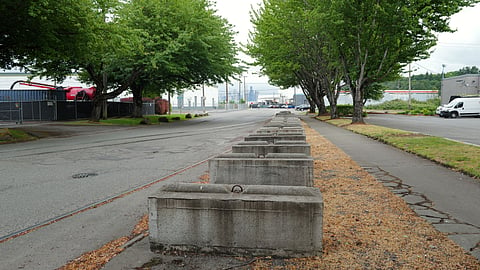
Throughout Georgetown, there are clunky clusters of what look like oversized, gray, concrete Legos in parking lots, outside of businesses, or even on the side of the road. The two-ton slabs of recycled concrete are called "eco-blocks."
When Charlie Martin and Lily Bayly, two University of Washington (UW) graduate students, began looking into the eco-blocks, they found little available information about them. After months of research, they found roughly 2,400 eco-blocks in Georgetown, where they are likely used to obstruct large vehicles, like RVs, from parking.
But so far, researchers have not been able to identify who has placed the barriers.
For Martin and Bayly, their findings are part of a larger effort to fill what they see as an "information gap" about eco-blocks and how the structures may impact unhoused people who live in their vehicles.
The research was part of their capstone project in the UW Library and Information Science program, which resulted in an interactive map of Georgetown that tracks clusters of eco-blocks and where service complaints about their placement have been filed.
"Many neighborhoods are affected by this," Martin said. "At the very least, there deserves to be more information about where these blocks are, how many there are, what businesses it might be affiliated with."
Martin and Bayly began tracking the concrete slabs in January, and they created a survey for geospatial data, driving every street in Georgetown and logging the number of eco-blocks per street.
"It means that we do have an aggregate number of [eco-]blocks," Bayly said. "And since we did street blocks, we do also have fairly specific geospatial information about where those are located."
Georgetown, a neighborhood in the Industrial District, stretches over 2½ square miles, resulting in a rate of 892 eco-blocks per square mile, according to their research. Seattle's District 1, which includes Georgetown, has the highest density of RV street parking, according to the Low Income Housing Institute. The next highest are Districts 6 and 7 (Ballard and Interbay).
Martin said that, in speaking with unhoused people, RVs are not ideal shelter to live in, but they can be preferable to a tent. As spaces that are available to park large vehicles decrease, the options for vehicle shelter become less tenable.
Before starting the project, Martin had worked with mutual aid groups like Stop the Sweeps, which combat city efforts to clear out homelessness encampments. In his experience, he said eco-blocks are often placed after a sweep to prevent RVs and other vehicles from parking there again.
When a sweep occurs, it can be an "incredibly stressful and traumatic experience" for houseless folks, Martin said.
"It's like this clock ticking," Martin said. "And if your car, or tent, [or] valuables are not off the street by 9 a.m. sharp on the day of the sweep, then it's gone: It's city property the minute they tow your RV. Once your RV is towed, it's almost impossible to get back."
A local mutual aid volunteer, who requested anonymity, also notes that during sweeps, people can lose documentation that could get them on the path to shelter.
While Martin said that he's spoken to unhoused people who've seen the barriers being placed on the streets, it remains unclear who exactly is placing them. In 2022, KOMO News reported that business owners in various neighborhoods had placed barriers to prevent encampments from forming outside of their establishments. While the City of Seattle has received complaints, the legality of eco-block placements can be "a bit of a grey area," Bayly said.
"There doesn't seem to be a good procedure that the city has for actually addressing and moving these blocks," Bayly said.
The Seattle Department of Transportation has received over 100 service requests about eco-block placements since 2021, Ethan Bergerson, an SDOT press secretary, wrote in an email to the Emerald. While the city does not generally permit eco-blocks in the public's right-of-way, which is illegal, enforcement against them can be "challenging" as it can be difficult to prove who is responsible for placing them.
"If the problem persists, and we know who is responsible, we can issue citations or seize the eco-block," Bergerson wrote. "Removal is time-consuming and costly, though, since our maintenance crews and equipment have to be reassigned from other work to haul the eco-block away."
Martin and Bayly hope their interactive map will open up possibilities to lead to future mapping and research of eco-blocks in other neighborhoods. Martin would also like their research to raise awareness about homelessness, specifically about people living in their vehicles.
"According to our research, no other city in the country has experienced the same issue with illegal eco-blocks," Martin wrote in an email. "As a resident of Seattle, I find this deeply embarrassing. The blocks are a constant reminder of the city's failure to manage the homelessness crisis."
No Paywalls. No Billionaires. Just Us.
We're building a newsroom rooted in community, not corporate backing. Help us raise funds to hire our first-ever full-time reporter and grow our capacity to cover the South End. Donate today.
