
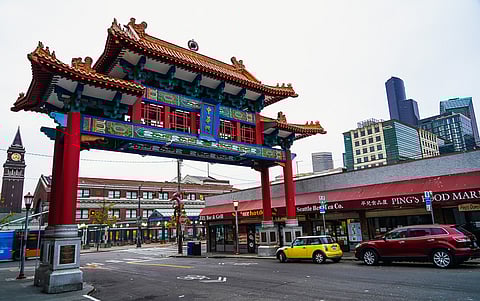
CID Businesses Say They Received Little Notice Before Four Nights of Power Outages

In a pitch-black room one evening in mid-September, a bartender at Gan Bei Eatery and Bar used a smartphone camera to see while cleaning up. The lights — and the power — had shut off earlier than expected.
From Sept. 14 to 17, the late-night spot on Seventh Avenue South and South Weller Street was forced to close its doors earlier than usual due to power outages. Manager Yen M. said the business lost 50% to 70% of its sales during the closures.
"Our normal hours have last call at 9:30. We pushed it back to 7:30 p.m.," Yen M. said on the last day of the outages. "That's like a big moneymaking hour. Not only we just lost two hours, we lost more … because after the kitchen closed, we still had people drinking and partying. So we actually lost four to five hours per day."
Gan Bei is one of numerous businesses and residences affected by roughly eight-hour power outages that occurred for four consecutive nights. The outages were scheduled by Seattle City Light (SCL), which reportedly shut down power lines for maintenance in the Chinatown-International District (CID). Some neighborhood business owners and organizers reported poor communication and planning from the city.
In an email to the Emerald, SCL spokesperson Kate Jacobs wrote that crews were tending to "emergency underground work," replacing primary feeder conductors. The CID had been operating on temporary equipment after previous fire damage.
"We understand that planned outages can be disruptive, which is why we limit them to critical work, coordinate with affected customers to minimize impact, and provide as much notice as possible," Jacobs wrote. "We aim to provide at least five days' notice. Shorter lead times may occasionally occur due to scheduling constraints, crew availability, or the nature of the work."
The CID has experienced both planned and unplanned one-day outages this year, but nothing to this extent, Tuyen Than, executive director of the Chinatown International District Business Improvement Area (CIDBIA), wrote in an email.
"This outage was significantly more disruptive because of the multi-day duration, the larger-than-communicated footprint, and the lack of adequate outreach to businesses, residents, and community organizations," Than wrote.
SCL blamed a "software error" for lack of communication.
In late August, businesses reported city employees asked them to identify appropriate times to conduct maintenance that would result in outages.
From Sept. 4 to 8, SCL employees reportedly handed out door hangers notifying businesses of a scheduled overnight power outage starting at 9 p.m. on Sept. 17, Jacobs said. On Sept. 11, businesses received notices that power would also be cut for three additional nights on Sept. 14, 15, and 16.
"It was just so last minute," Yen M. said. The restaurant "lost some food" on the first night of the outages, which led staff to move items into freezers in their homes and those of friends by the second night.
But on Sept. 5, Tabletop Village on Eighth Avenue South received a different notice for an overnight outage starting at 9 p.m. on Sept. 14. Staff only learned the outage was extended when the lights suddenly went off the following night.
The shop usually closes for business at 9 p.m. but will let gamers hang out until about midnight, owner Brian Myers said. When the lights went out on Sept. 15, staff prepared for the same thing to happen again — getting their information about the outage from other CID neighbors.
With no security system, Myers spent the nights in his shop during the outages, except for part of one night.
"Actually, my employees did me a solid and let me go home at 2 a.m., and then they stayed for the last three hours," Myers said.
Less than a block away at Filipino bar and restaurant Kilig, owner Melissa Miranda was forced to close the kitchen about 90 minutes earlier than usual that week, discouraging customers from coming in at all.
Like Gan Bei, Kilig had received notices for all four nights of outages.
"We know schedule changes can be frustrating, and trust us, they're not exactly ideal for a small business either," a Sept. 15 Instagram post read, announcing early closures for the week. "We appreciate your patience and support while we work around the outages."
On the last night of the outages, the restaurant had few customers during what would usually be the start of Tanduay Thursday, a beloved monthly event featuring DJs, drinks, and food hosted at Kilig. Due to the outages, the community event was canceled.
"September is usually hard for restaurants, because it's after Labor Day," Miranda said. "It sucks for the neighborhood. It's already so hard, and then to have something like this [happen]."
With the outages over, CIDBIA, Seattle Chinatown International District Preservation and Development Authority (SCIDpda), Chinese Information and Service Center (CISC), Wing Luke Museum, and others are planning a community debrief to address how the prolonged outages were handled, Than wrote in an email. CIDBIA has also been in contact with SCL to "escalate concerns and demand accountability."
The utility company is reaching out to businesses that did not receive a notification to ensure they are notified of future outages, Jacobs said.
"I imagine what Seattle City Light had to do was fairly important that it required the shutdown of all these people," Myers said. "I think the difference is that I believe if this was in any other area, somebody would obviously be like, 'Hey, we gotta make sure these buildings are on generators to supplement, like, this time that they're gonna need it at least for emergency use, right?'"
This article is published under a Seattle Human Services Department grant, “Resilience Amidst Hate,” in response to anti-Asian American, Native Hawaiian, and Pacific Islander violence.
No Paywalls. No Billionaires. Just Us.
We're building a newsroom rooted in community, not corporate backing. Help us raise funds to hire our first-ever full-time reporter and grow our capacity to cover the South End. Donate today.
