
Wilson Restarts Police Camera Expansion; Seattle Council Upholds Veto of RV Permit Bill

This week in City Hall, two decisions were made that will impact the city's surveillance camera program as well as how the city addresses people living in recreational vehicles (RVs).
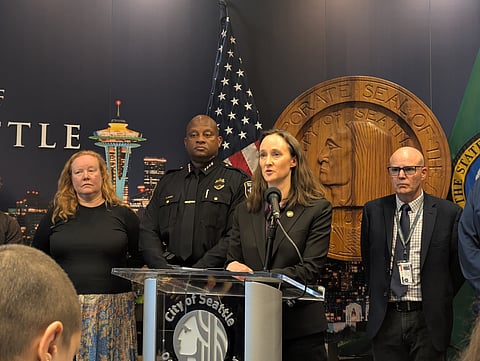
Seattle Mayor Katie Wilson announced on Nov. 10 that the city will proceed with an expansion of the Seattle Police Department (SPD) surveillance camera network in the Central District, SoDo, and Capitol Hill. The expansion, originally planned to begin earlier this year, was paused after Wilson ordered a data governance and privacy audit, conducted by New York University's Policing Project.
The audit, released by the mayor's office on Nov. 9, informed Wilson's decision to expand the surveillance camera program. The audit runs 77 pages, and it identifies "important gaps" and "shortcomings" in accountability, transparency, and data retention in the city's surveillance camera program. The audit, which cost the city about $233,000, lists 19 recommendations, many of which the city intends to implement, said Wilson.
"Seattle does not have to choose between taking crime seriously and taking civil liberties seriously," Wilson said at a press conference. "They are both about feeling safe and free."
The expansion has already begun. Surveillance cameras around the stadiums that had been operational during the FIFA World Cup in June were taken offline after the event. They have now been reconnected to the Real Time Crime Center (RTCC). Cameras in the nightlife area in Capitol Hill and around Garfield High School will be installed over the next four to six months, said Wilson.
Audit Finds Multiple Incomplete or Informal SPD Procedures
The audit identifies several current SPD surveillance-camera regulations and policies as being "unwritten," "informal," or being presented in "draft" form. For example, the audit highlights that SPD was only in the "process of drafting" procedures for the "day-to-day operations of RTCC personnel," meaning SPD staff currently relies on various practices the audit finds "inadequate."
The audit recommends the city address numerous issues, including the following:
Verifying that requests for RTCC assistance do not concern immigration enforcement or protected health care, and declining requests whose purposes cannot be confirmed
Creating rules regarding the use of surveillance cameras for protests or other political activities
Establishing standardized features between city cameras and private cameras connected to the RTCC
At the press conference, Wilson stated that her office and SPD will be "working urgently to implement most of the recommendations in this audit" and that implementing those recommendations would take up to six months.
Standing at the podium, she said that her assessment of the audit did not show "really big gaps that worry [her] that the data could be misused" or "fall into the hands of federal agencies."
After the mayor spoke, several city councilmembers held individual press conferences, including Public Safety Chair Bob Kettle. At his press conference, Kettle said that the City Council "will take up the recommendations from the [audit]" to "help in the program's continued improvement."
Kettle, who has oversight over SPD, said he was aware that SPD was operating under draft policies and that "writing the policies was an ongoing process and that they weren't complete." He later stated he had been aware of these draft policies as early as mid-2024.
City Council Sustains Mayor's Veto of RV Permitting Bill
Days later, on Nov. 12, the City Council held a special meeting to reconsider a bill that would have, among other things, created a permitting program for large RVs parked on city streets. Wilson vetoed the permitting bill, and the council needed six councilmembers to override the veto.
Before the vote, Councilmembers Eddie Lin, Alexis Mercedes Rinck, Dionne Foster, and Rob Saka said that they would uphold Wilson's veto. But the meeting grew tense when Councilmember Dan Strauss implied that his fellow councilmembers who supported the veto had engaged in "duplicitous" reasoning.
"Do not under any circumstance impugn my motives, my character, or my integrity," said Saka. "I don't do that to anyone else. Do not do it to me."
Strauss then said that his comments were directed at the timeline, not at any person's motives.
But in the end, the veto was sustained with a vote from Saka, who had originally voted for the RV permitting bill.
This saga began in October, when the City Council passed a sweeping set of bills to regulate large RVs on city streets. The most controversial bill in the package would have created a permitting program for people living in RVs, which advocates said amounts to banning RVs and towing people's property.
On Nov. 2, Wilson signed all but one of the bills, vetoing the RV permitting bill because, she said, it would be costly and create "risks that permit non-compliance could increase unsheltered homelessness." Wilson also signed an executive order to create a working group to write recommendations on how to improve the city's response to RVs on streets.
Wilson gave the working group until the beginning of January 2027 to complete its report and recommendations.
No Paywalls. No Billionaires. Just Us.
We're building a newsroom rooted in community, not corporate backing. Help us raise funds to hire our first-ever full-time reporter and grow our capacity to cover the South End. Donate today.