
- DONATE
- News
- Voices
- Arts & Culture
- Community
- EventsEvents
- Newsletters
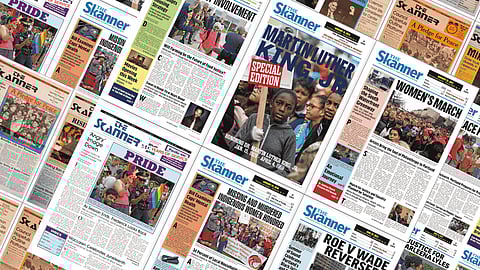

The Skanner newspaper, one of a small number of Black-owned newspapers in the Pacific Northwest, officially ceased operation on Jan. 30, 2026. Under the guidance of publishers Bernie and Bobbie Dore Foster, the paper, based in Portland, printed its first issue 50 years ago. Five years later, in 1981, they began publishing a Seattle edition. I was a freelance photojournalist for the Seattle Skanner and later the combined Portland-Seattle Skanner from 1997 until last year. Working for the paper as a white photographer was one of the best things that ever happened to me.
I've taken photos most of my life. I've shot everything from weddings and product photography to street photography, but what I always loved and really wanted to do was photojournalism. So in 1997, when I saw an advertisement in The Seattle Times that a small, minority-owned publication was looking for a photographer with their own darkroom, I applied.
The Skanner had an office in downtown Seattle, and when I was hired, I went there and met the publishers' daughter. There was never any mention of me being white. Instead, for my first assignment, she sent me to photograph a rehearsal of the Pacific Northwest Ballet. After I turned in some prints, I didn't hear from them for a while. But eventually they started sending me on other assignments. After taking photos, I'd develop the film, print three or four images, and then drive them to the Greyhound station in downtown Seattle — it used to be at Eighth Avenue and Stewart Street — where images would be put on a bus to Portland. After the paper was printed, the Seattle edition was then bused back to Seattle for distribution.
Several writers, including Al Sanders and Donna Stefanik, provided articles for the first few years, but after a decade or so it was just me covering two to three assignments a week, most of which I found myself. The pay wasn't great — when I started I got $40 an assignment — but I didn't do it for the money. I did it because I loved the experience. I would've done it for free.
Over time, people in the community got used to seeing me at events and would reach out to tell me what was going on in the community. I started covering annual events like the Roots Family Celebration, the July 4th Naturalization Ceremony, Umoja Fest, and Juneteenth at Pratt Park and, later, Jimi Hendrix Park. The annual MLK rally and march at Garfield High School was a particular favorite. I don't think I missed photographing it every January for 28 years.
When I began, I wondered if, being white, people in the Black community would be wary of me showing up. But from the start they accepted me and my camera, and many people told me they were happy to finally get media coverage. Sure, there were a couple times when someone asked what I was doing there, but other people at the events stood up for me and came to my defense. I never anticipated how much people would welcome me.
My work for The Skanner helped me discover so many beautiful things about Seattle and especially Seattle's Black community. I learned about and became a "fan girl" of Northwest Tap Connection and the dance group Kutt'N'Up, created by dancer and choreographer Koach Crosby. Every year I look forward to annual events like the Teen Summer Musical, Wa Na Wari's annual Walk the Block, and Africatown's Black Wall Street.
Working for The Skanner also gave me the chance to photograph extraordinary people, including Nelson Mandela, Desmond Tutu, Coretta Scott King, Barack Obama, Angela Davis, and Elaine Brown. I met Tuskegee Airmen and members of the Black Panthers. I've covered massive, world-changing events from the WTO in 1999 and the George Floyd protests in 2020 to intimate community gatherings like the Reunion on Union and the ROOTS picnic. I've met extraordinary people and made lifelong friends.
I feel so fortunate I was a photojournalist for The Skanner for 28 years. The paper served the Portland and Seattle communities for decades, and it changed one aspiring photojournalist's life forever.
Susan Fried is a veteran photographer whose work spans four decades, including 25 years as The Skanner News’ Seattle photographer. Her images have appeared in numerous publications, and she has been an Emerald contributor since 2015.
We're building a newsroom rooted in community, not corporate backing. Help us raise funds to hire our first-ever full-time reporter and grow our capacity to cover the South End. Donate today.
