
COLUMN | Why Was Tyran Stokes Presumed Guilty Over a 5-Second Video?

The other day, a friend and I were talking about how the presumption is always guilt where people of color are concerned. We weren’t talking about Brandon Roy, but we could have been. We weren’t talking about me, either, but we could have been.
We also weren’t talking about an accusation cycled through the Washington Interscholastic Activities Association (WIAA), but maybe we should have been.
On July 25, Roy returned to his alma mater, Garfield High School, which had dumped him, and his three-state-championship and NBA-star resume, as its boys basketball head coach some nine months earlier. He reclaimed the job with the utmost grace. And that’s where any similarities between him and me end.
Like Roy, I was part of an anonymous accusation submitted to the WIAA. The presumption, I was told, was that a violation was committed. There was no supporting evidence.
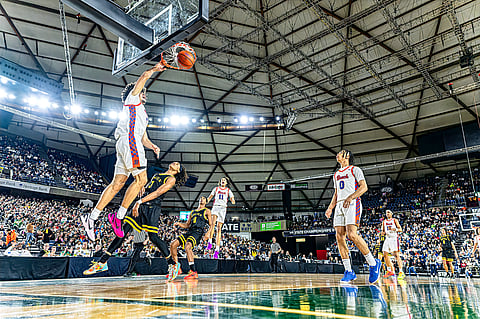
The accusation was facilitating a Name, Image, or Likeness (NIL) violation for Tyran Stokes. He was then the star of State 3A champion Rainier Beach High School. He’s now preparing for what is expected to be a one-year stint at the University of Kansas. Early looks at the 2027 NBA Draft are projecting Stokes as the No. 1 overall pick.
I found myself in this nutty entanglement due to the limited wisdom of the overlords of local high-school basketball. The episode was most probably touched off by the petty jealousy of those gunning for Stokes and Rainier Beach High School, in a misguided cultural appropriation of Malcolm X — by any means necessary.
In other words, it was not much different than Roy’s odyssey through anonymous, unfounded accusations, met by premature and egregious overreaction by his school and school district.
Coincidentally, my own trip began on the morning of March 16. That was the day a Seattle Times investigation found that Roy was fired by Garfield High School due to recruiting allegations. Not violations. Allegations.
As I sat stewing over the Roy affair, I received texts from someone associated with the Rainier Beach boys basketball team. They referenced a (very) short video I’d shot of Stokes holding up a printed South Seattle Emerald magazine with my story about him on the cover.
Is the magazine Stokes is holding for sale, the first text asked.
And a follow-up: Was Stokes paid for doing the video?
The magazine is a free, quarterly publication of a selection of recent stories published by the Emerald. It is distributed as a service to the South Seattle community that it covers. It’s laughable to speculate whether the Emerald, a nonprofit, BIPOC-centered media outlet, or I, a semi-retired sportswriter who covered the Vikings on a mostly volunteer basis, could (or would) compete with the likes of Nike, with whom Stokes already has a multiyear, multi-million-dollar NIL deal.
I’d given Stokes a couple copies of the magazine before his McDonald’s All-American celebration at Rainier Beach. He asked for more. I asked if he’d read the story. He had. I was kind of touched, so I asked him to hold up the magazine for me to record. I am proud of the story and wanted more people to read it.
Later that same day, I received a phone call from someone associated with the WIAA, an independent nonprofit that oversees high-school athletics and derives its authority from the schools that pay membership fees to be overseen. The call began testily and stayed that way for much of a 20-minute conversation. The caller launched into an interrogation. I had to request a 30-second timeout and ask, “Is this about my five-second video?”
Yes, the caller replied. Someone reported the video, and the WIAA considered it a violation (I later learned of WIAA rule 18.24.0, regarding amateur standing).
“How could it already be considered a violation?” I asked. “I’m the one who shot the video, and no one has even talked to me until now.”
This guilty-until-proven-innocent process is what already had me peeved about the Brandon Roy situation.
It’s literally un-American (i.e., unconstitutional) to deny due process.
That call ended with the caller saying, after my explanation, that this should be the end.
However, the very next day, I received a call from someone associated with Rainier Beach High School. Since the “violation” was reported, the school was required to investigate it. That call lasted 18 minutes. The next day brought two emails, then a request for a written statement. I produced one; it was 934 words and repeated the points I’d made during the two phone calls. The rest of this piece summarizes them.
Calling this video an "endorsement" is a distortion of the term, particularly in the context of amateur athletics, as associated with Rainier Beach High School, Seattle Public Schools, the Metro League, WIAA District, or WIAA. Stokes clearly is dressed in civilian clothes and bears no marks of any of the aforementioned institutions. The balloons in the background could be from a McDonald's or even the University of Kansas, which uses the same colors — colors, I would add, that also are not associated with any of the institutions in question.
In the video, Stokes plainly is saying, "...read about me." Is the promotion of reading a violation of WIAA rules?
Stokes makes no qualitative statements about the Emerald or my story — i.e., language even implying endorsement. Examples of qualitative terms would be, "I like...," "I love...," "I urge you to follow/support/donate to...," or, even, "You will enjoy reading..." Simply reading a story in any publication does not convey or imply approval or disapproval of said publication. The Emerald derives no financial remuneration for the simple act of having its stories read.
There was no discussion or instruction of how the video would be used, and no agreement between the Emerald and Stokes, his coaches, or his school administrators.
Those of us who were around the Rainier Beach team on a daily basis witnessed many similar interactions: for-profit media outlets or content creators asking a question, or pleading, "Hey look at the camera," or simply recording athletes (in uniform) in action. Those would include "promotions" imploring audiences to follow high-profile student-athletes on their platform and/or enjoying the "best" or "most comprehensive" coverage of the player/team/sport, even the WIAA, on said platform.
I have heard announcers on National Federation of State High School Association (NFHS) streams — for which the WIAA earns a cut — urge viewers to tune into matchups of this school's star against that school's star with accompanying images. If these constitute violations of WIAA rules, I have to assume that WIAA investigators are backed up for months. I also have to assume that the WIAA would have an obligation to investigate its own partners and their interactions with associated student-athletes, schools, and athletic programs.
For months, I witnessed the hatred spewed at the Rainier Beach boys basketball team — teenagers — even at its home court by visiting fans. I witnessed physical tactics used against Stokes that crossed ethical lines and would not be tolerated on any other level. If the WIAA is so concerned about protecting student-athletes, how much time has it spent investigating and legislating against the aforementioned?
The NIL inquisition over such an obviously benign, five-second video was ridiculously misinformed and shallow, and those who pursued it appeared not to understand their own rules. They further demonstrated no measure of common sense and universally held definitions and standards. I am further outraged at how this "allegation" follows a blatant trend of targeting schools and teams with primarily student bodies and players of color.
One last punchline: What was directly at stake was Stokes’ athletic eligibility. His basketball career at Rainier Beach already was over; he’s headed to greener and, presumably, more equitable pastures. The weekend after I was grilled, the WIAA passed an editorial clarification regarding NIL violations committed “during any one calendar year August 1 through July 31 or until the day after that student’s high school graduation.” In other words, the witch hunt was intended mostly to embarrass Rainier Beach and potentially put its state championship at stake for using an ineligible player.
Three and a half weeks later, I asked if there had been any developments in the “case.” “Nothing was found,” came the answer. After so much ado about nothing, I beg to differ.
Glenn Nelson covered the Sonics and the NBA at The Seattle Times for 17 years. He was a founding executive at Rivals.com, a co-founder at Scout.com, and the founder of ESPN HoopGurlz, a national website about women's and girls' basketball. He has won regional awards for his columns about race for the South Seattle Emerald.
No Paywalls. No Billionaires. Just Us.
We're building a newsroom rooted in community, not corporate backing. Help us raise funds to hire our first-ever full-time reporter and grow our capacity to cover the South End. Donate today.
