
New Arte Noir Show Reveals How Black Clay Artists Help Shape Culture — and History

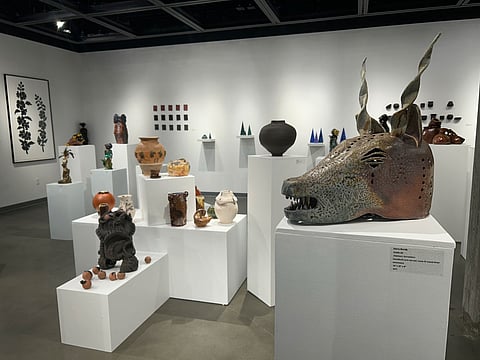
A lacquered, gourd-shaped pot. A bust of a young woman wrought in bronze-like ceramic. A head of a beast with sharp teeth and twisted antlers.
Together, these pieces form part of the wide selection of ceramicware at "Black Clay," a new exhibition at Arte Noir. Conceived in collaboration with Pottery Northwest, the show features work from both local and national ceramists, a testament to the diversity and strength of Black artists throughout the country working with clay. And the exhibit kicks off a month of workshops and other activations aimed at bringing the Black community into the world of ceramic.
"The diversity of creative thinking in this particular show recognizes that African Americans are not a monolithic culture, community, or dynamic," said Hasaan Kirkland, gallery curatorial manager at Arte Noir. "And that when we have the opportunity to express our creative thoughts, we will get a range. That range is validated when you see diverse levels of thinking, from non-objective works that would show the development of color, clay, and shapes, to something that's very specific, like representationalism."
"Black Clay" features the works of 25 artists, including Esther Ervin, Deshun Peoples, and Willow Vergara-Agyakwa. All of their pieces are curated close to one another, blending and melding together these two dozen artists' viewpoints, references, and approach to ceramics.
Along the back wall are several small sculptures by Tammie Rubin, a ceramist based in Austin, Texas, and a recent resident artist at Pottery Northwest. Rubin's work "Always & Forever (forever, ever) No. 15" is a little unnerving: a group of bright-blue upside-down porcelain cones with eye slits staring out at the viewer, decorated with patterns. At first glance, they look like the hoods worn by Ku Klux Klan members, but for Rubin, the reference is also broader: dunce caps, Nazarene capirotes (tall, conical hats) worn by penitents in Spain, witches, and figures in Hieronymus Bosch paintings. The work is meant to tap into preconceived associations and to flip them.
"The common denominator is the utilization of costuming as means of pageantry, uniformity, concealment, ritual, and power," she told Austin Monthly. "I am fascinated with how objects, divorced from function, allow the mind to wander freely over a range of associations, to skip magically between different categories of experience, opening up dream-like spaces of unexpected associations and dislocations."
That sense of dreaminess translates to three sculptures by Seattle-based ceramist and Pottery Northwest instructor Sierra Bundy. "Shadow Worker" is a stoneware piece that's formed like a freaky cryptid with a bird head and amorphous black body. Its tongue sticks out either in jest or as a taunt. And Bundy's "Guide #2" is a handbuilt wood-fired bust of another creature that's somewhere between an antelope and a dog, its glaze giving the surface a texture and appearance of it being an ancient artifact. Bundy's works almost vibrate with energy, evoking a kind of mythical animism in their construction.
The Black American community has a long history working with clay, with many enslaved Africans bringing their pottery traditions to the American South. The most famous among them is David Drake, also known as Dave the Potter, an enslaved Black potter born circa 1801 who lived in the Edgefield District of South Carolina.
Known for his massive, expertly crafted stoneware jugs and storage jars, Drake often inscribed his name or bits of poetry into his work, resisting fascist laws preventing enslaved people from learning how to read and write, thereby risking his life. Drake made tens of thousands of ceramic works — from which he earned no money — before he died as a free man sometime in the 1870s. Only several hundred survive today, which all sit in museum collections and go for millions of dollars at auction. It was only recently that the Museum of Fine Arts, Boston, returned pieces of Drake's works to his descendants.
In the 1920s and 1930s, Black clay artists flourished during the Harlem Renaissance, when ceramists like Augusta Savage and Selma Burke shaped Black cultural identity and artistic thought. Burke's 1945 relief carving of Franklin D. Roosevelt is thought to have inspired the former president's profile on the dime. Savage is known as a key influence in the Harlem Renaissance, mentoring artists like Jacob Lawrence and Gwendolyn Knight, in addition to crafting massive sculptural works for the 1939 New York World's Fair. Unfortunately, Savage could not often afford to cast her plaster or clay works in bronze, so many of her pieces have been lost to time.
Their influence lives on in artists like Syd Carpenter, Kehinde Wiley, and Wesley T. Brown. As a way of deepening their collaboration and furthering the Black clay tradition, Arte Noir and Pottery Northwest have coordinated three workshops to connect those curious about ceramics with instructors and a studio. Throughout the month of January, interested parties can sign up for a wheel-throwing demo with Ryan McDonald, a mask-making workshop with Bundy, and a workshop focused on making human features in clay with Aisha Harrison.
For Arte Noir, "Black Clay" — as both an exhibition and its programming — is emblematic of how they wish to situate the arts in the greater Black community in Seattle.
"It's the partnerships that we can create together and foster in the arts that helps build us a stronger community," said Kirkland. "And a stronger resource."
"Black Clay" at Arte Noir is up through Feb. 22, 2026. Learn more about the exhibition and workshops over on Arte Noir's website.
The Emerald's arts coverage is supported in part with funding from 4 Culture and the City of Seattle's Office of Arts & Culture. The Emerald maintains editorial control over its coverage.


No Paywalls. No Billionaires. Just Us.
We're building a newsroom rooted in community, not corporate backing. Help us raise funds to hire our first-ever full-time reporter and grow our capacity to cover the South End. Donate today.
