
New Photo Exhibit 'Crossings' Traces the Human Cost of U.S. Immigration Policy

In a black-and-white panoramic photo from 1989 taken by Susan Meiselas, a scene plays out against a giant bush. Backlit by a bright white light, an armed officer apprehends someone visible on the right side of the photo. The figures appear to be in motion, with the officer's hand hooked onto the person's arm. There's an intimacy to the photo, as if it's happening on a stark theater stage or a place outside of time.
But neither is true. Meiselas captured the photo of a U.S. Customs and Border Protection officer arresting an undocumented migrant worker near Tijuana, Mexico, at 1 a.m. Scenes similar to this have been occurring for decades along the country's southern border, where government forces have tried to thwart migrants attempting to cross into the U.S.
That image and others will be featured in Meiselas' photo exhibit Crossings, which opens Jan. 15 at Photographic Center Northwest (PCNW). The exhibition, which debuted more than three and a half decades ago at the Art Institute in Chicago in 1990, is composed of photographs Meiselas took from the late '70s to the late '80s, mixing in images from political unrest in Central America with photos of migrants attempting to cross the U.S.-Mexico border. Photos Meiselas took at the border in 2018 will also be on display.
Along with Crossings, there will be a companion exhibition, In the Shadow of the Border, which highlights images of three other artists who explore similar themes. To discuss the work, Meiselas will be in conversation with Henry Art Gallery director emeritus Sylvia Wolf, who codeveloped the original 1990 Crossings exhibition, at Seattle University's Pigott Auditorium on Jan. 16 at 6 p.m.
Though the images in the exhibition were taken in different countries, their political, social, and economic effects are deeply intertwined with one another. Meiselas first became interested in Nicaragua following the assassination of journalist and political leader Pedro Joaquín Chamorro in 1978, an act that some blamed on then-President Anastasio Somoza Debayle, which he denied.
"I was reading about U.S. involvement supporting the Somoza regime in Nicaragua and went there before the popular insurrection began," Meiselas wrote over email. "I stayed as the rebellion evolved, leading to the overthrow of [Anastasio Somoza Debayle] by the Sandinistas and following the ongoing civil war in El Salvador, up until the peace accords. It was in the center of the news then, though I saw it as history."
Meiselas put herself on the front line of the revolution in Nicaragua capturing photos of history in motion. She said she built relationships with people there over time, staying and returning to follow the progress of events. In one photo, a fighter on the street crouches amid rubble and a burning tire, a white bandana wrapped around his face, a small silver gun in his hand, looking off in the distance, his face unreadable. In another, a woman flees the bombing of Estelí, a city in Nicaragua, with a giant sack thrown over one shoulder while she carries a child. The images show the human faces of people on the receiving end of dictatorship and U.S. foreign policy during the '70s and '80s.
That thread is followed in her work documenting migrants attempting to cross the U.S.-Mexico border in 1989. The period of instability in Central America led to many seeking refuge from the political and economic impact of the wars, heading north to the U.S. Meiselas embedded herself with border patrol officers, following them with a camera on daily routines and capturing their interactions with migrants, like the one in Tijuana. She also documented the border itself, underlining the impracticality of border maintenance.
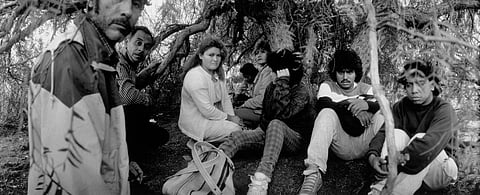
On the Mexican side of the border, she was able to meet and talk with migrants hoping to make it into the U.S. These encounters were brief and shifting due to their transitory nature. Instead of using a 35mm camera, Meiselas experimented with another format, the Widelux panoramic film camera, to reflect the movement she saw there. The effect is that her photos seemingly sweep across the landscape, engulfing whole scenes of movement and life along the border.
In one impactful photo, Meiselas documents a group of migrants caught heading north along I-5, seeking shelter under a tree. In the center, a woman in white looks directly into the camera, her face somber and her eyes downcast. In another, Meiselas captures a few mattresses and blankets left in a wooded area in Oceanside, California, a drop-off site for migrants. It's a desolate and haunting documentation of the conditions migrants have to endure in order to make it to the U.S.
Meiselas' work feels even more urgent in the wake of the raids conducted by ICE targeting immigrant communities in cities across the country, and the recent deaths of Keith Porter, shot and killed by an off-duty ICE agent on Dec. 31 in Northridge, California, and Renee Nicole Good, shot and killed by an on-duty ICE agent on Jan. 7 in Minneapolis, Minnesota. While these flash points occur squarely on U.S. territory, it's a reminder of the violent ways citizenship and borders are maintained by the government forces, often categorizing those who are against state repression as enemies. Now, with cellphones, people have a camera in their pocket, which can document the ways their communities have been impacted by immigration policies.
"All the eyes recording now are vital," said Meiselas. "Communities are observing and witnessing, providing evidence of the violent disruption ICE is mandated to perform."
"Crossings" by Susan Meiselas will run until March 22, 2026, at the Photographic Center Northwest. Meiselas will also speak at 6 p.m. on Friday, Jan. 16, at Seattle University's Pigott Auditorium.
The Emerald's arts coverage is supported in part with funding from 4 Culture and the City of Seattle's Office of Arts & Culture. The Emerald maintains editorial control over its coverage.


No Paywalls. No Billionaires. Just Us.
We're building a newsroom rooted in community, not corporate backing. Help us raise funds to hire our first-ever full-time reporter and grow our capacity to cover the South End. Donate today.
