
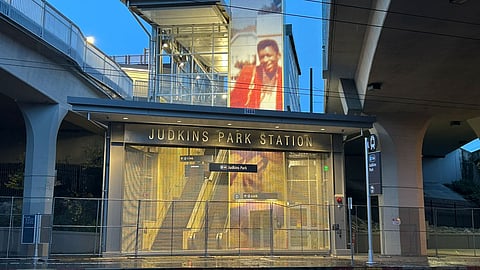
Artwork at New Judkins Park Light Rail Station Honors 'Transitional Neighborhood'

After three years of delays, Sound Transit's Judkins Park light rail station will open to the public this Saturday, March 28.
Now Seattleites can hop on the light rail and shuttle across Lake Washington through the equally new Mercer Island Station to explore far-out corners of the Puget Sound universe, like the Bel-Red Microsoft campus or downtown Redmond. It's a monumental moment for the region, the city, and, especially, the Judkins Park neighborhood. The station will serve as a sort of welcoming mat to the city for visitors from across the lake.
Sound Transit chose Seattle-raised Barbara Earl Thomas and New York-based artist Hank Willis Thomas (no relation) to install artworks inside and outside the Judkins Park Station. Collectively, their work reflects the spirit and history of the area, embodying the people who have called this place home and the experience of living and traversing through the neighborhood.
"Judkins Park is a transitional neighborhood that's gentrifying and has been gentrifying for quite a while," said Kurt Kiefer, senior project manager for public art at Sound Transit. "It's on the edges of the area of Seattle that was redlined, a traditionally African American neighborhood that has changed a ton. We wanted to be thinking … about the past of the neighborhood, what its future will be, and be respectful of both those things."
Hank's Jimi Hendrix-themed contribution to the station — "Crosstown Traffic (So Hard to Get Through to You)" — is visible from the streets with photomurals on the eastern and western facades. Both use images licensed by Hendrix's sister, Janie, from the Authentic Hendrix archives.
On the eastern side of the station on 23rd Avenue South facing Jimi Hendrix Park, Hank made a bronze photomural by collaging photos of Hendrix at the height of his fame. He used circular cutouts in the bronze arranged in a halftone effect, so the images fade in and out like smoke. On a giant porcelain panel on the station's western flank, facing Rainier Avenue South, Hank enlarged a famous photo of teenage Hendrix with his guitar, vamping for the camera on his parents' lawn on Yesler Way.
Hank told the Sound Transit blog that his image use and "halftone technique are a continuation of my interest in and exploration of how history informs notions of place and identity through different cultural and artistic perspectives."
But the first thing light railers actually see when they get to Seattle is Barbara's art. Her piece "A Walk in the Neighborhood" is located across several glass dividers along the platform and is easily seen from both sides. Known for her intricate cut-paper compositions, Barbara translated her paper and Tyvek-cutting technique to acetate pressed between glass for the Judkins Park Station. The result is an artwork that is functional — transparent enough that riders are aware of their space — while also artistic. As you move, the background of each work changes depending on your vantage point.
In composing this artwork, Barbara says she was inspired by the daily walks she takes around the city, smelling flowers, talking with friends, and taking in the fresh air. Roosters, turtles, tree branches, hummingbirds, flowers, a cat, and a dog all figure into her compositions.
"I would just pick up some of the things that I saw during my walks in the day and things that I think anybody would see getting off the train and walking around the neighborhood," said Barbara. "And combining that with then getting on a train and going to your destination: Those are things within the realm of the imagination of the rider."
Like much of her other work, Barbara also included depictions of people close to her. In one glass panel, Wa Na Wari co-founder, curator, and artist Elisheba Johnson gazes out at the viewer, half-smiling while reading a book. In another, studio assistant Peggy Allen Jackson stands dressed in an intricately patterned coat as a bird floats delicately above her outstretched hand. Barbara's portraits of Pulitzer-winning playwright August Wilson and author Charles Johnson face one another. Wilson is portrayed next to images of bound scripts of his plays Two Trains Running and Jitney, while Johnson holds a copy of Middle Passage, his National Book Award-winning novel on the trans-Atlantic slave trade.
"They were people that I know and I knew that they were friends together. And they both have books that have titles that allude to movement and travel, so that made sense to me," said Barbara about her inclusion of two Black authors with connections to Seattle. "I also think that when you get on a train or a bus or anything, you take your book and you're on a mode of transport. And then you're carried away by the material you're reading. So I wanted to make those two links."
Because it's been nearly a decade since Barbara received the initial commission, she's had time to tweak and add more on to her original piece. She redid an entire glass panel to make it more thematically and technically cohesive with the rest of the work in the station. The time proved fruitful to include a collaboration with The Lighthouse for the Blind, a local organization dedicated to empowering people who are blind, deafblind, and blind with other disabilities.
"We are trying, in general, to think of how we can develop some of our public art projects in a way that is accessible to people with vision impairments," said Kiefer. "Barbara's project was uniquely suited for this. And besides being a brilliant visual artist, Barbara is also a brilliant writer."
Instead of a museum label with a short description of the project, Barbara instead wrote a dreamy, reflective prose poem of her experience walking through the neighborhood. That reflection was then translated into braille and raised print, fabricated on metal plaques that included motifs from her works in the station, and spread across the station platform. In it, Barbara captures the beauty of movement — by foot, by train, by imagination — in a way that also serves as a blessing for the transit riders who will walk and whoosh right past it on their way in or out of the city.
"I walk to move my body," she wrote. "My best walks have no destination and can change mid-stride if something catches my eye, and I might even imagine the possibility it might go on forever."
No Paywalls. No Billionaires. Just Us.
We're building a newsroom rooted in community, not corporate backing. Help us raise funds to hire our first-ever full-time reporter and grow our capacity to cover the South End. Donate today.
