
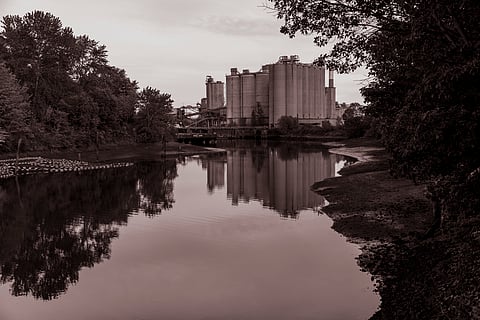
Artist Timothy White Eagle Invites Seattle to Embrace the ‘Once Wild’ Duwamish River

For the last year, Seattle artist Timothy White Eagle has been listening to the Duwamish River: Where it’s going, where it’s been, and how the last century of industry has diluted its power but never enough to make it go away completely.
As the artist-in-residence with the Green-Duwamish Watershed Urban Waters Federal Partnership and the Environmental Protection Agency, he spent time communing with the river, considering the tension between the waterway’s innate force and industrial concrete that seeks to control it. White Eagle’s upcoming show, Once Wild River, which opens on May 9 at Mini Mart City Park in Georgetown, explores the Duwamish River’s contradictions, toxicity, healing, and materiality.
“In effect, [my previous project] Indian School was a lot about the Colorado River, and so some of the same lessons came forward, which is that the rivers aren't what they used to be because of how tightly we can attempt to control them,” said White Eagle in a recent interview. “So that's really intriguing to me, the idea of trying to control this wild force, and I think that's how [collaborator Adrain Chesser and I] landed on the title.”
The Duwamish that trickles through Seattle today is worlds away from the Duwamish of old. For centuries, the Duwamish people lived in relation to the river, a waterway that ended in a sprawling delta, and – after an earthquake several centuries ago – gave rise to miles of fertile wetlands. In the early 20th century, American colonizers straightened and dredged the meandering river into a waterway that served the needs of industry and capital. Over the decades, toxic waste from factories, boats, Boeing Field runoff, and the highway made the last five miles of the Duwamish one of the most polluted waterways in America.
White Eagle likened the arrival of industry and Seattle’s early growth, at the start of the 20th century, as the genesis for creating a new kind of boundary for the Duwamish. “[The city] came in, and then grew, and then grew higher, and then grew higher, and then grew higher. And all of a sudden, the river is contained in a different kind of canyon,” he said. “It's this canyon of asphalt and concrete, and the canyon doesn't try and control the river, but they kind of rub against each other, creating a story about who they both are.”
Alongside White Eagle’s work will be pieces by lead collaborator and photographer Adrain Chesser, painter Laura Wright, interdisciplinary artist Epiphany Couch, sound artist Crystal Cortez, and visual artist Sarah Kavage. Each artist finds their own entry point to the history of the river, embodying its present and imagining a future for it through sound, image, poetry, installation, and performance. Through these pieces, White Eagle is inviting the public to consider where they stand in relation to the history of the river.
“There's a piece that Adrian and I have always shared, which is the potential for including spiritual practice in the way we make art. So as we approach these objects, we're thinking about the transmission of medicine, we're thinking about how to create sacred space inside a secular gallery,” said White Eagle. “I wanted to create an energetic opening between people’s hardened, mundane shell and their softer, creative, open-to-spirit self.”
Part of cracking open that spiritual door comes through installing a crossroads marker, a literal spot for viewers to stop and reflect. Chesser also created dozens of photographs for the exhibition, capturing stoic industrial landscapes as well as images of humans and other signifiers of life along the Duwamish River. The photos themselves are red sepia-toned, based on the color of river silt and cedar bark found around the Duwamish.
“It adds a softness, but also poignancy that I think speaks to the river itself,” said Chesser.
The collaborative nature of the Once Wild River came out of necessity: around the time White Eagle started his residency, he was diagnosed with pancreatic cancer. As he went through treatment, White Eagle brought on Chesser, to assist with navigating the project. Together, the two artists have worked on a suite of works – photos, a video installation, and sculpture – that intertwines White Eagle's cancer journey and spiritual practices with that of the Duwamish River’s legacy.
In one such installation, Chesser took black-and-white portraits of White Eagle as he progressed through chemotherapy over the last several months. Those photos will be enlarged and installed outside, with medicine pouches filled with dye – charcoal that artist Laura Wright made from Duwamish River sediment and red ochre – placed along the top, exposed to the elements.
“The dye, which is the medicine, will cover the photographs over the period of the exhibition,” said Chesser. “It's a reflection about the poisoning of the river, but also this remediation process. It's a very personal-meets-the-universal aspect of this project.”
The story of the Duwamish hasn’t been static – the river has shifted and changed over the centuries due to geologic and industrial change – and in that way mirrors our city’s urban environment. For White Eagle, Once Wild River is an opportunity to connect the historic and embodied knowledge of the Duwamish River’s power to people in Seattle.
“Our city changes so quickly, and it scoops away all that history, and we don't get to see the interaction between the river and the city,” said White Eagle. “So, that’s one small cumulative part of what I learned: that we don't get to see the relationship of the force of water on a wall in the canyon of the city.”
Timothy White Eagle’s Once Wild River will be at Mini Mart City Park May 9 - June 21. On May 9, there will be an opening party from 4-9 p.m.. On May 21, C. Davida Ingram will moderate an artist panel featuring White Eagle and the other contributors in the exhibition.
No Paywalls. No Billionaires. Just Us.
We're building a newsroom rooted in community, not corporate backing. Help us raise funds to hire our first-ever full-time reporter and grow our capacity to cover the South End. Donate today.
