
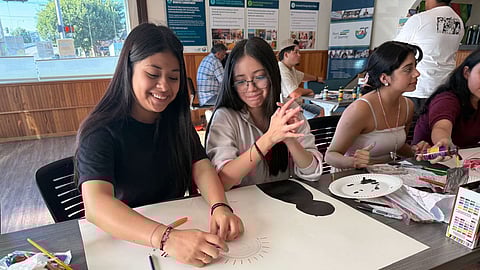
Youth in the Duwamish Valley Explore a World Without Waste

On Jan. 28, 20 youth from South Park and their parents gathered in the Duwamish River Community Hub on the south bank of the Duwamish River to celebrate all they’d learned and accomplished over the preceding nine months. Starting last May, the Duwamish Valley Sustainability Association (DVSA) launched a program to engage roughly two dozen students from around the neighborhood in a course of training that would familiarize them with the organization’s freshly debuted biodigester — a container-sized device that converts food waste into fuel and fertilizer — while teaching them about the circular economy and providing them the space to dream up their own project proposals.
For more than a century, the Western world has been mired in what experts and sustainability advocates often refer to as a "linear economy": an economy that extracts resources from around the world; funnels them to refineries and factories; and ships the resultant products to stores and supermarkets where they’re shelved for consumers to purchase, take home, use briefly, and then throw away.
This straight line from mine to landfill daily depletes the Earth’s resources. Globally, humanity fells more trees, quarries more stone, mines more ore, farms more food, hunts and slaughters more animals, and in general uses more resources annually than the planet can replenish in that time. In fact, humans would need more than 1.8 Earths to meet current demands, according to the Global Footprint Network. And if everyone lived like United States residents, it’d take almost five Earths to satiate our appetite.
Some have proposed a solution beyond simply reducing consumption: a so-called circular economy, one that keeps almost all the resources extracted from the Earth circulating in one form or another. This would take many different interlocking parts to work together to succeed. Recycling is a familiar component of this emerging kind of economy, but it is by no means the sole solution, says sustainability and zero-waste consultant Moji Igun.
When explaining the circular economy to people for the first time, Igun often points to all those forms of waste that can’t be recycled — electronics, old clothes, most plastics — and asks, “Where do we want to put that? Where should that go?” It turns out, a lot of options exist: items can be shared, rented, donated, repaired, modified, reused, redistributed, upcycled, and, only as an option of last resort, recycled into raw materials to manufacture new goods.
Many of the components for each of these alternatives already exist: Seattle, for instance, has a network of tool-sharing libraries, many of which host repair nights, and the city is encouraging restaurants and cafes to ditch single-use cups and plates. But systemic barriers prevent the circular economy from fully maturing as, among other challenges, tech companies design devices to fail and make them difficult, if not impossible, to repair.
From last May through this January, DVSA’s program — which Igun wrote the curriculum for — gave South End youth the chance to not only learn about how the circular economy could work in theory, see it in practice, and explore the obstacles confronting it; they were also afforded space to envision projects of their own that could inch the dream of a zero-waste world toward reality. At the program graduation at the end of January, the students presented their proposals to the public.
Their ideas included introducing new waste streams into the Seattle Public Utilities system that would allow families to separate out waste in more ways than the limited trash, compost, and recycling options we have today; collecting metal waste and providing it at low cost to local artists and craftspeople to convert into sculptures, artworks, or even new products; and replacing aluminum foil commonly used for wrapping foods with toxin-free, biodegradable “ecowraps.”
One proposal, called “ecotrapos,” would aim to collect waste clothing and other textiles and convert them into cloths and rags that could be used in commercial and industrial settings. According to Edwin Alberto Hernández-Reto, DVSA’s executive director, King County is interested in partnering with the youth who proposed the idea and connecting them with a consultant to explore what it would take to develop and realize the project.
Beyond that, “we were looking for exposure to the green career sector, making sure that individuals have the access and opportunity to learn about these new green careers,” says Gus Williams, the climate and development workforce adviser in Seattle’s Office of Sustainability and Environment, which contracted DVSA to develop the program. In that regard, participants feel the program succeeded: “It opened my eyes to different types of careers that I never thought I’d be interested in,” one of the youth said during the program graduation.
This kind of exposure is critical throughout Seattle, where a green workforce is burgeoning — underscored by the City's Climate Innovation Hub that opened downtown just over a year ago — but BIPOC folks are underrepresented in the sector. “Now [DVSA] has a curriculum,” which the organization developed as part of their contract with the city, “that can be shared to other communities,” adds Williams, “and we as a city government can support those different initiatives” as community groups adopt the curriculum.
Ensuring underrepresented and historically marginalized communities are well-equipped to take climate action is increasingly important, especially since they’re most at risk; planet-warming emissions once again rose in the United States last year despite scientists warning of the increasing urgency of eliminating those emissions. And efforts focused squarely on the circular economy have a special importance for the Duwamish Valley. “South Park is a Superfund site,” says Katherinne Osorio-Urtecho, a project manager with DVSA who coordinated the biodigester youth training program. “We need to reduce the contamination in the land, air, and water, and with a circular economy, you have the possibility to regenerate nature.”
DVSA’s biodigester, for instance, doesn’t just keep food waste out of landfills, where it would otherwise break down to release methane, a potent pollutant; it also creates a resource rich in nutrients that can be used to grow food and treat the soil. The biogas it creates, Osorio-Urtecho says, could also be used to fuel scooters and shuttles to help promote public transportation.
As anyone who lives, works, or visits the South End and the Duwamish Valley knows, the community is exposed to noise and air pollution from industries, airports, flight paths, and nearby highways. “The reason why that's all happening is because of extractive capitalism,” Igun points out. “So, we're trying to be less reliant on that. And how we can do that is [by investing] in the circular economy.”
DVSA is far from the only organization in the community working to make that happen, adds Igun: “There's a collaborative ecosystem that is springing up in the Duwamish Valley around the circular economy.”
The Emerald's environmental reporting is funded in part by the City of Seattle's Environmental Justice Fund.

No Paywalls. No Billionaires. Just Us.
We're building a newsroom rooted in community, not corporate backing. Help us raise funds to hire our first-ever full-time reporter and grow our capacity to cover the South End. Donate today.
