
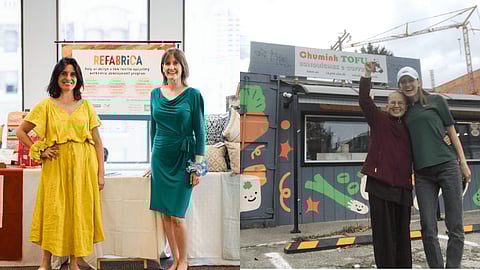
From Tofu By-Product to Textiles, South Seattle Projects Cut Waste

In November 2025, three South Seattle-based community organizations received a ReThink Waste Grant from Seattle Public Utilities (SPU) and Waste Management (WM) that will support local efforts to reduce and prevent waste, promote recycling, and advance a circular economy in Seattle.
For the purposes of this grant's goals, SPU and WM define a circular economy as "a system that keeps materials in use for as long as possible through reuse, repair, and recycling rather than sending them to landfills."
The first round of this funding went out in 2019, and SPU says it has provided a total of $70,000 in funding so far. Of the $10,000 granted per year, grant recipients have received between $500 and $5,000.
"Through the ReThink Waste Grants, we're investing in community-driven projects that make these practices easier and more accessible for businesses and organizations, helping Seattle reduce waste, cut greenhouse gas emissions, and conserve resources," Travis Gershaneck, acting public information officer for SPU, wrote in an email to the Emerald. "Our goal is to create practical, scalable solutions that keep valuable materials circulating locally, fight climate change, and build a more sustainable economy."
ChuMinh Tofu and Vegetarian Deli
At the ChuMinh Tofu and Vegetarian Deli Rainier Valley location, owner Thanh-Nga Nguyễn, who often goes by Tanya or Chef Tanya, is using $2,000 awarded through the grant to reduce food and packaging waste and distribute fresh okara out of the restaurant to anyone from the community who is willing to bring their own container.
Okara is the pulpy by-product of tofu and soymilk. As a vegetarian chef, Nguyễn found herself with a steady supply of it. Rather than tossing it, she's giving it back free of cost to the community as a nutritional source of food. This versatile ingredient can be added to salads, sweet and savory dishes, smoothies, and more. Okara can also be used for fertilizer and animal feed.
Distribution takes place at the Rainier Valley location through a walk-up community-based model rather than delivery, Nguyễn said in an email to the Emerald.
The project began in late 2024 and was to run for approximately one year. The grant has allowed Nguyễn and the restaurant to continue longer term. She says she and her coworkers currently serve people on a weekly basis, including dozens of individuals and households, home cooks, gardeners, and other community members. She says the restaurant has the potential to reach several hundred people over the course of the year.
"ChuMinh Tofu is dedicated to promoting healthy, sustainable, and compassionate plant-based living through traditional Vietnamese vegan cuisine," Nguyễn told WM when applying for funding. "We aim to reduce food waste, uplift our community, and honor cultural heritage while making eco-conscious food accessible and affordable for all."
The Chinatown-International District Business Improvement Area (CIDBIA)
In the Chinatown-International District (CID), the CIDBIA is using $3,000 awarded through the grant to rid the neighborhood streets of cigarette butts.
The issues with cigarette butts are more than just aesthetic. The filters are toxic, packed with microplastics, nanoplastics, and other chemicals. When scattered in large amounts around the sidewalks in the neighborhood, they present health risks to not just the human and pet population in the CID, but also to the surrounding region. Rain carries butts from the impervious surfaces of the CID into stormwater drains, and those drains eventually empty into Puget Sound. The toxins then work their way up the aquatic food chain, from plankton to salmon to orcas.
"We have a really high concentration of cigarette butts in the neighborhood, and there just hasn't been a solution, so we're looking to do that with this funding," said Yongkang Zhou, the CIDBIA's Clean and Green program manager and project lead.
The CIDBIA will use its grant to install disposal receptacles in front of storefronts, restaurants, and residential areas with the highest amount of foot traffic. It's also incorporating a public education component: The receptacles will have a QR code that will link to the CIDBIA's website, where it will publish more information on toxins in butt litter, health issues related to smoking, and links to resources on quitting smoking.
The circular economy component comes into play with the upcycling of the butts. Zhou is working with TerraCycle, an international recycling and upcyling company. TerraCycle is providing the receptacles, and as they fill up with butts, the CIDBIA will send the waste to the company. TerraCycle will then clean and separate the butts to remove the toxins and convert the fibrous byproduct into plastic for making new products, like picnic tables, park benches, and Adirondack chairs.
The partnership with TerraCycle came recommended by Seattle's Metropolitan Improvement District, which installed 15 receptacles within its 300-block scope of coverage throughout downtown Seattle in 2015.
"Our goal is to make the community clean and welcoming, and so hopefully this project can accomplish that," said Zhou. He says the CIDBIA plans to install the receptacles by spring.
ReFabrica by ReDesign Collective
SODO-based Redesign Collective received "Winner Spotlight" recognition this grant cycle for its ReFabrica initiative, a program that upcycles textiles while providing Spanish-language workforce training for Latina immigrants, in partnership with Casa Latina.
Redesign Collective founder Lisa Hilbert has been collecting textile waste from mostly Georgetown and industrial areas of Seattle businesses since 2022 to upcycle them into products, from art to furniture — and now clothing. She says she's diverted almost 5,000 pounds of textiles since she began.
According to the Environmental Protection Agency, discarded clothing is the main source of textiles in municipal solid waste and has increased in landfills by more than 80% since 1960.
Hilbert says the ReFabrica partnership with Casa Latina was a natural fit. Redesign Collective had access to textile scraps headed for landfills as well as connections with trainers and microenterprise colleagues, and Casa Latina had workers ready to learn how to process reclaimed materials and seek employment in the circular textile economy. ReFabrica brought in local designer and fashion brand La Paisa to teach workshops on pattern cutting and deconstructing existing textiles to create clothing. Redesign Collective has also led trainings on how to take apart jeans and turn them into patchwork jackets, diverting 48 pounds of denim from the waste stream.
Hilbert says the company has had the opportunity to train 30 to 40 women so far. The grant has provided stipend funds for ReFabrica participants and supplies for a sewing tool library for Casa Latina members, allowing for shared access to expensive necessities, like sewing machines and rotary cutters. The ability to check out and borrow spendy tools has allowed program participants the flexibility to work where they like to work.
When the participants are able to come and work together, Hilbert says it creates a sense of community and information sharing on entrepreneurship.
"There's a therapeutic aspect to upcycling," Hilbert said. "When you reclaim materials, revalorizing these materials and seeing the beauty in what would otherwise be discarded has a healing aspect to it. And working together in a group with your hands also, there's value to that that we have seen and will continue to explore."
The Emerald's environmental reporting is funded in part by the City of Seattle's Environmental Justice Fund.

No Paywalls. No Billionaires. Just Us.
We're building a newsroom rooted in community, not corporate backing. Help us raise funds to hire our first-ever full-time reporter and grow our capacity to cover the South End. Donate today.
