
- DONATE
- News
- Voices
- Arts & Culture
- Community
- EventsEvents
- Newsletters

In Seattle, fishing season never fully ends. Fishers visit the Duwamish River, Lake Washington, or the Sound seeking different species, depending on the time of year. In spring, maybe they'll snag flounder, lingcod, or trout. And later in the year, the salmon runs will peak and the beaches will often be busy with other visitors, swimming and playing.
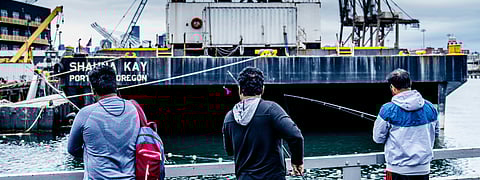
But on an overcast fall day last year, the waters were quiet, and fishers lined bridges and beaches to see what they could catch. Writer Timothy Dong and photographer Mark White visited the Spokane Street Bridge between West Seattle and SoDo to talk to fishers about what brings them to the water — particularly the Duwamish, which flows through South Seattle and connects with Elliott Bay.
One of Seattle's most popular fishing spots, the Spokane Street Bridge is a place where people coexist with fish and factories, framed by a gray sky, a blocky cement plant, and the towering West Seattle bridge dozens of feet up.
The people are here not to gaze at the overcast Seattle skyline in the distance, but rather to try their luck at catching salmon. In early September, the fishermen are hoping to hook a pink or coho salmon. On a sunny day, the bridge would be crowded, but because it's a cloudy day, a smaller group stands at the railing, patiently waiting for a bite.
A fisherman named Chad ebbs his fly fishing rod up and down, the rod rippling like water, in an attempt to catch the attention of fish. He comes down to the West Seattle Bridge to relax and try his luck at fishing on the weekends. Even though plastic bottles and oil stain the waters, he says he goes where the fish go. The air smells like the salty sea, and the ground is stained with dried salmon blood.
"Fishing, a lot of the time, is an individual activity," Chad said. He likes to come down here to get away from other people and get out in nature. Although when crowds of prospective fishermen and even vendors, like jig sellers, come together, there's a sense of camaraderie. Just under the surface, a school of salmon suddenly swims by. Chad's rod jerks a bit, and he exclaims in excitement. But the fish get away — they don't come easy. Since the season began, he's only caught nine fish despite 20 years of fishing experience.
Chad also remarks on the polluted waters and the five-lane road nearby, where he recalls recently seeing a gas truck and car collision. Indeed, while the river is an essential habitat for wildlife, it's also an industrial channel. The fishing bridge extends over a section of the Duwamish Waterway that stretches from the artificial Harbor Island to Tukwila and was declared a Superfund Site by the Environmental Protection Agency (EPA). It gained this status in 2001, and it's a designation reserved for "sites of national priority" for cleanup, according to the EPA's website. The bridge is less than a thousand feet downstream from a cement plant, and the waters are full of discharged contaminants, like petroleum and arsenic, from multiple industries.
Because the water under the bridge is polluted, only salmon are safe to eat, according to the King County website. Because salmon don't spend prolonged time at the mouth of the Duwamish, they aren't as contaminated, whereas creatures that spend their entire lives in the river — such as perch, crab, and clams — contain high levels of toxic chemicals.
In its Duwamish River Consumption Advisory graphic (pictured above), available in multiple languages, King County further refines this advice into salmon that are safe to eat several times per week and salmon that should only be consumed a couple of times per month. According to the Duwamish River Community Coalition, several agencies and community groups have partnered with the University of Washington Superfund Research Program to "educate local communities about the safety of eating fish from the river."
Farther down the bridge from Chad's setup is a father, Carlos, guiding his son, Sebastian, in fly fishing. The boy's rod is much taller than him.
Another fisher at the bridge is Mohideen, a man from India who grew up fishing with bamboo sticks. He's there with a couple of friends, and he says he decided to come to this bridge for the first time because it's one of the most popular fishing areas.
On the other side of the bridge stands Jon Hamilton in a black motorboat. Along with other people in the boat, including his son Jon Jr. and his daughter Iamya, he's a member of the Muckleshoot Tribe, and they're there to check on the fishing nets they laid down. As a tribal member and third-generation set netter, he's been fishing since age 5, and now has more than three decades of experience.
It's "just our life," Jon says, chuckling, from the boat. He's just pulled up a gill net and is waiting for the tide to drop so his boat can pass under the bridge into the Sound. Although some other fishers complain about the netting, Jon explains that the nets only catch 10% of the salmon. In addition, he asserts that these are his treaty rights. It's "who we are," he says.
The Muckleshoot Tribe is among 19 other tribes that make up the Northwest Indian Fisheries Commission, an organization that supports natural resources management for the 20 treaty tribes in Western Washington. The Muckleshoot continue to practice their entitled 50% of the annual fish harvest from their treaty, reaffirmed by a judge in 1974. After netting the fish, Jon says, the tribe brings them to a Muckleshoot processing plant and then ships them to local grocery stores and eating establishments for resale.
In 2016, an EPA study found that despite the pollution, many fishers continue to catch and eat resident fish, for both fun and sustenance, and those fishers are primarily from South Seattle. It reads, "Over 20 ethnic groups fish in the Duwamish River. The pollution in the river likely has more impacts on communities of color and low‑income people."
Further, "many Duwamish fishers who fish for resident species have immigrated to the United States from countries where fishing is an important part of providing food for their families." The pollution in the river isn't visible in the water or the fish, and the study found that fishing advisories may not always be in the right language or format to reach all the people who prefer to fish from the river.
So for the fish — and the people fishing — the ongoing cleanup and restoration efforts are critical. And for the Muckleshoot Tribe and other tribes that have been catching salmon to sustain their way of life for a long time, river restoration — and the resulting salmon recovery — will mean future generations can continue to fish these waters without fear.
The Emerald's environmental reporting is funded in part by the City of Seattle's Environmental Justice Fund.

We're building a newsroom rooted in community, not corporate backing. Help us raise funds to hire our first-ever full-time reporter and grow our capacity to cover the South End. Donate today.
