
Washington Deportation Defense Hotline Seeks State Funding as Calls Surge

For almost 10 years, thousands of people have relied on the deportation defense hotline run by the Washington Immigrant Solidarity Network (WAISN) as a way to report immigration enforcement activity and connect immigrants with resources.
Now, WAISN is requesting $5 million from the Washington State Legislature to meet the rising demand of people using its hotline. People call the hotline to help make informed decisions about their daily lives, including understanding their rights, learning how new executive orders or policy changes will affect them, and verifying immigration enforcement reports. The final budget proposal will be approved by March 12.
"In this moment, our communities are already under so much stress and anxiety," said Brenda Rodríguez López, WAISN's executive director, emphasizing the importance of communities receiving verified information.
Rodríguez López recounted her own experience when unconfirmed reports of immigration enforcement activity spread in the small town of Eastern Washington where she grew up. At the time, she said, a majority of immigrants living there didn't go to work and her parents wouldn't send her to school for up to a week due to the fear.
Recently, unconfirmed reports of Immigration and Customs Enforcement (ICE) activity led to temporary shelter-in-place orders for multiple South Seattle schools, stopping a planned student walkout and drawing community members to campuses to support students and ensure they felt safe.
The number of calls to WAISN's hotline has quadrupled since the second Trump administration's push to increase immigration enforcement. WAISN is expecting to see the number of calls continue to rise this year.
The hotline is available from 6 a.m. to 6 p.m., five days a week. Early morning hours were added because of the increase in workplace immigration raids during those hours, and WAISN has now hired full-time phone operators. The hotline also offers interpretation in over 300 languages and can receive text messages in addition to calls.
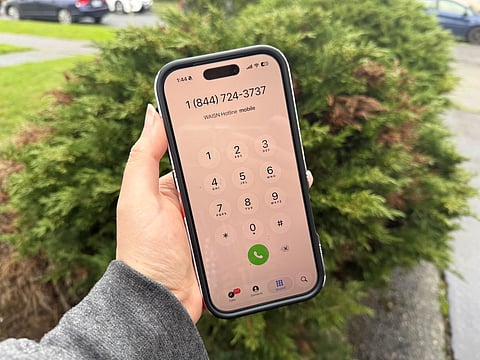
The hotline has become a trusted resource and the number, 1-844-724-3737, is widely shared by government agencies, businesses, and nonprofits.
Local organizing efforts to share the hotline have been growing. Materials distributed statewide, including in the South End through several efforts, feature the hotline number. In Seattle, 19.3% of residents are foreign-born, according to the Office of Immigrant and Refugee Affairs.
State Sen. Rebecca Saldaña, who represents the 37th Legislative District which includes the South End, said the hotline is a credible and reliable resource she has shared with constituents.
"I support us making sure that, given the intense volume … people can get through that line," Saldaña said, adding that she wants the hotline to remain a resource communities can rely on, "especially with increased hostility from the federal government."
When someone calls the deportation defense hotline to report immigration enforcement, the phone operator who answers asks questions to get detailed information such as the number of agents, location, and type of activity.
Reports with the most information provided are then relayed to a network of volunteers who act as legal observers and arrive at the location to record and take photos in public spaces at a safe distance and support families of the people detained. If there is no activity by the time they arrive, they reach out to neighbors and local businesses to verify those reports.
"We don't stop any deportations. We are there to document any violations of people's constitutional rights and civil liberties," Rodríguez López said. "Our job is to bear witness and document, not to obstruct the duties and responsibilities of any official."
If someone is calling about a family member being detained, the operator can support families in locating detained loved ones and connecting them with resources such as rent support, food assistance, and other legal counseling.
"This is about our communities having a place to call in some of the worst moments of their life, and on the other side of that phone, having someone who understands that reality," Rodríguez López said.
No Paywalls. No Billionaires. Just Us.
We're building a newsroom rooted in community, not corporate backing. Help us raise funds to hire our first-ever full-time reporter and grow our capacity to cover the South End. Donate today.
