
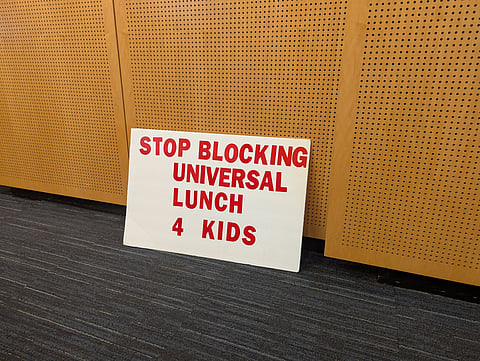
Seattle City Councilmembers Reverse Course on Universal School Meals

Facing strong public opposition over its plan to feed Seattle students, three Seattle City Councilmembers put forth an unanticipated proposal: fund universal meals for school students starting this fall.
"Every kid deserves to eat, whether that's through universal free school meals or grocery cards for low-income children," Councilmember Dan Strauss, the proposal's lead co-sponsor, said in a press release. "We don't have to choose. Supporting our students is not a zero-sum game."
Council President Joy Hollingsworth and Councilmember Dionne Foster, who originally sought to delay the universal school meals for a year, are also co-sponsors of the plan.
This new proposal, announced on the council's blog mid-day July 23, would work in conjunction with the Families, Education, Preschool, and Promises (FEPP) Levy. The previous day, the council approved a FEPP implementation and evaluation plan, which includes funding for the food-assistance voucher program for students.
The proposal to fund universal school meals will first be voted on Aug. 4, at the Finance, Native Communities, and Tribal Governments Committee.
The Story Behind the Shift
In a nearly four-hour Select Committee meeting held the day before the proposal was announced, the council voted to amend Mayor Katie Wilson's plan, opting to rely on Seattle Public Schools (SPS) employees to determine which students receive food vouchers to buy food when they're not in school, such as on the weekends or over winter break.
The amendment delayed Wilson's original vision, which was to offer universal free school meals to SPS students beginning with the 2026–2027 school year.
The council voted 6-3 to delay universal free meals, with Councilmembers Eddie Lin, Alexis Mercedes Rinck, and Rob Saka voting in opposition. Council President Joy Hollingsworth and Councilmember Dionne Foster proposed the amendment, with Councilmember Debora Juarez later signing on as a co-sponsor.
The FEPP Levy, transmitted last year by then-Mayor Bruce Harrell, included expanding the Seattle Preschool Program, free mental healthcare for Seattle teens, increasing access to post-secondary education, and increasing direct payments to childcare workers. But the part that received the most attention, and seemed to generate the most fervent support, was Wilson's plan for a universal free school meals program. The proposal would have spent $3.3 million the first year and $4.7 million the second year. After that, the universal school meals would have been paid for by the state, through Gov. Bob Ferguson's plan for a future millionaires' tax.
The approved amendment would have delayed the universal meal plan until the 2027–2028 school year and used the savings to add $500,000 a year for six years to the Food Assistance Program for K–12 students.
Through the program approved in the recent vote, vouchers are provided by SPS personnel to assist low-income families who face food insecurity over weekends and breaks, though it excludes summer. Up to 5,000 families will be eligible for the program, according to the amendment. Currently, this program is funded through the Sweetened Beverage Tax.
Close to 50 people spoke during public comment at the Select Committee meeting, with most speaking against it. But South Seattle residents who spoke were divided on whether they supported the amendment.
"I want to voice our strong support of [the amendment]," said Albert Shriver of Community Passageways. "The current model leaves our most vulnerable students behind during the weekends and throughout winter and spring breaks. Hunger does not take a break when the school cafeteria closes."
"What I know is that across our district we have hungry kids," said education advocate Sebrena Burr. "We have families that left Southeast Seattle for a better education who are in North Seattle who still have the same concerns. So I am 100% for universal school meals."
From the dais, Hollingsworth and Foster defended the amendment and addressed the intense public outcry against it. Both councilmembers voiced support for universal school meals, but, as Hollingsworth said, they wanted to be "thoughtful about food insecurities," and that the amendment is an exercise in a "policy and implementation decision."
Both councilmembers addressed what they thought were misconceptions around using "means testing" to determine who is eligible for the vouchers based on income.
"The means testing — I don't know where that came from," said Hollingsworth. "We created [the voucher program] so it was flexible, so it could go directly to family support workers … and school administrators to best identify the rollout of a grocery-card assistance program."
"There is not a requirement for means testing," said Foster. "The intent has never been to undermine universal school meals. It's been to prioritize resources to kids who are reliant on those [school] meals for food access and to ensure there are additional dollars for those young people during out-of-school times and weekends."
But at least one councilmember changed their stance on the mayor's proposal. In April, Councilmember Maritza Rivera had thanked Wilson for moving forward on universal school meals "sooner and not waiting until 2029." But in a turnaround at the Select Committee meeting, Rivera voted in favor of the amendment and against the mayor's proposal. Rivera explained her change to the Emerald.
"I didn't have all the background information on how we would pay for it [then]," said Rivera. "When I found out about how we would pay for it, then it became a concern because of what's happening with the millionaires' tax."
In his dissent of the amendment, Councilmember Rob Saka talked about relying on free school lunches in his youth, and the systemic barriers that prevented him from receiving additional, needed benefits. "I can only imagine that burden on the families most needed today," said Saka.
The vote on the amendment took place during a Select Committee meeting, where councilmembers voted on the Implementation and Evaluation Plan for the FEPP Levy. The council passed the plan 8-1, with Saka voting no.
Now the full council must vote on the implementation plan once more during its regular full council meeting on July 28 at 1 p.m. If the plan is approved then, it will go into effect.
Editor's Note: This article was updated on July 28 to clarify the committee meeting attended by councilmembers and the origins of the FEPP Levy and the Implementation and Evaluation Plan.
No Paywalls. No Billionaires. Just Us.
We're building a newsroom rooted in community, not corporate backing. Help us raise funds to hire our first-ever full-time reporter and grow our capacity to cover the South End. Donate today.
