
At the Duwamish Longhouse: An Upcoming Native Art Market and a Future Community Center

On Nov. 27 and 28 and Dec. 19 and 20, the Duwamish Tribe will hold its 18th annual Duwamish Native Art Market. The event will feature 21 Indigenous vendors selling paintings, jewelry, pottery, and more, plus home-cooked food in the tribe's Duwamish Longhouse and Cultural Center. The market, one of the largest annual events by the Duwamish Tribe, typically draws more than a thousand shoppers.
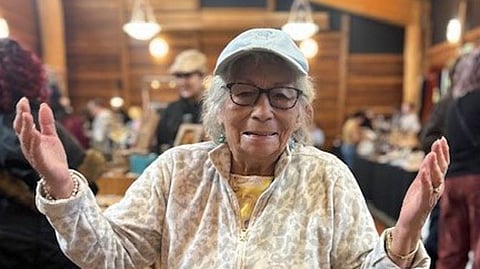
The Emerald spoke with Kristina Pearson, Duwamish tribal member and executive director for Duwamish Tribal Services, about the market and upcoming Duwamish Tribe events and projects. Pearson's grandmother is Cecile Hansen, the Honorable Tribal Chair of the Duwamish Tribe since 1975; Hansen has 17 other grandchildren.
How did the Duwamish Native Art Market start?
It started out of necessity in 2009, the year the Longhouse opened. Events were our way of making revenue to keep the lights on. The idea was if folks come to the Longhouse to shop with Native artists, they would also buy things in our gift shop. Cecile has always opened up the kitchen and made frybread during the market. It's festive and fun and people look forward to it each year.
Who are some of the artists featured at the event, and particularly who are some of the Duwamish artists?
Artists like Terrance Guardipee and Peter Boome are two who've been with us since the beginning. This year's Duwamish artists are Anna Green, [who makes] pottery, Tayla Jade, known for her earrings, and Tiffany Eley, who creates jewelry and wellness products.
The menu for the event includes frybread plain, with butter, or with honey; meat and vegetarian tacos; seafood chowder; and huckleberry pie. Is there a story around the food for the event?
The frybread is Cecile's recipe, and the tacos are frybread tacos. I've adapted my own seafood chowder recipe, and I'm back there making it a lot of the time. You'll commonly find Cecile, myself, my mom, my sisters, and my son in the kitchen. There have been some good arguments in the kitchen that revolve around the soup because [family members] have [different] opinions about how to make it, and the soup goes fast, and the pressure's on to keep making it [during the event].
I've seen on your website that you've had monthly frybread making classes.
Yes, they're taught by Cecile. It's her frybread recipe.
We have a guiding principle — to respect our elders — that shapes us. Some of my earliest memories are of special dinners that Cecile would throw at her house. I remember looking at all my aunts and my mom moving around the kitchen before and after dinner with everyone helping. I thought they were the most beautiful ladies ever in the world. For Cecile to want to pass down her recipe and her knowledge with folks, it means a lot.
Tell me about the significance of the Duwamish Longhouse and Cultural Center, the space that hosts the annual Duwamish Native Art Market.
The Duwamish Longhouse is a reclaiming of space in the Duwamish Valley and was built so we can revitalize and preserve our cultural traditions. The building looks out onto the Duwamish River and onto the site of a former tribal village where hundreds lived. It's the only naturally remaining stretch of the Duwamish River, and it's a major archaeological site. The Duwamish Longhouse and Cultural Center was built in 2009. It's a centrally located physical space for us to tell our story and keep fighting for [federal] recognition [of the Duwamish Tribe].
What's in store for the Duwamish Tribe? I heard about a youth center?
We've reached a capacity issue with the Longhouse. We have around 700 members. For the [art] market specifically, we want more space for the artists. We had the opportunity to purchase the warehouse just to the south of our property, and then we did the outreach to the community to learn about what they want to see there. They wanted to prioritize youth and families with a community center idea. It'll be great to spread out and have regular programs here for youth and for tribal members. There'll be a dedicated basketball court and an upper-story track area, classroom spaces, and a multimedia room. We can have after-school programs and summer programs there.
We're set to receive about $7 million in funding from the Seattle Equitable Development Initiative and planning is underway. The tribe is fundraising to cover the cost for operating the space for a year after it's built. We expect the new youth center to open in early 2029.
The Duwamish Tribe raises its own funds, and there's another campaign I've seen out there, Real Rent Duwamish. That's separate from the Duwamish Tribe, right?
We raise our own funds through grants, modest sales in the Longhouse, and space rentals. Duwamish Solidarity Group was started by a group of our volunteers who ran with an idea that they got from Cecile. She would make jokes about how if everybody who lived in Seattle gave us a buck, we wouldn't have to choose between the lights or the heat. The group of folks from the community organize their own fundraising. They're amazing. They have a monthly newsletter for people who donate, who they call "real renters," and have outreach campaigns throughout the year. They're literally helping to fund jobs at the Longhouse. We used to have 1.5 paid staff and now we have 11 paid staff.
What has shaped you and influenced your decision to work in the way you do today?
Cecile has always been my hero. Because of this long and continuing fight [since the 1970s] for the Duwamish Tribe's federal recognition, I feel like in addition to inheriting my culture from her, I inherited a briefcase and an attitude for justice and fight. That was always something that I saw in her and I was proud of her for. She's just one lady, and she didn't have to devote 51 years now to this — and she did. I thought my elders were going to do this work forever. Now I realize it's my generation's turn and my turn to step up.
Got an idea for a South End story you'd like to see us cover? Let me know: Yuko.Kodama@SeattleEmerald.org.
No Paywalls. No Billionaires. Just Us.
We're building a newsroom rooted in community, not corporate backing. Help us raise funds to hire our first-ever full-time reporter and grow our capacity to cover the South End. Donate today.