
The Roundup: From 'Defund the Police' to 'Keep the Chief'?

What's up, South End?
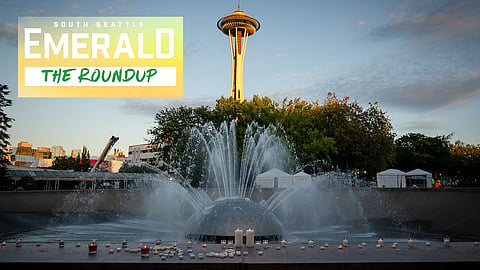
Last week was rough. Our city, unfortunately, found itself in the middle of national news when gunfire erupted on Sunday at Bite of Seattle. In the aftermath, we learned that three people were killed and another four were injured.
The next day, Emerald reporter Connor Nash had a viral moment with Police Chief Shon Barnes, who was out of town when this shooting happened.
Emerald founder and columnist Marcus Harrison Green penned an op-ed on what he coined "asymmetric compassion," arguing that our collective response to violence is more dependent on the neighborhood where said events occur than the actual victims involved.
Somehow, we landed at the end of the week with a delegation of leaders from Black organizations holding a rally at City Hall in support of Chief Barnes, who at that time was rumored to have been fired. As of now, he has resigned, but all of these events sparked a conversation between Marcus and myself that I'd like to share with y'all.
We discussed asymmetric compassion and how it impacts Rainier Beach. We discussed how media coverage often positions a small number of Black organizations and leaders as the definitive voice of Seattle's Black community, obscuring the reality that no community of more than 52,000 people speaks with one perspective.
We also questioned whether, in the aftermath of one teenager being killed and another being taken into custody on gun-related charges, too much of the public conversation centered on the future of the police chief instead of the families, neighborhoods, and young people most affected by the violence.
This interview has been lightly edited for length and clarity.
MD: The shooting at Bite of Seattle sent shockwaves throughout the country. I looked up and saw you on NewsNation. The social media sleuths did their thing, but when actual info came out, the first thing I remember hearing about was a suspect's potential connection to Rainier Beach … And I'm looking for a question in this …
MHG: Nah, I get what you're saying. Sometimes we have to have these difficult conversations. I know "intersectionality" is a buzzword, but at Seattle Center, we saw these intersections of the gun violence epidemic, the epidemic of the under-resourced community that is South Seattle, also just the fact that where this violence happens matters. I mean, just that same weekend there was a shooting in Capitol Hill, the day before, and I've not heard that [spoken about] one time this week.
And I get that this was Bite of Seattle and you had so many people around for the festival, but I do think, as I've said, there is an important distinction between this and the incident at Cafe Racer in 2012. This was not a domestic terrorist. As far as we know, this was between folks who knew, or were associated with, one another, and things went south. It's a tragedy.
MD: I get that, and it also leads right into my next question. In your article, you wrote the phrase "asymmetric compassion." Can you talk about that term and how it relates to what happened?
MHG: You had the shooting that happened at Seattle Center, and again, it's a horrific tragedy. Every tear that's been shed needs to be shed for these victims. Every single one. I'm not saying that was too much empathy. They deserve it all. But, as I said in my piece, I listed various deaths, murders, killings that have happened in the South End over the span of just the last six months. The New York Times didn't cover those deaths. There was no 10-point plan in a memo from the City about what to do after those deaths. We didn't get 15 press conferences or have the governor there.
When you do all that for one situation and then all those things are absent from other situations when people have died and life has been taken, what message is that that you are sending to the people that live in the area where the most of these deaths take place? And by that I mean, what are you actually saying to the South End? To Brighton, Othello, and Rainier Beach?
MD: That goes back to your point about this event happening in Seattle's civic living room. And that put Seattle at the center of national attention. The news cameras are here. The governor has come down from Olympia. Girmay Zahilay is here. Katie Wilson is out there. All the politicians are here. And Chief Barnes is not here. So he's in the hot seat. Then he goes viral for the exchange with Connor.
And you had all these prominent Black organizations come to the epicenter of all of this and rally for Barnes to keep his job. And I guess the part that makes me uncomfortable is that in this moment, when they have the nation's attention and they decide not to ask for public safety, or resources for our teens — how are we supposed to feel? Our youth are losing their lives and the big ask is for the police chief to keep his job?
MHG: So, I was on a conference call with a group of Black men, and the group consensus was that they didn't realize people were riding for the police chiefs in this way. How did we go from fighting against oppression from the police, and the No New Youth Jail movement, and having all this systemic analysis, to now we're caping for the top police officer?
I thought the whole thing was like, we're not trying to necessarily validate these systems that have historically oppressed us and historically been places that have beaten Black folks and, you know, overpoliced us. So, you know, what is going on here? What's the concerted effort around this?
And I know this probably isn't popular to say, but I was actually supportive when Carmen Best was here. And I understand the "copaganda" talks around Detective Cookie Chess Park, but also I see the nuance of when there was nothing else around for certain folks to do. I mean, it was an activity that folks could do. And I'm saying all that to say when I look at people like Carmen and Detective Cookie, these are people who have been here and have paid their dues in this community.
That's where the disconnect is for me. Just me as an individual, not the whole Black community. I think the thing that has been missing from this conversation is just the fact that Chief Barnes came in under a process that, at least as far as I recall, was not the most community-forward, community-centered, community-centric way. I remember even when, for instance, Carmen Best was up for police chief, there was all types of community input. I don't recall that with Chief Barnes. I want to be clear, there is nuance here, and I don't want to dismiss anybody's positive experience with Barnes, I'm just speaking for myself in reflection of a conversation I had with some of my brothers, who are all Black men, on a call today.
MD: Where do we go from here?
MHG: I was talking to a local AAU basketball coach who is fairly apolitical, and he said, "It seems like the mayor got a fall guy, the chief got a bag to leave, and we still have a suspected shooter who hasn't been caught. But more than that, we have a community that is no better off than it was before the shooting."
His opinion was basically, "We expended all of that energy for what? Where were all the people at City Hall at the vigil for the two Rainier Beach students? And what about all the people at the vigil for the Seattle Center victims? Were they at the vigil for the Rainier Beach students earlier this year?"
I want to be clear: I think this is constructive feedback for all of us, myself included. My conversation with him has made me rethink how we move, what we actually demand, and making sure our energy is concentrated in a way where our motivations are less about one individual and more about how we ensure our community thrives. Because I think we're all going to start being judged and scrutinized more by what we say our values and priorities are, versus where we actually spend our time and energy.
The Roundup Rundown
As I mentioned above, politics reporter Connor Nash had a viral confrontation with the former Police Chief Shon Barnes.
Emerald founder and columnist Marcus Harrison Green was on the scene for the aftermath of the events at Seattle Center. He wrote this op-ed to reflect not only on that event, but also on gun violence that has plagued the South End for years.
Events of late have totally, and understandably, overshadowed this, but I gotta remind y'all: Seafair is this weekend. The event is polarizing to say the least, and every year y'all flood my inbox in response to whatever angle we cover the event from.
Sign Up for More!
This is an abbreviated version of The Roundup newsletter. To get the entire newsletter, including a weekly list of events to check out and my shout-out to South End Gems, subscribe here. See you next week!
Mike Davis is the newsletter editor and Voices editor at the South Seattle Emerald. Born and raised in Seattle's South End, Mike is a longtime journalist who's covered everything from arts and culture to sports to politics.
No Paywalls. No Billionaires. Just Us.
We're building a newsroom rooted in community, not corporate backing. Help us raise funds to hire our first-ever full-time reporter and grow our capacity to cover the South End. Donate today.
